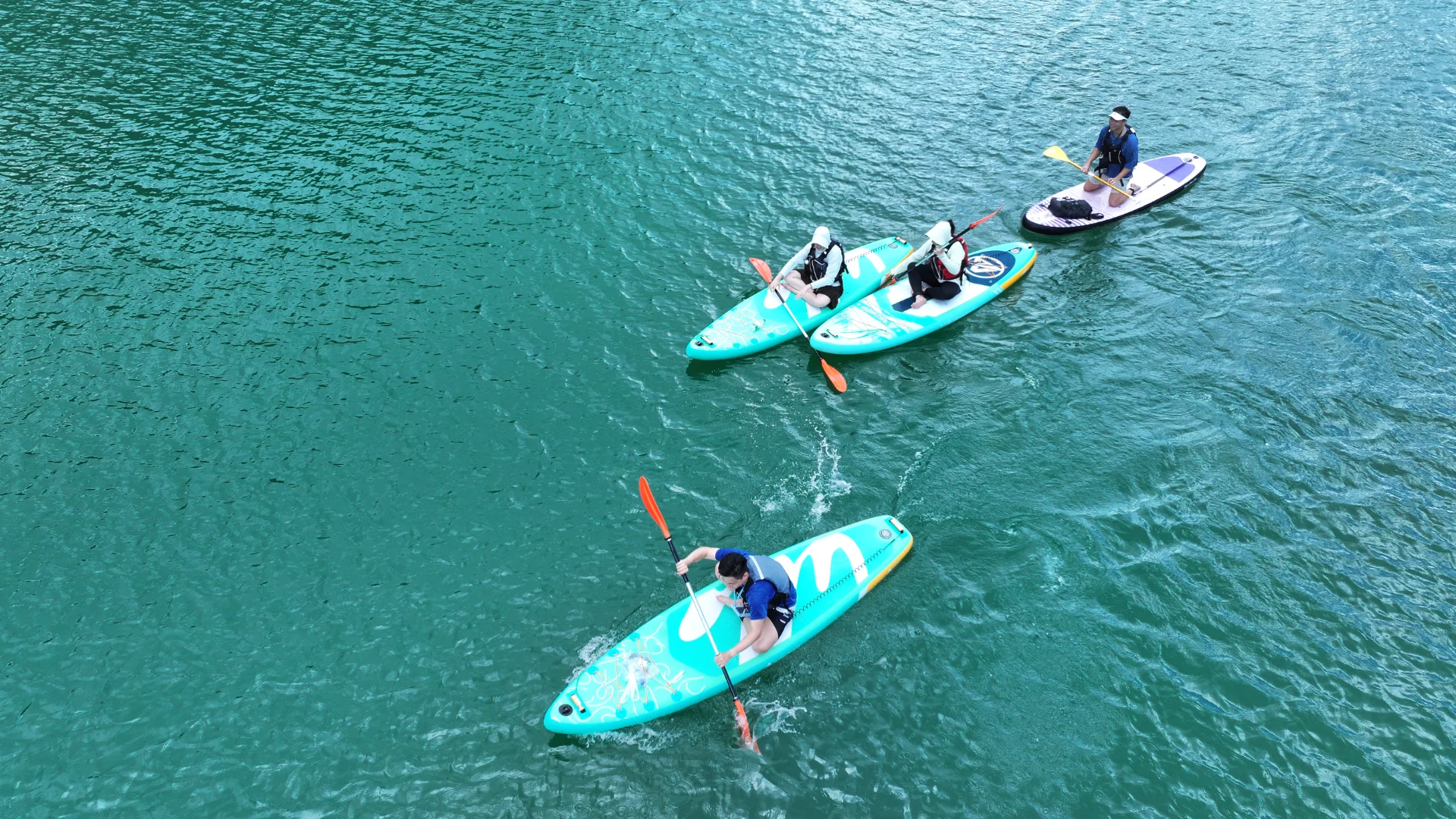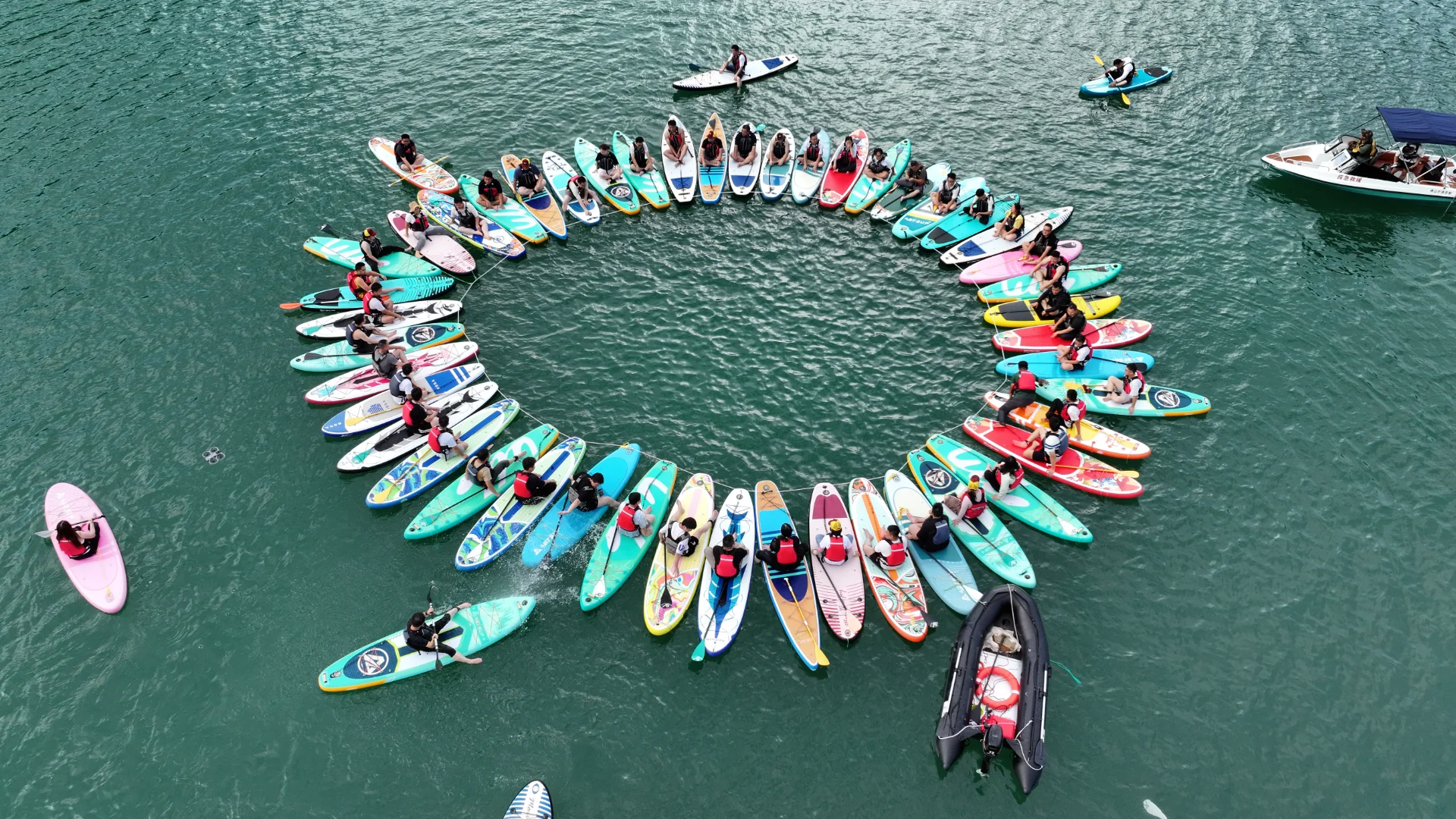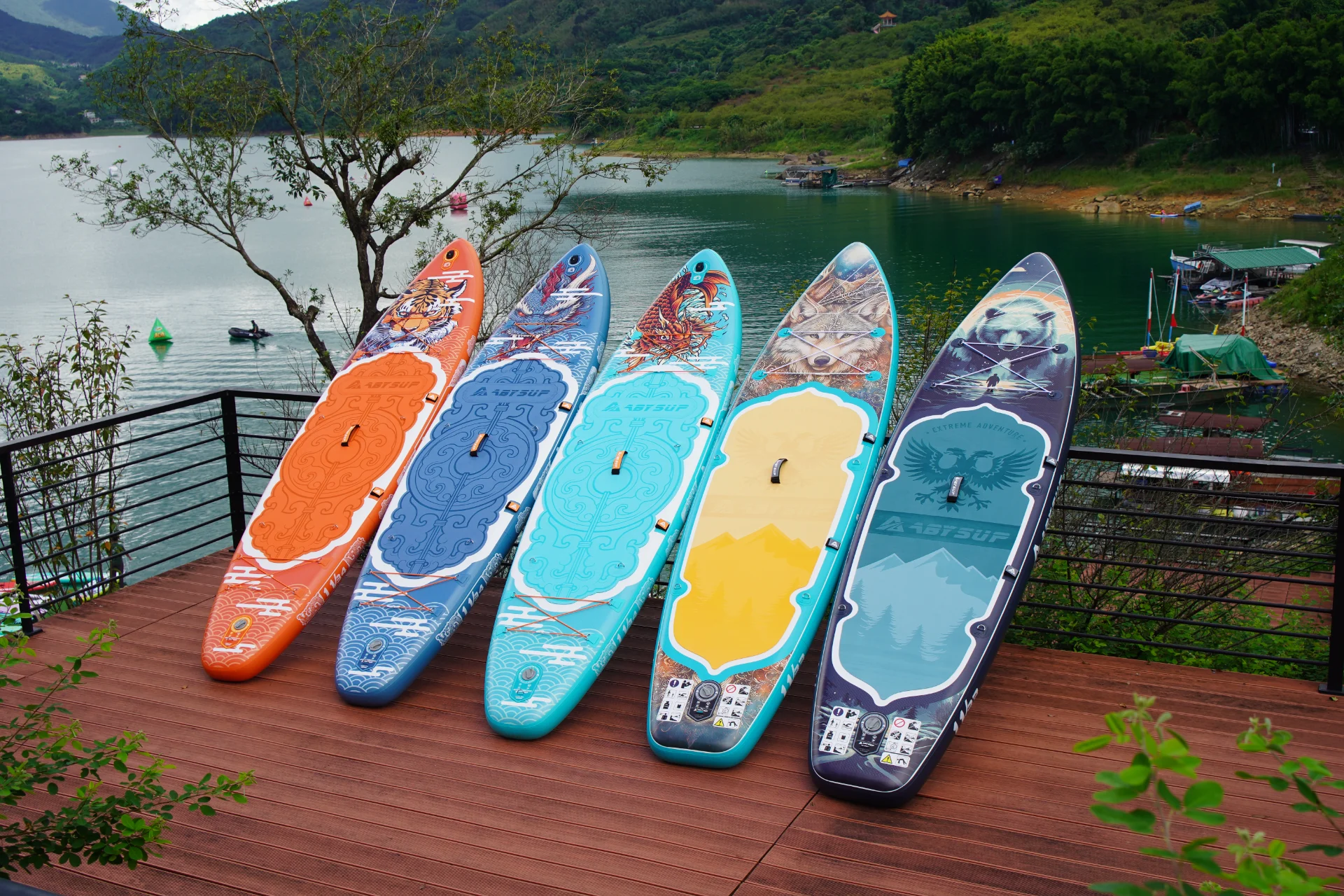
Your board arrived this morning. You’ve inflated it on the driveway, slid the paddle out of the bag, and now you’re holding three sections of aluminum staring at numbered marks wondering where to lock it in. I’m Allen, Senior Industrial Designer at ABYSUP — I’ve spent nearly a decade designing inflatable SUPs and the paddles that go with them. If there’s one thing I want every first-time paddler to know before that first stroke, it’s this: paddle height matters more than the brand on the shaft. Get it right and you glide. Get it wrong, and your shoulders will be sore by the end of session one.
This guide gives you the formula we teach every new ABYSUP customer, plus the small adjustments that make the difference between a stroke that works and one that fights you back.
The Formula That Works for 90% of First-Time Paddlers
Here’s the rule: your height + 10 inches (25 cm). That’s the paddle length you set for general flatwater cruising — and it’s where I’d tell anyone to start before tweaking for activity.
Want to check it the visual way? Stand the paddle vertically beside you with the blade flat on the ground. Reach one arm straight overhead. The T-grip should sit roughly at your wrist — not your fingertips, not your forearm. Wrist.
Why ten inches? Because that’s the geometry that lets you reach the water with a slight forward lean — which protects your lower back — without forcing you to over-extend your shoulders on every stroke. Anything shorter and you’ll start hunching to reach. Anything longer and your top hand drifts above your eyeline, which is where shoulder fatigue starts.
Quick reference for common heights:
- 5’4″ / 163 cm paddler → 74 in / 188 cm
- 5’8″ / 173 cm paddler → 78 in / 198 cm
- 6’0″ / 183 cm paddler → 82 in / 208 cm
- 6’2″ / 188 cm paddler → 84 in / 213 cm
Round to the nearest mark on your paddle shaft. You’re not performing surgery — within an inch is fine.
Why the Wrong Paddle Height Wrecks Your First Session
Most paddle complaints we receive aren’t about the paddle. They’re about the height it was set to. I see this constantly in customer photos — somebody wrote in last summer asking why his shoulders were burning halfway through a sunset paddle on Lake Tahoe, and the moment he sent the photo I could see it: paddle set a full four inches taller than it should have been.
“He messaged us back two days later from the same lake, paddle dropped 10 cm, and the only thing different in the photo was the smile. Same paddler, same board, same water — different setting on the shaft. That’s the entire story.” — Allen Xiao, ABYSUP Design Team
Here’s what each mistake actually feels like on the water:
Paddle too short: You hunch forward to reach the water. Your low back takes the load. After thirty minutes you’ll feel it between your shoulder blades and at the base of your spine. Your strokes feel weak because you can’t drive through with your core.
Paddle too long: Your top hand pushes up past your eyeline on every stroke. Your shoulders absorb the entire range of motion. You’ll splash water onto your bottom hand because the blade enters at the wrong angle. Twenty minutes in you’ll know.
The good news: both problems disappear within three strokes of fixing the setting. According to the International Surfing Association’s SUP technique standards, an upright torso and arm position that doesn’t break above the eyes are the two markers of efficient paddling — and both come from getting paddle length right.
Adjusting Your Paddle for Yoga, Touring, and Flatwater Cruising
The +10 inch rule is your starting point. Once you know what you’re doing on the water, here’s how to fine-tune it:
| Activity | Formula | Example (5’8″ / 173 cm paddler) |
|---|---|---|
| Flatwater cruising | Height + 10 in / 25 cm | 78 in / 198 cm |
| Yoga & fitness | Height + 6–8 in / 15–20 cm | 74–76 in / 188–193 cm |
| Touring & distance | Height + 10–12 in / 25–30 cm | 78–80 in / 198–203 cm |
| SUP surfing | Height + 4–6 in / 10–15 cm | 72–74 in / 183–188 cm |
Yoga & fitness — go shorter
You’ll spend a lot of time kneeling, sitting, or transitioning through low poses. A shorter paddle keeps the blade reachable from those positions and stops the T-grip from clocking you in the chin during a transition. Most yoga paddlers set the shaft 4–6 cm below their cruising mark. If you’re on one of our wider 34″ yoga decks from the [Link to ABYSUP Yoga Series], this is the setting that works for both paddling out and resting between flows.
Touring & distance — go slightly longer
Higher cadence over longer distances rewards a slightly taller paddle. The extra reach lets you start the catch further forward, which lengthens each stroke and reduces total stroke count over a 5–10 km route. The trade-off is more shoulder load, so I wouldn’t push past +12 inches unless you’ve already paddled hundreds of kilometers.
Flatwater cruising — stick with the formula
If you’re not sure what you’re doing yet, leave it at +10 and don’t overthink it. Most paddlers — including most of our return customers — never adjust away from this setting.
SUP surfing — go shorter still
Surf paddling rewards quick, low strokes for maneuvering on a wave. The +4 to +6 inch setting keeps the paddle responsive when you’re shifting weight and turning. This is a specialized use case — most beginners won’t need this setting in year one.
How Our 3-Piece Adjustable Paddle Covers 165–220 cm of Riders
The paddle that ships in every ABYSUP board bag is a 3-piece adjustable design with an aluminum shaft, nylon blade, and a cam-lock adjustment system. The full extension range runs from 165 cm to 220 cm — which covers paddlers from roughly 4’9″ up to 6’10”. For most households, that’s everyone in the family on one paddle.
Here’s the design decision behind that range. When we redesigned this paddle in 2022, our engineering team initially wanted to simplify to a 2-piece for stiffness. I pushed back because of what we kept hearing from customers: one paddle, multiple users. Mom is 5’4″, dad is 6’1″, their teen is 5’9″. A 2-piece locks you into a narrow adjustment range — that household would need three paddles. The 3-piece gave us 55 cm of usable range while keeping break-down length under 90 cm for trunk and luggage storage.
“The first time I handed our redesigned 3-piece to one of our European distributors at a trade show, he locked it at three different heights inside thirty seconds without checking the markings — purely by feel. That’s when I knew the cam-lock geometry was right.” — Allen Xiao, ABYSUP Design Team
Here’s the honest trade-off: an aluminum-shaft 3-piece weighs around 900 grams. A premium full-carbon, single-piece paddle weighs closer to 500 grams and transfers slightly more energy per stroke because there’s less flex in the shaft. If you’re paddling 5+ hours a week or training for distance racing, you’ll feel the difference within a month.
For your first season — and for most of the weekend paddlers reading this — you genuinely won’t. We’ve shipped tens of thousands of these paddles, and the most common upgrade story isn’t “I needed a stiffer paddle,” it’s “I bought a second one in carbon for racing days and kept the original for the family.” The included paddle isn’t the budget option. It’s the right tool for the use case.
You can see our full paddle range and material options on our SUP paddles collection.
Who This Sizing Guide Is For (And Who Needs Something Different)
The +10 inch formula is reliable for the vast majority of paddlers. But it’s not universal — and I’d rather tell you that up front than have you return a board because we sold you a use case it wasn’t built for.
This guide is for you if:
- You’re a first-time paddler figuring out your setup
- You’re buying for someone else — a partner, a teen, a parent — and need a paddle that fits without re-measurement
- You paddle on flatwater: lakes, calm bays, rivers without serious current
- You practice SUP yoga or fitness on the water
- Your household shares one paddle across different heights
- You paddle 1–4 times a month for fun, fitness, or photography
You’ll want a different setup if:
- You’re a competitive racer — fixed-length, full-carbon paddles cut to your exact height are the standard
- You’re a dedicated SUP surfer — surf-specific blade shapes and shorter shafts work differently
- You paddle whitewater or river-running — different blade geometry, often shorter
- You’re training for a specific distance event (BOP, ICF) — at that level the +10 rule is just a starting point for further customization
If you’re in the second list, talk to a specialist before buying. Stand-up paddleboarding covers a range of disciplines that have evolved their own equipment standards, and one paddle can’t optimize for all of them.
Frequently Asked Questions About SUP Paddle Sizing
What length should my SUP paddle be?
For general flatwater cruising, set your paddle to your height plus 10 inches (about 25 cm). A 5’8″ paddler runs around 78 inches; a 6-footer runs around 82 inches. That’s the starting point for almost everyone.
Once you know what activity you’re focused on, you can fine-tune from there. Yoga paddlers go a little shorter — about +6 to +8 inches. Touring paddlers nudge slightly longer — +10 to +12 inches. SUP surfers go shorter still. But if you’re new and not sure, leave it at +10 and don’t overthink it.
Is it better for a SUP paddle to be too long or too short?
Honestly, neither — but if forced to choose, slightly too long is less painful than too short. A too-short paddle forces you to hunch, which loads your low back on every stroke. That kind of fatigue takes hours to recover from and can ruin a full-day session.
Too-long is fixable mid-paddle: you’ll feel shoulder strain within twenty minutes, and you can stop, drop the height by a few centimeters, and continue. Too-short you might just push through, hurt yourself, and assume the sport isn’t for you. So if your paddle is on a half-mark and you’re between settings, round up rather than down.
How do I know if my SUP paddle is at the correct height?
Three on-water checks. First, your top hand should sit roughly at eyebrow height during the catch (the start of the stroke), not above your forehead. Second, your torso should stay relatively upright — if you’re hinging forward at the hip every stroke, your paddle is too short. Third, your bottom hand shouldn’t get splashed; if it does, the blade is entering the water at the wrong angle, usually because the shaft is too long.
The land check is even simpler: stand the paddle vertically with the blade on the ground, raise one arm overhead, and the T-grip should sit at your wrist. That’s the +10 inch position without needing a tape measure.
Should a SUP paddle be taller than you?
Yes — always. Unlike a kayak paddle, a SUP paddle is held vertically and used while standing, which means it has to extend above your head to reach the water at a useful angle. If your paddle is shorter than your standing height, it’s almost certainly set wrong or it’s the wrong paddle entirely.
The +10 inch rule means your paddle will sit roughly 25 cm above your head when stood beside you. That’s normal. That’s the design.
Can one adjustable paddle work for the whole family?
Yes — provided the adjustment range covers everyone. Our included 3-piece adjusts from 165 to 220 cm, which works for paddlers roughly 4’9″ to 6’10” tall. That’s the entire range of most family households.
Lock-and-unlock is fast — about ten seconds per change. We designed the cam-lock specifically so kids can adjust it without struggling, and so adults don’t end up loosening it accidentally during a stroke. If your family includes someone outside that height range, let our team know and we’ll point you to the right alternative.
Find the Paddle That Comes With Your Setup
Every ABYSUP board ships with our 3-piece adjustable paddle as standard — same range, same cam-lock, same nylon blade across the lineup. There’s nothing extra to buy on day one. Inflate the board, set the paddle to your height plus 10 inches, and you’re on the water.
If you want to see the full paddle range — including our carbon upgrades for committed paddlers and our spare paddles for households running multiple boards — visit our SUP paddles collection. For families weighing up which board to start with, our [Link to ABYSUP All-Round Boards] series is where most first-time customers begin.
Wholesale and dealer inquiries: our design team works directly with regional distributors on volume pricing, custom branding, and trade catalogues. Reach out through the trade form and someone from our team will be in touch within 48 hours.
Whatever you’re paddling for — first session, weekly fitness, family weekends, or a shop floor of 200 boards — the paddle you start with should fit you the moment it leaves the bag. Set it to +10 and let me know how it goes.