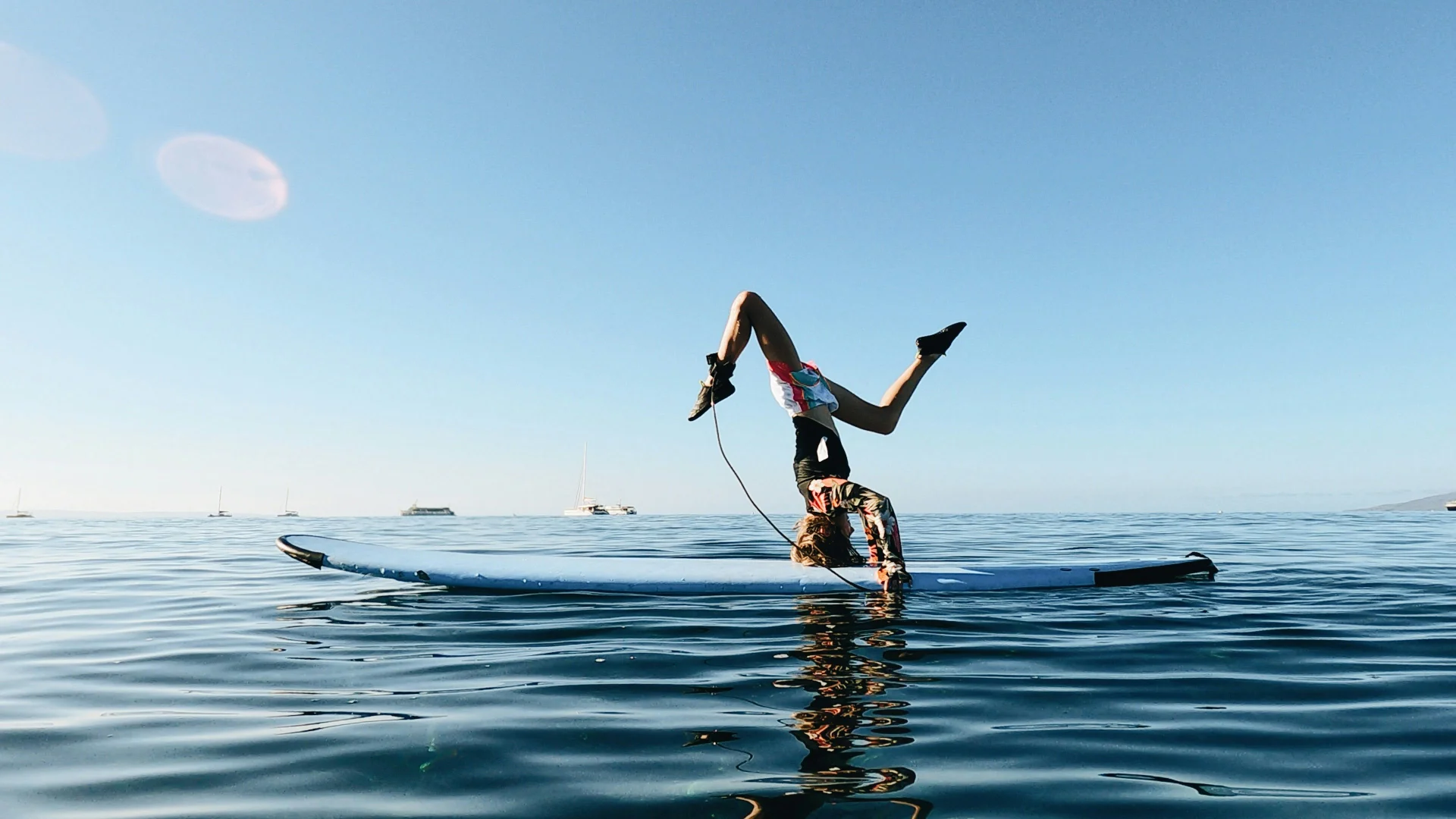
The first time I held downward-facing dog on a paddle board floating in open water, two things happened simultaneously. First, my brain registered every micro-movement of the board beneath me in a way it never had during land yoga. Second, my mat slipped about 3 inches forward because the deck pad on that early prototype was only 50% coverage and my hands had landed on smooth PVC. Both moments changed how I think about yoga SUP design.
I’m Allen, Senior Industrial Designer at ABYSUP. I’ve spent nearly a decade designing inflatable paddle boards, and a meaningful portion of that work has been on yoga-specific board development — testing pose stability with actual yoga teachers, debating deck pad textures with practitioners who slip from sweat versus practitioners who slip from cold water, redesigning rail profiles three times because the first two interfered with side plank.
This guide is the honest version of what SUP yoga actually requires from a board, from you, and from the water you practice on. I’ll walk you through which boards genuinely work (and which are All-Round boards with marketing stickers), the technique adjustments that make floating yoga sustainable rather than terrifying, where SUP yoga shines, and the honest limitations you should know before buying anything. This is one specific use case in the larger SUP world — and the most popular one by search volume for good reason.
Why SUP Yoga Is Its Own Use Case (Not Just Yoga That Happens on a Paddle Board)
Before getting into boards and technique, let me clarify what SUP yoga actually is — because the marketing photos of impossible-looking poses on floating boards have done this use case a disservice. The reality is both more accessible and more specific than the Instagram version suggests.
What SUP yoga genuinely is
SUP yoga is a hybrid practice that combines three things: floating meditation (the water below you affects your nervous system in ways land practice can’t), modified asana practice (most poses work, some don’t, and a few don’t make sense at all), and active core engagement (every pose recruits stabilizers that land practice doesn’t reach).
The water under you is the entire point. If you remove the water — if you take the same board and pose sequence to dry land — the value disappears. SUP yoga is not yoga “with a fun new accessory.” It’s a distinct practice with its own benefits and requirements.
Where SUP yoga genuinely shines
Three real reasons people fall in love with SUP yoga:
- Forced presence. You cannot zone out during SUP yoga. The board’s micro-movements demand continuous attention. People with busy minds find this meditatively powerful in ways traditional yoga can’t replicate.
- Deeper core engagement. Every pose recruits small stabilizer muscles that don’t fire on a mat. Side plank on a SUP works abdominal obliques 40-60% harder than the same pose on a studio floor.
- Environmental immersion. Practicing surrounded by water, sky, wildlife, and natural sound creates a sensory experience studios can’t reproduce. Sunrise yoga on a quiet lake is genuinely transformative for many practitioners.
Where SUP yoga is genuinely wrong for you
I’ll be direct about this — most articles don’t address it. SUP yoga is not the right use case if you:
- Have no land yoga experience. SUP yoga is harder than studio yoga; you need a foundation of basic poses before adding instability. At minimum, six months of regular land practice.
- Want a calorie-burning intense workout. SUP yoga is meditative and stabilizer-focused, not cardio-intense. If you want intense fitness from your SUP, fishing-style standing paddling or distance touring burns more calories per hour.
- Practice power yoga or fast-flow vinyasa exclusively. SUP yoga sequences much slower than land flow — the transitions need extra time for the board to stabilize between poses.
- Are uncomfortable falling into water. You will fall. Probably multiple times in your first 5 sessions. If this prospect makes you anxious enough to inhibit practice, work on water comfort first.
- Live somewhere with consistently cold water. Cold-water immersion during inevitable falls turns relaxing practice into endurance practice. Wait until water hits 18°C / 65°F minimum.
If any of these describe you, work on the foundation first. SUP yoga rewards practitioners who come to it from a base of land yoga and water comfort — not the other way around.
“A customer in San Diego bought one of our yoga boards because she wanted to ‘start yoga’ and thought SUP yoga looked like a fun way to begin. She’d never done land yoga. Her first session was a disaster — she couldn’t hold any of the foundational poses with the added instability, and she walked away frustrated. We talked it through and I suggested she try 3 months of land yoga first, then come back to the water. She did. Six months later she sent me a photo holding a perfect tree pose on her board. Foundation before instability. Always.” — Allen Xiao, ABYSUP Design Team
What Makes a Board a Real Yoga SUP (Not an All-Round With Marketing)
The yoga SUP market has the same problem as the fishing and touring markets: any reasonably wide board gets labeled “yoga.” The actual specs that define a yoga-capable board are specific, and surprisingly few boards in the market meet them.
Width: this is non-negotiable
Yoga SUPs are 34″ wide minimum, with the sweet spot at 34″–35″ for most practitioners. Why such a specific number?
Yoga poses load the board asymmetrically and dynamically. Warrior 2 puts your feet 3+ feet apart with weight shifting between them. Side plank stacks your body on one rail. Crow pose concentrates your entire bodyweight on a 12-inch area. All of these demand stability margin that recreational widths (32″–33″) don’t provide.
Below 34″, asymmetric poses become balance-fights instead of poses. Above 35″, the board becomes unwieldy to paddle to your yoga spot. The 34″–35″ range hits the sweet spot.
Deck pad coverage: the spec almost no other board needs
This is the single most important yoga-specific design feature. Yoga SUPs need full-length deck pad coverage — extending from nose to tail, covering 85-95% of the board’s length.
Why? Because yoga poses use the entire board surface. Downward-facing dog plants your hands near the nose and your feet near the tail. Camel pose extends backward across multiple feet of deck. Wide-leg forward fold spreads your legs across the rails. Anywhere your body contacts a smooth PVC patch instead of grippy EVA, you slip — usually mid-pose, when slip becomes fall.
Compare to other use cases:
- Fishing SUPs: 70% deck pad coverage (centered platform)
- Touring SUPs: 50-60% deck pad coverage (standing area only)
- All-Round SUPs: 50-60% deck pad coverage
- Yoga SUPs: 85-95% coverage from nose to tail
This is the spec that genuinely separates yoga boards from everything else. When you compare boards, count where the deck pad starts and ends. Marketing claims of “yoga-friendly” mean nothing if the deck pad covers less than 80% of the board’s length.
Deck pad texture: the EVA matters more than the size
Standard recreational deck pads have a diamond-groove pattern designed for foot grip. Yoga-specific pads need different texture properties:
- Matte finish, not glossy — sweat and water make glossy EVA slick
- Densely textured but flat-topped — your palms during downward dog need grip but not pain from sharp ridges
- Soft enough for kneeling comfort — child’s pose on hard EVA is unpleasant; quality yoga decks use slightly thicker, softer EVA
- Sweat-resistant — some deck pads absorb moisture and become slippery; quality yoga pads shed moisture
This is where premium yoga SUPs justify their price. The deck pad is the surface your body contacts for 30-60 minutes of practice — the texture quality matters disproportionately to the spec sheet’s other numbers.
Deck surface flatness: the spec other use cases don’t need
This is the most subtle yoga-specific spec, and the one nobody talks about. Yoga decks need to be flat across the width, with minimal rail elevation.
Some boards have raised rails (the edges of the deck rise above the center) for hydrodynamic reasons. This is invisible during standing paddle, but it’s a problem for yoga. When you place your hands in downward dog, raised rails interfere with palm contact. When you go into side plank, the rail digs into your foot or wrist.
Quality yoga SUPs have deliberately flattened deck profiles — the center and rails sit at nearly the same height. This sacrifices a tiny amount of hydrodynamic efficiency during paddle for a meaningful improvement in pose comfort.
Length and thickness: less critical than other specs
Most quality yoga SUPs are 10’6″ to 11′ long, 6″ thick. Length isn’t critical for yoga itself (you only need enough deck for your tallest pose dimension), but you also paddle to your yoga spot, and 10’6″–11′ covers the paddle reasonably well. Thickness at 6″ gives the buoyancy you need to ride high under static load.
D-rings and tie-downs: yoga’s small but real difference
Yoga boards need specific D-ring placement for the yoga session itself:
- Center D-ring at the board’s pivot point — for clipping a small anchor in calm conditions to prevent drift during practice
- Nose and tail D-rings for paddle storage and possibly a small dry bag
- No side rail D-rings on the deck surface — these interfere with yoga poses
This is a small spec detail but a real one. Boards designed for fishing have side rail D-rings (great for rod holders, bad for yoga). Boards designed for yoga keep the deck surface clean.
The honest spec hierarchy
If I were buying a first yoga SUP today, priority order:
- Width 34″+ (non-negotiable — defines the use case)
- 85%+ deck pad coverage (extending nose to tail)
- Matte yoga-specific EVA texture
- Flat deck profile (minimal rail elevation)
- Length 10’6″–11′ (sufficient for poses + paddleability)
- Drop-stitch fabric 1.2mm+ (durability matters for repeated use)
- Center D-ring placement for optional anchor
Most “yoga SUPs” check 2-4 of these boxes. Real yoga-purpose-built boards check all seven.
SUP Yoga Technique: What Land Yoga Doesn’t Prepare You For
The technique you developed on the studio floor transfers to about 70% of SUP yoga. The other 30% is brand new. Here’s what changes when the floor moves under you.
Adjustments that apply to every pose
Three universal modifications:
- Slower transitions. The board needs 2–3 seconds to stabilize between poses. Trying to flow at land-yoga speed creates wobble that turns into falls.
- Wider stances by default. Where land yoga might cue feet at hip-width, SUP yoga cues slightly wider. The wider base absorbs board movement.
- Lower center of gravity. Where land yoga lets you stack vertically (mountain pose, warrior 1), SUP yoga benefits from slight knee bend and grounded engagement even in “tall” poses.
Where to position yourself on the board
The board’s pivot point — the spot where it rotates around an axis — is the center handle. Most yoga poses work best when your body weight sits over or near this pivot point.
- Standing poses: feet straddle the center handle, weight centered over it
- Seated poses: sit just behind the center handle, knees forward
- Lying poses (savasana, fish, bridge): head toward the nose, feet toward the tail, body centered along the long axis
- Inversions and arm balances: hands placed at or slightly behind center, weight stacked above the pivot point
Poses that work beautifully on a SUP
These translate cleanly from land:
- Mountain pose — the starting/reset position
- Downward-facing dog — with full-length deck pad, this works perfectly
- Plank and side plank — challenging but rewarding; engages core more than on land
- Warrior 1 and 2 — with wider stance and slower transitions
- Triangle pose — feels deeper because every micro-adjustment requires conscious engagement
- Child’s pose and seated forward fold — actually easier on a SUP than land (the board’s slight movement enhances the release)
- Savasana — the floating final relaxation is the entire reason many practitioners come to SUP yoga
Poses that require modification
These work but need adjustment:
- Tree pose — keep gaze fixed on a distant point; the swaying board makes balance harder than on land
- Crow pose and arm balances — possible but require strong land foundation first; sessions 1–5 should not include these
- Sun salutations — slow down each transition by 2–3 seconds; the flow becomes more meditative
- Standing forward fold — keep slight knee bend; folding fully forward shifts weight over the nose and can tip the board
Poses that don’t work and shouldn’t be attempted
I’ll be honest about this — some poses are just bad ideas on a SUP:
- Headstand and shoulderstand — risk of head/neck injury during fall is genuine; not worth attempting
- Handstand — same reason; falling from handstand on a 6-inch-thick board into water is dangerous
- Pose sequences that require rapid transitions — power vinyasa flow doesn’t translate to SUP; the practice is fundamentally different
- Bind-heavy poses (extended side angle with bind, etc.) — the bound position prevents quick recovery if balance fails
If your land practice centers on these advanced poses, SUP yoga will feel limited. That’s a use case mismatch, not a failing of either practice.
Falling — and accepting it
You will fall during SUP yoga. Even experienced practitioners fall occasionally. Accepting this changes the practice for the better:
- Fall to the side, into water, never onto the board — same rule as recreational SUP
- Treat falls as part of the practice, not as failure — they’re moments of presence
- Don’t attempt complex poses far from shore — keep falls in manageable water
- Falling resets your body’s relationship with the board — sometimes the post-fall remount produces a better-balanced subsequent pose
“At a yoga retreat in Bali, I watched an experienced teacher fall during her own demonstration session — mid-warrior 3, full extension. She came up laughing, climbed back on, and finished the sequence flawlessly. Later she told the group: ‘The board taught me more about humility in 10 minutes than 10 years of teaching land yoga.’ That’s the practice working as intended.” — Allen Xiao, ABYSUP Design Team
Where SUP Yoga Works (And Where It Doesn’t)
SUP yoga rewards specific environments. The “magazine photo” version makes it look like you can practice anywhere — the reality is that location matters enormously.
Water conditions for productive yoga sessions
Yoga is the most condition-sensitive of all SUP use cases. Wind, chop, and current all disrupt practice in ways that other use cases can absorb:
- Wind under 5 mph — above this, the board drifts during pose holds and constantly requires repositioning
- No visible surface chop — even small ripples create board movement that disrupts longer holds
- No current or tide — anything that moves the board independently of your body destroys the practice
- Water temperature above 18°C (65°F) — inevitable falls in cold water turn meditative practice into stress
- Air temperature above 21°C (70°F) — you’ll be relatively static for 30+ minutes; cool air gets cold fast
Ideal yoga locations
Small protected coves and bays. The classic SUP yoga environment — small enough to feel contained, sheltered enough to stay calm, beautiful enough to motivate practice. Find these via local paddle clubs or yoga schools that run on-water classes.
Calm lakes during dawn or evening hours. The 6–8 AM and 7–9 PM windows on most lakes offer the calmest conditions. Most yoga practitioners are early-morning people anyway — the conditions align with the preference.
Sheltered harbor edges and marina basins. Counterintuitive but real — protected marina water with no boat traffic offers excellent conditions. Check local regulations first.
Anchored locations. Some yoga practitioners drop a small grapnel anchor at their preferred spot to prevent drift during longer sessions. Drop from the center D-ring on a 20-foot line.
Locations to avoid
- Open lakes over 200 acres — fetch creates wind chop that disrupts even calm-weather practice
- Any moving water — rivers, tidal areas, places with current
- Heavily boat-trafficked waterways — boat wakes will end your session abruptly
- Open ocean — even calm ocean has more movement than yoga tolerates
- Crowded popular swimming areas — kids splashing creates chop and energy that destroys practice
Timing your sessions
SUP yoga is more time-sensitive than other paddle activities:
- Best time: within 90 minutes of sunrise (calmest wind, cool but not cold, magical light)
- Second best: within 90 minutes of sunset (similar conditions, popular for sunset yoga classes)
- Acceptable: mid-morning if your location is sheltered from afternoon winds
- Avoid: midday in summer (heat, sun, peak boat traffic, peak wind in most areas)
Session length and frequency
Most productive SUP yoga sessions are 30–60 minutes. The combination of constant stabilizer engagement and meditative depth makes longer sessions hard to sustain for most practitioners. Even experienced yogis find 90 minutes ambitious.
Frequency depends on access. If you have a convenient water location, 2-3 sessions per week creates rapid skill development. Once-a-week practice still produces benefit but progress is slower.
According to yoga practice research on outdoor versus indoor settings, outdoor and water-based yoga produces measurably different neurological effects than indoor practice — particularly increased parasympathetic nervous system activation, which is the “rest and digest” state most practitioners seek.
Equipment Beyond the Board
Yoga SUP equipment requirements are simpler than fishing or touring — but a few specific items make the difference between adequate sessions and great ones.
What you actually need
The essential yoga SUP kit:
- Yoga SUP board with full deck pad — covered above
- Paddle for getting to and from your practice spot — adjustable, lightweight (carbon shaft worth the upgrade for one-handed lifting onto the deck during practice)
- Coast Guard-approved PFD — required by law in most jurisdictions; some practitioners use slim inflatable waist-pack PFDs that don’t interfere with poses
- Ankle leash or coiled calf leash — keeps board attached if you fall; calf placement allows poses without interfering
- Small folding anchor (1.5–3 lbs grapnel) with 20–30 foot line — drops from the center D-ring to prevent drift during longer holds
Small additions that improve the experience
- Water bottle in a center bungee — yoga practice creates thirst; have water reachable
- Small dry bag with phone, towel, and warm layer
- Reef-safe sunscreen — you’re static under direct sun for 30+ minutes
- UPF rashguard or long-sleeve yoga top for sun protection during long static holds
What you don’t need (despite marketing)
- Specialized SUP yoga mat overlay — quality yoga SUPs have appropriate deck texture built in; mats slide
- Floating water bottle holders — your bungee cords work fine
- Specialized yoga clothing for SUP — any quick-dry yoga gear works; avoid loose fabric that catches on the paddle
- Multiple anchors — one is sufficient for any session
What about clothes?
Yoga SUP clothing balances three needs: yoga mobility, sun protection, and tolerance of getting wet. Most practitioners settle on:
- Quick-dry yoga shorts or capris (synthetic or quick-dry blend, never cotton)
- Athletic top with built-in sun protection — either UPF rashguard or fitted sports top
- Snug-fitting layers — loose clothing catches on the paddle during transport and creates drag during poses
- Footwear: barefoot — yoga poses require direct foot contact with the deck pad for grip
Building Up to SUP Yoga (The Foundation Most People Skip)
The biggest mistake new SUP yoga practitioners make: skipping the foundational steps and going directly to floating practice. The result is frustrating sessions, slow progress, and a high dropout rate. The real progression is layered.
Foundation 1: Land yoga base (minimum 6 months)
Before you set foot on a yoga SUP, you need:
- Comfort with foundational poses on land (mountain, downward dog, warrior 1/2, triangle, plank, side plank, child’s pose)
- Basic alignment knowledge — knowing what a pose should feel like in your body
- Breath awareness — yogic breathing as a regular practice
- Honest acceptance of your current ability — knowing which poses are accessible vs aspirational
Without this foundation, SUP yoga is just stressful balance-fighting. With it, the floating practice deepens what you already know.
Foundation 2: Basic SUP confidence (minimum 10 sessions)
You should be able to:
- Stand and paddle confidently on an All-Round board in calm water
- Fall and remount without panic
- Hold a stationary standing position for 5+ minutes without struggle
- Kneel and stand transitions without thinking about them
If standing on a paddle board still requires conscious effort, you’re not ready for adding yoga to the equation. Build the SUP foundation first. Our complete SUP learning path walks through the progression from absolute beginner to confident paddler.
Stage 1: First yoga SUP sessions (1–5)
Your goal: get comfortable with the new combined practice. Don’t worry about pose complexity or sequence flow.
- Practice in completely calm conditions — wind under 3 mph, water glassy
- Stay close to shore for the entire session — 15–30 yards out maximum
- Sessions 20–40 minutes
- Practice only foundational poses: mountain, downward dog, plank, child’s pose, savasana
- Spend significant time just kneeling on the board and breathing — building water/breath awareness
Stage 2: Pose expansion (sessions 6–15)
Your goal: add standing poses with confidence.
- Add warrior 1, warrior 2, triangle, side plank
- Practice slow transitions between poses
- Begin developing your own short sequences (5–6 poses linked thoughtfully)
- Sessions extend to 40–60 minutes
- Try anchoring at your favorite spot if drift becomes an issue
Stage 3: Established practice (sessions 16+)
Your goal: develop a sustained personal practice.
- Build a 45–60 minute personal sequence you can repeat
- Consider taking a SUP yoga class with a qualified instructor for skill refinement
- Begin experimenting with more challenging poses (tree, dancer, eventually crow if your land practice supports it)
- Practice 2–3 times per week if access allows
- Integrate longer savasana — the floating final relaxation is one of the most powerful experiences in SUP yoga
The patience rule
SUP yoga progress is slower than land yoga progress because you’re learning two skills simultaneously: the yoga itself, and the board adaptation. Most practitioners need 20–30 sessions to develop a comfortable practice that feels genuinely yogic rather than balance-focused.
This is a feature, not a bug. The slower progression encourages the patience and presence that yoga itself teaches. Practitioners who try to rush through stages usually plateau in frustration; practitioners who accept the gradual build develop deeper, more sustainable practice.
Why We Design Our Yoga SUPs the Way We Do
I’ll be transparent about something most brand reps won’t say out loud: at ABYSUP, our yoga line isn’t designed to win general customers. It’s designed for practitioners committed enough to yoga that they want a dedicated board — and that means making trade-offs that wouldn’t make sense for a general-purpose board.
34″–35″ width — full commitment to yoga stability
Our yoga line sits at 34″–35″ wide, not the 32″–33″ some “yoga-friendly” boards use. The wider platform absorbs asymmetric pose loads (warrior 2, side plank, triangle) in ways narrower boards can’t.
The trade-off: 34″–35″ boards paddle 12–15% slower than 32″ All-Round boards. For yoga practitioners, this doesn’t matter — you’re not racing to your practice spot. For paddlers who also want recreational versatility, the slower paddle speed is a real consideration. We accepted this trade because it serves the yoga use case fully rather than partially.
Full-coverage deck pad — the spec other use cases skip
Our yoga line uses deck pads that extend 90% of the board’s length, from a few inches behind the nose to a few inches forward of the tail. This is 30–40% more EVA coverage than our All-Round line.
Why this matters: I described it above, but the design decision is worth explaining. Land yoga practitioners place their hands and feet anywhere on the mat without thinking — the entire mat is grippy. SUP yoga should work the same way. A board with partial deck pad coverage forces yogis to think about where their body lands. Full coverage removes that mental friction and lets the practice flow naturally.
The cost: full-coverage deck pads add 0.6 lbs to total board weight. The benefit: practitioners don’t slip during sweaty downward dogs or wet warrior poses. Worth every gram.
Matte yoga-specific EVA texture
Our yoga line uses a different EVA compound than our recreational boards. The yoga EVA is:
- Slightly softer (lower durometer) for kneeling comfort during child’s pose, table pose, and other knee-loaded postures
- Matte-finished with fine diamond groove — grippy when wet from sweat or water without being abrasive against bare palms
- Moisture-shedding rather than absorbing — stays grippy even during long sessions where sweat or water accumulates
This EVA is more expensive per square foot than our standard deck pads. We use it on the yoga line specifically because practitioners contact the surface with their full bodyweight in ways recreational paddlers don’t.
Flat deck profile — the design detail almost nobody mentions
Most paddle boards have slightly raised rails — the deck edges sit 5–10mm higher than the centerline. This is good for recreational paddle hydrodynamics and structural rigidity. It’s bad for yoga.
Our yoga line deliberately flattens the deck profile. The rails sit at nearly the same height as the centerline — within 2–3mm. This sacrifices a tiny amount of hydrodynamic efficiency for a meaningful improvement in pose comfort. Side plank doesn’t have a raised edge digging into your foot. Downward dog doesn’t have rails interrupting palm contact.
This is the kind of design detail that requires actual yoga practitioner feedback to identify. Engineers don’t notice it. Yogis notice it immediately.
Center D-ring placement for optional anchoring
Our yoga line includes a dedicated D-ring at the board’s exact center pivot point. This isn’t for cargo — it’s for optional anchoring during longer sessions where drift would disrupt practice.
Most boards don’t include this. We added it because actual yoga practitioners requested it: “I want to anchor at my spot and not worry about drifting into other paddlers.” Small spec, real difference in practice quality.
How yoga connects to our other use cases
Yoga SUPs are the widest, most stable boards in our lineup. The closest cousin is the family-paddling XL board — both prioritize stability through width. The differences: yoga boards have full deck pad coverage and flat rail profiles; family boards have multiple side D-rings and slightly more aggressive rail elevation for paddleability.
Touring SUPs are at the opposite end of our design spectrum — narrow and efficient. Fishing SUPs share yoga’s wide-and-stable philosophy but add attachment hardware that yoga boards deliberately avoid. The full spectrum of use case differentiation is covered in our complete SUP use cases guide, which walks through how different boards serve different practices.
According to yoga industry research, water-based yoga is one of the fastest-growing specialty disciplines in modern yoga practice — driven by practitioners discovering the meditative depth that floating practice produces.
How SUP Yoga Connects to Other Paddle Board Use Cases
Yoga sits within a larger paddle board ecosystem of distinct use cases, each with its own design priorities. Understanding where yoga fits — and where it diverges sharply — helps you make better purchase decisions and avoid buying the wrong board for your real practice.
Yoga and family paddling share the stability priority
Wide stable boards work for both yoga and family paddling — both use cases benefit from 34″+ width and high weight capacity. A quality yoga SUP often makes an excellent family board, and vice versa, especially for casual family weekends where extreme stability matters more than other features.
The differences are in the deck details. Family boards have multiple D-rings for clipping kid toys, dog water bowls, and small coolers — these same D-rings get in the way during yoga poses. Yoga boards prioritize clean deck surfaces with maximum pad coverage.
If your weekends might involve both yoga and family use, lean toward a yoga board for the cleaner deck — family use absorbs the lack of attachment points easily, but yoga can’t absorb interruptions to the practice surface.
Yoga and fishing share the wide-stable philosophy but differ everywhere else
I covered this in our SUP fishing guide, but worth repeating: fishing wants 34″+ width with multiple attachment points for rod holders, anchors, and tackle. Yoga wants 34″+ width with completely clean deck surfaces.
The width is the same; the deck philosophy is opposite. Fishing boards optimize for cargo and attachment; yoga boards optimize for body contact. If you want to do both seriously, owning two boards is the honest answer.
Yoga and touring are completely opposite
This is the sharpest contrast in our use case lineup. Touring SUPs are narrow (30″–31″), built for efficient distance paddling. Yoga SUPs are wide (34″–35″), built for stability during pose holds.
Our SUP touring guide walks through the touring philosophy in depth. The short version: a touring board is barely usable for yoga, and a yoga board is genuinely slow for touring. These boards exist in opposite design spaces and serve opposite use cases.
Practitioners interested in both will eventually own both. There is no compromise board that does both well.
Yoga and All-Round overlap partially
A 32″–33″ All-Round board can support yoga at the beginner level. Many SUP yoga practitioners start on All-Round boards and discover their practice progresses faster after upgrading to a dedicated yoga board.
The progression most committed practitioners follow:
- All-Round board for first 10–20 yoga sessions — figuring out whether yoga is a primary use case
- Upgrade to dedicated yoga SUP once practice becomes consistent
- Continued use of All-Round for non-yoga paddling — building a small quiver
You don’t need a dedicated yoga board to start. You probably do need one if SUP yoga becomes a regular weekly practice.
Building toward a yoga-focused quiver
For practitioners who get serious about SUP yoga, the long-term ideal setup is typically:
- One dedicated yoga SUP (34″–35″ wide) for regular practice
- One All-Round or touring board for non-yoga paddling sessions
- Optional: small grapnel anchor for fixed-position practice
This isn’t necessary to start. Begin with one good board — either an All-Round if yoga is one of several activities, or a dedicated yoga board if yoga is your primary intent. Add additional boards as your practice and budget mature.
Who SUP Yoga Is For (And Who Should Wait or Skip It)
This use case isn’t right for every paddler or every yogi. Make sure you’re the right reader before investing in a yoga-specific board.
SUP yoga is for you if you…
- Have at least 6 months of regular land yoga practice
- Have at least 10 paddle board sessions of basic confidence on water
- Live near calm, protected water (small bays, sheltered lakes, marina edges)
- Are comfortable with the possibility of falling into water
- Want meditative depth in your practice that land yoga doesn’t fully provide
- Enjoy environmental immersion (water, sky, wildlife) as part of practice
- Are interested in deeper core engagement and stabilizer recruitment
- Have flexible schedule for early-morning or late-evening practice (when conditions are calmest)
- Operate a yoga studio considering on-water class offerings
SUP yoga is probably not for you if you…
- Have less than 6 months of land yoga experience
- Have fewer than 10 hours of SUP confidence on water
- Practice primarily power yoga or fast-flow vinyasa
- Want calorie-burning intense workouts from paddling
- Live in consistently cold-water areas (under 18°C / 65°F most of the year)
- Are uncomfortable with the prospect of unexpected immersion
- Have neck, shoulder, or balance-related injuries that limit recovery from falls
- Live far from any protected calm water
If you’re outside this use case, no shame — your land yoga practice is fully valuable on its own, and SUP can still be a great recreational activity without adding yoga to it. Both practices are complete in themselves; combining them is an option, not a requirement.
The honest first session test
If you’re genuinely uncertain whether SUP yoga is your use case, find a beginner SUP yoga class with a qualified instructor before committing to buying a yoga-specific board. Most yoga studios in coastal or lake regions offer on-water classes during warm months. A single guided class on a borrowed board will tell you more than any number of articles, including this one.
If the class leaves you energized, curious, and wanting more — you’ve found your use case. If it leaves you frustrated, fearful, or doubting whether it’s worth it — that’s also valuable information. Honest self-knowledge before purchase prevents expensive mistakes.
Frequently Asked Questions
Is SUP yoga hard for beginners?
Harder than studio yoga, yes — but achievable with the right foundation. SUP yoga combines two skills simultaneously: yoga practice and paddle board stability. Practitioners who already have solid land yoga experience and basic SUP confidence find SUP yoga challenging but rewarding. Practitioners trying to learn both skills from scratch typically find it frustrating.
The recommended progression is six months of regular land yoga practice plus 10+ hours of paddle board confidence before adding SUP yoga to your practice. With that foundation, most practitioners develop a comfortable SUP yoga practice within 5–10 dedicated sessions. Without that foundation, the practice can take 20–30 sessions to feel natural — or feel impossible and lead to giving up. Build the foundation first.
What size paddle board do I need for yoga?
For SUP yoga, choose a board that’s 34″ wide minimum (35″ for maximum stability), 10’6″–11′ long, and 6″ thick. The 34″+ width is essential — anything narrower creates balance challenges during asymmetric poses like warrior 2 and side plank that turn the practice into a balance fight instead of yoga. Standard All-Round boards at 32″–33″ can work for very beginner yoga, but committed practitioners benefit significantly from dedicated yoga widths.
Beyond width, prioritize full-length deck pad coverage (85%+ of the board’s length). This single design feature matters more than most spec sheet numbers. Your hands and feet during yoga land all over the board — a board with only 50–60% deck pad coverage forces you to think about where your body lands, which disrupts practice. Full coverage lets the practice flow naturally.
Can you do real yoga on a paddle board?
Yes — most foundational yoga poses translate cleanly to a paddle board with quality construction. Mountain pose, downward-facing dog, warrior 1 and 2, triangle, plank, side plank, child’s pose, seated forward fold, and savasana all work beautifully on a proper yoga SUP. Some poses require modification (slower transitions, wider stances), and a few advanced poses (headstand, handstand, complex arm balances) should be avoided due to fall risk.
The practice is genuinely yoga — not “yoga-themed exercise.” The added instability of the board recruits stabilizer muscles deeper than land practice, the meditative aspect intensifies due to forced presence, and many practitioners report that their land practice improves after consistent SUP yoga. It’s a legitimate evolution of the practice for committed yogis, not a novelty.
What do I need for SUP yoga?
The essential SUP yoga kit beyond your board includes a quality lightweight paddle (carbon shaft worth the upgrade), a Coast Guard-approved PFD (slim inflatable waist-pack versions don’t interfere with poses), an ankle or calf leash, and a small folding anchor with 20–30 feet of line for preventing drift during longer sessions. That’s the minimum kit for productive practice.
Add as your practice develops: a water bottle clipped to bungee cords, UPF-protective rashguard for sun protection during static holds, reef-safe sunscreen, and a small dry bag for your phone and warm layer. You don’t need specialized SUP yoga clothing — any quick-dry yoga apparel works. Don’t add a yoga mat overlay; quality yoga SUPs have appropriate deck texture built in, and mats slide on the wet deck pad surface.
How do you not fall off a paddle board doing yoga?
The honest answer: you will fall sometimes, even with perfect technique. SUP yoga is a balance practice — falls are part of it. That said, several techniques minimize falls: practice in calm conditions only (wind under 5 mph, no chop), maintain slower transitions between poses than land practice (the board needs 2–3 seconds to stabilize), keep your gaze fixed on a distant point during balance poses (looking down at the board destroys balance), and start with foundational poses before adding complex ones.
The bigger technique principle: accept falls as part of the practice rather than treating them as failures. Practitioners who fight falling become rigid and actually fall more. Practitioners who accept the possibility of falling tend to relax into poses with better balance. The meditative quality of the practice extends to your relationship with falls — they’re moments of presence rather than mistakes.