You’ve probably seen the skeptics: “It’s just a glorified pool toy.” “It’ll go soft the moment you stand on it.” “Real paddlers ride hard boards.” If you’re about to spend real money, those doubts deserve a straight answer — not a sales pitch.
I’m Allen, Senior Industrial Designer at ABYSUP, and I’ve spent nearly a decade designing inflatable paddle boards. That makes me biased, and I’d rather admit it than pretend otherwise. So here’s my deal with you: I’ll tell you exactly where inflatables win, where a hard board still beats them, and the one thing that separates a board you’ll love from one you’ll regret.
Because the honest answer to “are inflatable paddle boards good?” isn’t yes or no. It’s “the good ones are excellent, the cheap ones are genuinely bad, and the gap between them is enormous.” Let me show you how to tell which is which.
The Short Answer: Yes, If You Buy the Right One
For most people, most of the time, on most water — an inflatable is the smarter choice. Not a compromise. The smarter choice.
Here’s why I can say that with a straight face. The technology changed. A well-built inflatable inflated to 15 PSI feels solid underfoot — close enough to a hard board that the average paddler genuinely can’t tell the difference on a calm lake. The flex and “bounce” people complain about almost always come from one of two things: a cheap board, or a good board that wasn’t pumped up properly.
And inflatables quietly beat hard boards in the areas that actually wreck people’s paddling plans:
- Storage — it lives in a closet, not on your ceiling rack. The single biggest reason hard boards get used twice and then abandoned.
- Transport — it fits in a backpack, in a car trunk, on a flight. No roof rack, no truck.
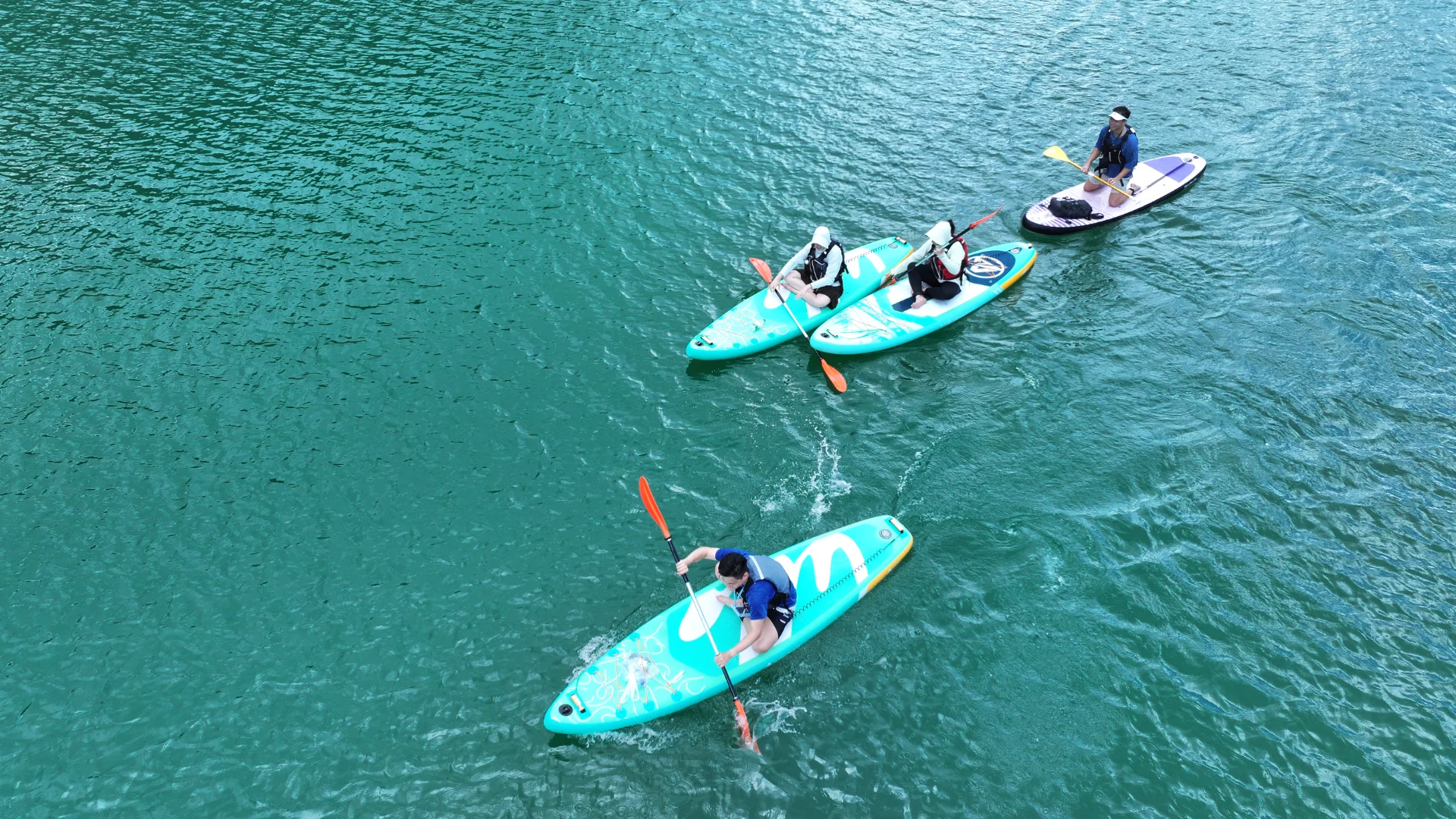
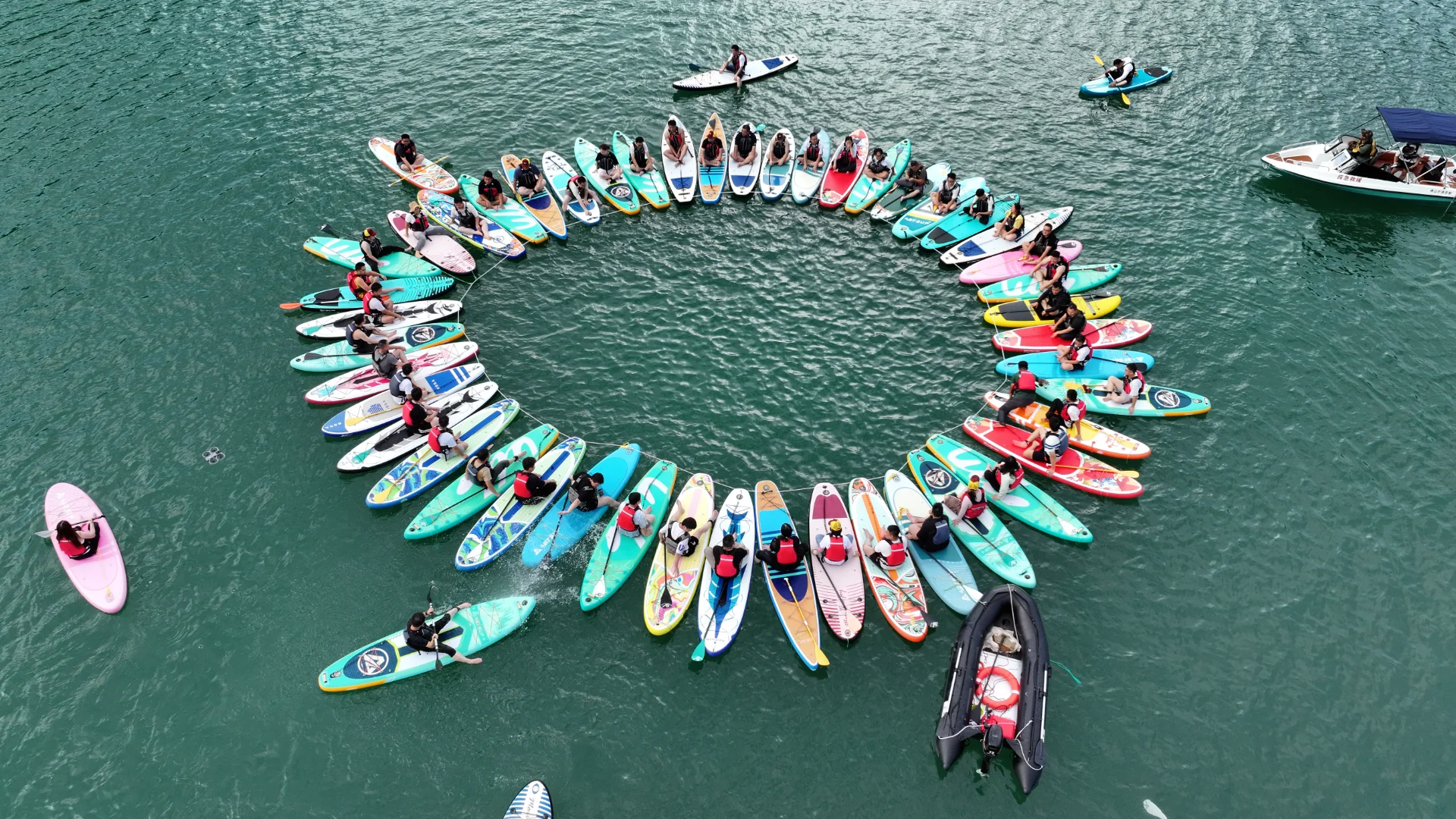
- Impact durability — drop it on concrete, bounce it off a dock, let your dog claw it. It deforms and springs back where a hard board cracks. The whole reason rental fleets and SUP schools run almost entirely on inflatables.
So the convenience is real and the performance is now genuinely close. But “close” isn’t “identical” — and you deserve to know where the difference still bites.
Where Hard Boards Still Win (And I Won’t Pretend Otherwise)
I design inflatables for a living, and I still own a hard board. That’s not a contradiction — it’s the honest acknowledgment that different tools do different jobs. Here’s where a rigid board genuinely outperforms anything I can build with air.
Top-end speed and racing
A hard board’s hull holds a precise shape and slices water with less drag. If you’re racing, chasing distance records, or you simply care about squeezing out the last 5% of glide, a hard board wins. An inflatable has closed most of that gap, but “most” isn’t “all.”
Serious surfing
In real waves, a hard board’s rigidity and sharp rails give you carving response an inflatable can’t match. Inflatables handle small, gentle surf fine — but if breaking waves are your main goal, buy rigid.
Instant readiness
A hard board is paddle-ready in the time it takes to clip your leash. An inflatable costs you 5–8 minutes of pumping each session. For some people that’s nothing; for the paddler who wants to grab-and-go on a whim, it’s a real friction point worth being honest about.
Notice the pattern: hard boards win at the performance extremes — racing, serious surf, competition. If that’s you, I’d rather you buy the right tool than the one I make. But if you’re like most paddlers — lakes, bays, calm rivers, relaxed cruising — none of those advantages will ever show up in your day on the water.
The One Spec That Separates a Great iSUP From a Pool Toy
If you remember nothing else from this article, remember this: the inflatable-vs-hard debate matters far less than the good-inflatable-vs-bad-inflatable debate. The difference inside the inflatable category is bigger than the difference between categories.
And it almost all comes down to construction. Here’s what actually drives whether a board feels like a plank or a pool float:
- Drop-stitch density and weave — thousands of internal threads hold the top and bottom skins parallel under pressure. More threads, tighter weave, stiffer board. This is the single biggest factor in how rigid it feels underfoot.
- Layer construction — a single-layer board is light but flexy over time. A heat-fused or double-layer build (we use MSL Fusion) bonds the layers without piling on heavy glue, so you get rigidity and lower weight.
- Working PSI — a quality board reaches hard-board feel at 15 PSI. Be a little skeptical of boards advertising huge numbers like 25 PSI as the headline; past a point, more pressure adds stress and packing hassle for little real-world gain.
“During development we run a brutally simple test: I stand on the center of the board and have a colleague photograph it from the side. A bad board visibly sags into a banana shape under my weight — what we call ‘taco-ing.’ A good one stays dead flat. No spec sheet communicates rigidity faster than that one photo, and it’s why we obsess over the core, not the marketing number.” — Allen Xiao, ABYSUP Design Team
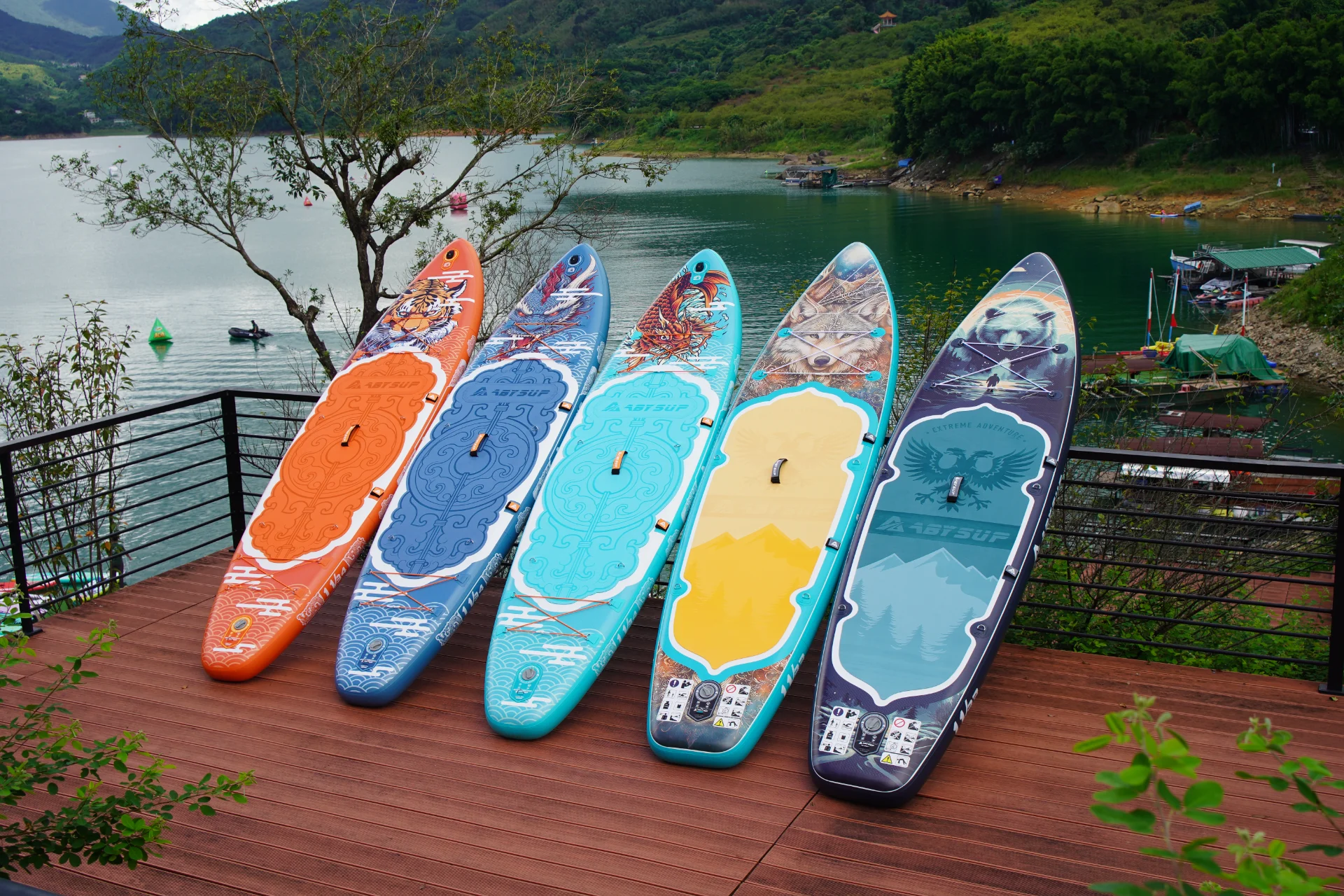
This is the design philosophy I keep coming back to: weight is the enemy, not the feature. The easy way to make a stiff inflatable is to dump in layers of glue and PVC until it can’t flex — but then it weighs 13 kg and nobody carries it to the water twice. The hard part, the part worth paying for, is rigidity without the weight. That’s what our Lightweight & Agile Series is built around — hard-board stiffness at 18.7 lbs. Independent reviewers at outlets like Paddling Magazine make the same point: construction quality, not the inflatable-vs-hard label, predicts whether you’ll be happy.
So Which Should You Buy? (Honest Self-Qualifier)
Let me make this concrete instead of leaving you with “it depends.”
Buy an inflatable if…
- You paddle lakes, calm rivers, sheltered bays — recreational cruising, fitness, exploring.
- You have limited storage or no roof rack — apartment, small car, shared garage.
- You travel or hike to the water and need it to pack down — start with the Lightweight & Agile Series.
- You’re a beginner who wants a stable, forgiving, soft-to-fall-on platform — the All-Round Series is the classic first board.
- You do SUP yoga or fishing, where the cushioned deck is a genuine advantage — see the Lifestyle Series.
- You’re heavier, taller, or bring a kid or dog aboard — inflatables often carry more, and the XL Stability Series is shaped for it.
Buy a hard board if…
- You’re racing or chasing distance times where every bit of glide counts.
- You surf real, breaking waves as your primary use.
- You have easy storage and transport and value grab-and-go readiness over everything else.
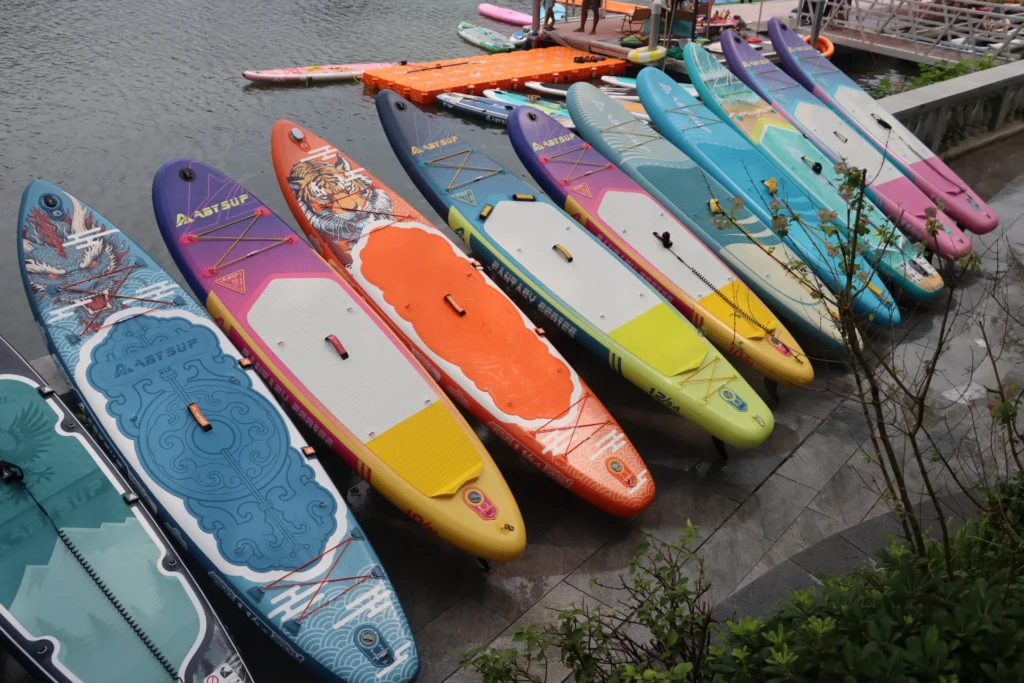
One more honest note for the in-between paddler: if you want inflatable convenience but you’re developing real paddling fitness and crave more glide, our Touring Series is the bridge — a narrower, faster hull that still rolls into a backpack. And if you’re still unsure on size, our paddle board size guide sorts it by weight and water type.
Frequently Asked Questions
Are inflatable paddle boards durable, or do they pop easily?
Quality inflatables are remarkably tough — often more impact-resistant than hard boards in everyday use. The military-grade PVC and drop-stitch core flex on impact and spring back, where a rigid board cracks. That’s exactly why rental fleets, river paddlers, and SUP schools, which see the roughest handling imaginable, run almost entirely on inflatables.
The “pops easily” myth comes from cheap boards with weak seams and thin shells. On a well-built board you’ll rarely touch the patch kit. The risk isn’t air — it’s buying on price alone.
Do inflatable paddle boards feel stable and rigid enough to stand on?
On a properly inflated quality board, yes — it feels solid, not squishy. Rigidity comes from drop-stitch density and reaching the recommended PSI, not from the board being hard-shelled. Most paddlers who think inflatables feel “wobbly” either tried a cheap one or never pumped it to full pressure.
If anything, inflatables are often more stable for beginners, because they tend to be wider and thicker, with more volume and a softer, more forgiving surface underfoot.
How long do inflatable paddle boards last?
A well-cared-for quality inflatable lasts 5–10 years, and the best ones can go a decade or more. Longevity depends far more on construction quality and care than on the inflatable-vs-hard question — both types degrade under UV and poor storage.
The simple rules: rinse after salt water, dry before storage, keep it out of prolonged direct sun, and don’t store it cooking in a hot car. Do that and the board outlasts your interest in upgrading.
Is an inflatable or hard board better for beginners?
For almost every beginner, inflatable. They’re more stable, more forgiving when you fall, easier to store so you’ll actually use them, and far cheaper to live with. The learning curve is gentler and the barrier to getting on the water is lower.
Hard boards make sense for beginners only in narrow cases — usually if you live somewhere with effortless storage and you already know your main goal is surfing or racing.
Can clubs, rentals, or resorts rely on inflatable boards for heavy daily use?
Absolutely — it’s the use case inflatables are arguably best suited for. A rental fleet is the harshest durability test there is: a hundred strangers a week, dragged across docks and rocks, handled with zero care. Inflatables take that abuse better than hard boards and cost less to store and transport in volume.
For operators, wholesale pricing, MOQ tiers, and custom branding are available on request — a fleet of forgiving, impact-resistant boards keeps both your customers and your repair budget happy.
Find the Board That Fits Your Real Life
So — are inflatable paddle boards good? The good ones are genuinely excellent, and for most people they’re the right call. The trick was never inflatable versus hard. It was learning to spot the construction that separates a board you’ll paddle for a decade from one you’ll abandon in a season.
If you’re ready to choose, start with the All-Round Series and our size guide to match a board to your water and weight. And if you run a club, rental, or shop and want a lineup built on construction you can stand behind, our team would love to talk — apply to the ABYSUP dealer program and let’s build it together.
The best board isn’t the hardest or the lightest. It’s the one that gets you on the water — and keeps you coming back.