
aby inflatable Paddle Board with Pet: Take Your Dog on the Water
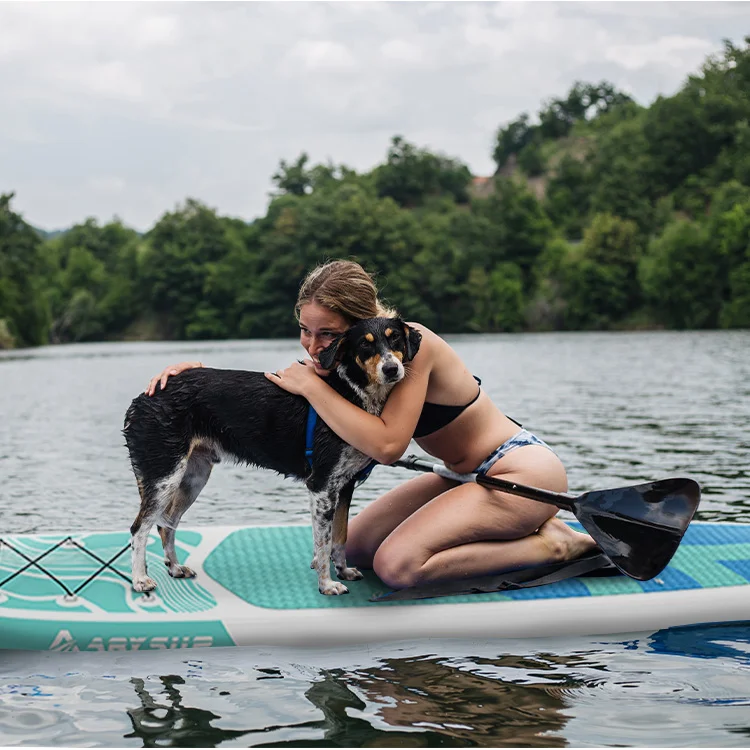
Wide, stable, and tough enough for claws. ABYSUP pet-friendly SUP boards are built for the paddlers who never leave their dog behind.
The Problem With Taking Your Dog on a Standard SUP
- Most paddle boards were not designed with dogs in mind. Standard EVA deck pads cover only the centre strip — the moment your dog moves to the nose or edges to look at the water, they are standing on bare PVC with nothing to grip.
- Dog claws are also harder on deck surfaces than most board makers account for. A thin EVA pad degrades visibly within one season of regular dog use — peeling at the edges, compressing in the areas where your dog sits or repositions repeatedly.
- ABYSUP pet-friendly boards use full-deck EVA coverage with a denser foam compound — built to handle claws, repositioning, and the extra dynamic load of a dog moving around while you paddle.
What a Pet-Friendly SUP Actually Needs
Full-Deck EVA Coverage
Not just a centre strip. Full-deck EVA means your dog has grip wherever they stand, sit, or reposition — nose, tail, edges included. No bare PVC for claws to slip on.
Width: 33"–35"
A dog moving around on a narrow board tips the balance equation immediately. A 33"+ wide board absorbs your dog's weight shifts without transferring every movement to your feet.
Weight Capacity: 300+ lbs
Your weight plus your dog's weight plus gear adds up faster than most people expect. A board with genuine capacity margin sits higher in the water and feels more stable for both of you.
3 Tips for Paddling With Your Dog
Introduce the Board on Dry Land First
Let your dog explore the board before you get on the water. Let them sniff it, step on it, and sit on it while it is deflated on the ground. A dog that is comfortable with the board on land will settle faster once you are moving.
Start in Calm, Shallow Water
First sessions should be in flat, shallow water where your dog can jump off and get back on without needing your help. Confidence builds fast when your dog realises they are not trapped — they are choosing to stay on the board.
Always Fit a Dog Life Jacket
Even strong swimmers should wear a life jacket on the water. A handle on the back of the jacket lets you lift your dog back onto the board from the water — without that handle, getting a wet 30kg dog back on a moving board is genuinely difficult.
Paddling With Your Pet — FAQ
Can any paddle board be used with a dog?
Technically yes — but not all boards handle it equally well.
The key differences are deck coverage and width. A board with partial EVA coverage leaves your dog standing on bare PVC at the nose and tail, which has very little grip when wet. A narrow board amplifies every weight shift your dog makes.
For regular paddling with a dog, look for full-deck EVA, minimum 33" width, and a weight capacity with meaningful margin above your combined weight.
What size paddle board do I need for me and my dog?
Add your weight to your dog's weight, then choose a board rated for at least 20–30% more than that combined total.
For most paddler-and-dog combinations, an 11' × 34" board rated for 300–350 lbs covers the range from a 70kg person with a 15kg dog through to a 90kg person with a 35kg dog.
If you have a large breed — Labrador, Golden Retriever, German Shepherd — size up to a board with 350 lbs+ capacity. A board near its weight limit sits lower in the water and is harder to balance on.
Will my dog's claws damage an inflatable paddle board?
On a correctly specced board — no. The PVC shell of a drop-stitch inflatable is significantly tougher than it looks, and dog claws do not generate enough force to puncture it under normal use.
The more realistic concern is EVA deck pad wear. Thin EVA pads compress and peel under repeated claw contact. A dense full-deck EVA pad handles regular dog use without visible degradation for 2–3 seasons.
If your dog tends to scratch aggressively at the board surface, a fitted board bag between sessions protects the EVA when the board is not in use.
How do I get my dog back on the board if they fall off?
This is the question most people do not think about until it happens.
The easiest method: stabilise the board by kneeling or sitting, position your dog alongside the middle of the board, grip the handle on their life jacket, and lift and roll them onto the deck in one motion. Without a life jacket handle, getting a wet dog back on a floating board is significantly harder.
Practise this in shallow water before your first real session — both of you will be more confident for it.
Does my dog need a life jacket on a paddle board?
Yes — even if your dog is a confident swimmer.
The reasons are practical, not just precautionary. A life jacket keeps a tired dog afloat in situations where they would otherwise struggle. The handle on the back is how you lift them back onto the board from the water. High-visibility colours make your dog easier to spot if they drift away from the board.
A dog that has never worn a life jacket before should be introduced to it on dry land several sessions before their first time on the water — same principle as introducing the board itself.
Not Sure Which Board Fits You and Your Dog?
Tell us your weight, your dog's breed, and where you plan to paddle —
we'll help you find the right board for your size, your dog, and your water.