The lake is glass. There’s no wind. The forecast says zero gusts all afternoon. You’re 80 meters from shore on your new board, and the leash is sitting in the bag where you left it because — honestly — it felt like overkill for water this calm.
I’m Allen, Senior Industrial Designer at ABYSUP — I’ve spent nearly a decade designing inflatable SUPs and the safety gear that goes with them, and I’ll tell you up front: the leash is the single piece of equipment that new paddlers most often skip and most often regret skipping. Not because something dramatic happens. Because something small happens, and the gap between “small” and “scary” closes faster than anyone expects.
This isn’t a fear piece. It’s a math piece. Once you understand the numbers, you’ll never paddle without one again — and more importantly, you’ll paddle with the kind of relaxed confidence that the leash actually exists to give you.
The Math That Changes How You See the Leash
Here’s the scenario almost no first-time paddler runs through their head before they fall in.
You’re standing on your board. A small wind shift hits — a 10 km/h breeze, the kind you’d describe as “barely noticeable.” You lose your balance and tip into the water. The board, with its 32-inch-wide deck acting as a sail, immediately catches that breeze. Within 90 seconds, it’s 30 to 40 meters away from you.
Now you have to swim after it. Here’s the comparison nobody shows you:
| Scenario | Speed | Reality Check |
|---|---|---|
| Average recreational swimmer (clothed, no fins) | ~2 km/h | What most adults can sustain |
| Strong swimmer in swimwear | ~3 km/h | Sustainable for short distances |
| Olympic-level sprint | ~7 km/h | Not you. Not anyone you know. |
| SUP board in a 10 km/h breeze | ~3–4 km/h | Faster than you can swim |
| SUP board in a 15 km/h breeze | ~5–7 km/h | You will not catch it. |
Read that bottom row again. In a wind that most people would describe as “a nice breeze,” your unleashed board moves faster than you can swim. Not slightly faster. Significantly faster.
And that’s just wind. Add a current — even a slow one — and the gap opens further. The reason the American Canoe Association classifies SUP leashes as essential safety equipment isn’t drama. It’s physics. Once a board is more than about 20 meters away, the swim back becomes hard. Once it’s 50 meters away in any kind of wind, it becomes genuinely dangerous.
The leash closes that gap in one decision. Clip it on at the shore, forget about it for the next four hours.
What “Calm Water” Actually Means (And Why It Misleads First-Timers)
The trap with “calm water” is that calm describes how the surface looks, not how the air above it behaves. A lake can look like glass at 8 a.m. and be pushing a 4-knot wind by 10:30. A protected bay can be mirror-still in the lee of the headland and have a steady offshore breeze fifty meters out.
I learned this in our own product testing. Three years ago we were shooting catalogue photography on a small alpine lake — the kind of scene that sells boards. Glass surface, no visible ripples, perfect light. One of our designers stepped off her board to adjust the camera angle from the water. By the time she’d swum twenty meters back to retrieve a dropped lens cap, her board had drifted forty meters in the opposite direction. She had to sprint-swim for it.
“What looked like dead-calm water from shore was actually a steady drainage breeze coming down from the valley — invisible at the surface, very real once you had a 32-inch-wide PVC sail in your hand. She wasn’t in danger because we had a safety boat ten meters away. But she would have been alone on a recreational paddle. That moment changed how I write the product copy for our leash range.” — Allen Xiao, ABYSUP Design Team
Here’s the part that matters: the visible cues you rely on to judge wind on land — leaves moving, flags flapping, ripples on the water — are unreliable predictors of how a SUP behaves once it’s untethered. A board doesn’t need ripples to drift. It just needs a pressure difference between one side and the other, and that exists in air movements far below the threshold of human perception.
Translation: if you can feel any breeze at all on your face, your unleashed board is already moving faster than you’ll be able to chase it.
The Real Reason Experienced Paddlers Wear Theirs Every Time
If you watch experienced paddlers — the ones doing 10-kilometer touring days, the ones racing, the ones teaching beginners — you’ll notice something. They never debate the leash. It goes on at the car park, it comes off at the car park. Not because they expect to fall. Because they’ve stopped thinking about it.
This is the reframe that took me years to articulate properly: the leash isn’t there to save you when something goes wrong. It’s there to free your attention so you stop scanning for what could go wrong.
Without a leash, every gust of wind triggers a small mental calculation. If I fall now, can I catch it before it crosses to that buoy? Every kid jumping off a nearby dock, every motorboat wake on the horizon — they all enter the same background loop. You’re never fully present on the water because part of your brain is running a constant board-recovery simulation.
With a leash on, that loop disappears. The board is never more than 8 to 10 feet away from your ankle, full stop. You can stand more relaxed. You can try the harder stroke. You can lean further into the turn. The leash doesn’t restrict your paddling — it expands what you’re willing to attempt.
One of our long-term customers, an instructor on Lake Tahoe, put it this way in a feedback session last summer: she said her beginner students all paddle better the moment they clip on. Not because they’re safer in any abstract sense, but because their shoulders drop. Their stance widens. They stop bracing. The leash gives them permission to relax. That’s the design intent. That’s why we treat it as core equipment, not an accessory.
Choosing the Right Leash for Where You Paddle
Not every leash is right for every environment. Here’s the breakdown we use when fitting a board kit to a paddler’s actual use case.
Coil leash — the default for flatwater
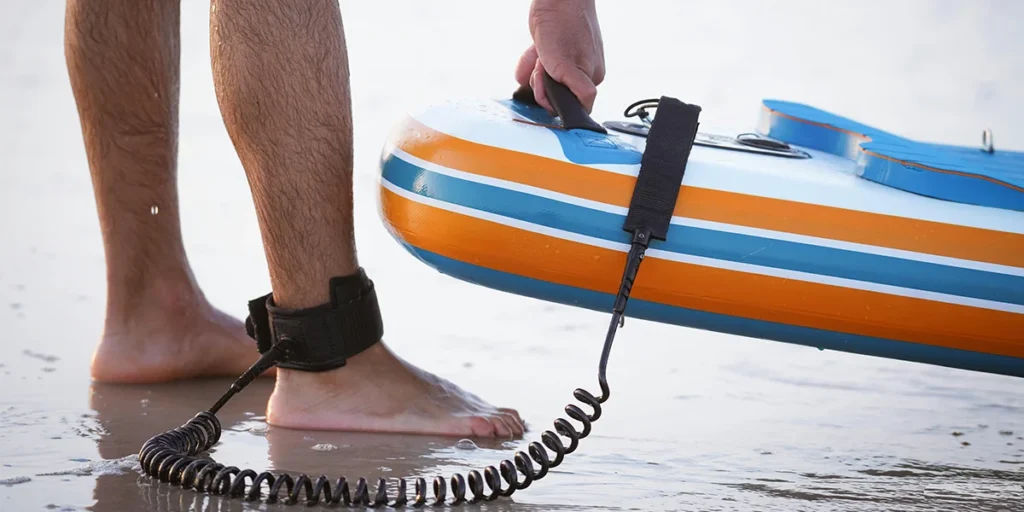
A coiled leash sits on the deck like a phone charger cable. It stays out of the water, doesn’t drag, doesn’t catch on the fins, and stretches when you need it. This is the right choice for 90% of paddlers — lakes, calm bays, slow rivers, SUP yoga, fitness paddling.
The honest trade-off: a coiled leash has slightly more recoil if your board snaps back at you after a fall. We solved this on our current generation by tuning the coil pitch — tighter coils, lower recoil energy — but the physics is real. If you’re paddling in surf where the board can be flung by a wave, you don’t want coil.
Straight leash — for surf and rough water
A straight leash is a single uncoiled urethane cord, typically 9 to 10 feet long. It trails in the water behind you. Use this only if you’re SUP surfing or paddling in conditions where breaking waves are a real factor. On flatwater, a straight leash is a snag hazard — it drags on the fins, catches on weeds, wraps around your paddle blade.
Ankle vs. calf attachment
Most leashes attach at the ankle by default. For surfing or stand-up racing where the leash needs to clear the deck quickly during a fall, calf attachment (just below the knee) is preferred — the cord exits higher up and is less likely to tangle around your feet on the recovery.
For everyone else: ankle is fine. We at ABYSUP designed our standard leash with a neoprene-padded ankle cuff because all-day comfort wins over technical edge cases. You’ll forget you’re wearing it within fifteen minutes of clipping on.
One critical exception: never wear a standard leash in moving water
If you’re paddling on a river with current — even a slow one — a standard SUP leash becomes a snag risk. If it catches on a submerged branch, log, or rock while you’re in the water, the current can hold you under. For moving water, use a quick-release waist belt leash designed specifically for river SUP, not an ankle leash. This is the one scenario where a standard leash is more dangerous than no leash.
For more on the established safety standards behind SUP leash design, the stand-up paddleboarding entry covers the equipment evolution from surf leashes to dedicated SUP designs and the discipline-specific variations that emerged.
Who Should Wear a Leash (And the One Exception)
Short answer: almost everyone, almost always. Here’s the honest breakdown.
Always wear a leash if:
- You’re a beginner or intermediate paddler on any open water — lake, bay, ocean, reservoir
- You’re paddling solo, even for a short session in familiar water
- You’re paddling more than 30 meters from shore
- You’re paddling in any wind above truly dead calm (which is almost never the case for a full session)
- You’re a parent supervising a child paddler — model the behavior, every time
- You’re paddling SUP yoga or fitness, where falling in is part of the expected experience
- You’re paddling in cold water (under ~16°C / 60°F) — separation from your board in cold water becomes serious very quickly
The one exception — moving water
If you’re paddling on a river with any visible current, do not wear a standard ankle leash. Use a dedicated quick-release river SUP belt leash with a hand-pull release at the waist, or paddle without a leash and stay close to shore. A standard leash in moving water is an entrapment hazard.
This is the only scenario where “no leash” is the safer choice — and even here, the right answer is “the right kind of leash,” not “no leash at all.”
Frequently Asked Questions About SUP Leashes
Do I really need a leash for paddle boarding on a calm lake?
Yes — and the calmer it looks, the more important it becomes. Calm water lulls paddlers into skipping the leash, but a 10 km/h breeze can push your board 3–4 km/h, which is faster than most adults can swim in clothes. The drift gap opens within 60 to 90 seconds of a fall.
The leash isn’t there for storms. It’s there for the small, ordinary moments — a misjudged step, a passing wake, a brief loss of balance — when separation from the board could otherwise become a real problem. Wear it.
What kind of leash do I need for flatwater paddle boarding?
A coiled ankle leash, 8 to 10 feet long, with a neoprene-padded cuff. The coil keeps the cord on the deck and out of the water, the length gives you working room without being unwieldy, and the padded cuff is what makes the difference between “I forgot I was wearing it” and “I had to take it off after an hour.”
Skip straight leashes unless you’re specifically going to surf with the board, and skip ankle leashes entirely if you’re paddling rivers with current — you want a quick-release waist belt for moving water.
Can a SUP leash actually be dangerous?
Yes, in one specific context: moving water. If you’re paddling a river or any current-driven environment and your standard ankle leash snags on a submerged branch or rock, the current can hold you underwater. This is why dedicated river SUP leashes use a quick-release belt at the waist with a hand-pull release.
For lakes, ocean flatwater, and calm bays — which is where most paddlers spend most of their time — a standard ankle leash is significantly safer than no leash. The river-SUP exception is real, but it’s the exception, not the rule.
How do I attach a SUP leash to my board?
Every quality inflatable SUP has a leash D-ring or attachment loop near the tail of the deck. The leash has a fabric loop on one end that threads through the D-ring with a larks-head knot — pass the loop through the ring, then pull the rest of the leash through the loop and tighten. It takes about ten seconds.
The other end has a Velcro cuff that wraps around your ankle (or just below your knee for racing). Make sure the swivel — the small rotating fitting where the cuff meets the cord — is positioned so the cord trails behind you, not across your foot.
Should kids wear a leash on a paddle board?
Absolutely yes — and even more importantly than adults. Children are lighter, tire faster in the water, and have a smaller margin for error if separated from their board. The leash is non-negotiable for any child paddler.
Pair it with a properly-fitted PFD (life jacket), and make leash-clipping the first thing you do at the shoreline, before they even step on the board. Kids learn safety behaviors through ritual repetition. Make the leash part of that ritual every single time.
Find the Leash That Fits How You Paddle
Every ABYSUP board ships with a coiled ankle leash as standard equipment — neoprene-padded cuff, stainless steel swivel, 10-foot extended length. There’s nothing extra to buy on day one for flatwater paddling.
If you want to see our full leash range — including straight leashes for surf paddlers and quick-release belts for river SUP — visit our SUP leash collection. For households with multiple paddlers, spare leashes are sized for both adult and youth ankles.
Wholesale and dealer inquiries: our team works with regional retailers and rental operators on volume pricing for safety equipment, including branded leashes and PFDs. Reach out through the trade contact form and someone from our team will respond within 48 hours.
The leash is the smallest piece of gear in your kit. It’s also the one that decides whether your worst-case day on the water is a story you laugh about later — or a story you don’t get to tell. Clip it on. Forget about it. Paddle freely.