A lake can look almost flat from the car park and still be a bad day to launch a paddle board. That’s because the number on your weather app is only part of the decision — wind direction, gusts, exposed distance and your route back to shore can matter just as much as average wind speed.
I’m Allen, and I’ve spent nearly a decade focused on inflatable SUP design. Wind is one of those conditions where I don’t like giving paddlers one magic number. An experienced paddler on sheltered water and a beginner on an exposed coast can face completely different risks at the same reported wind speed.
So instead of asking only, “Is 10 mph too windy?”, this guide will help you read the whole situation: speed, direction, gusts, water surface and whether you can still get home under your own power.
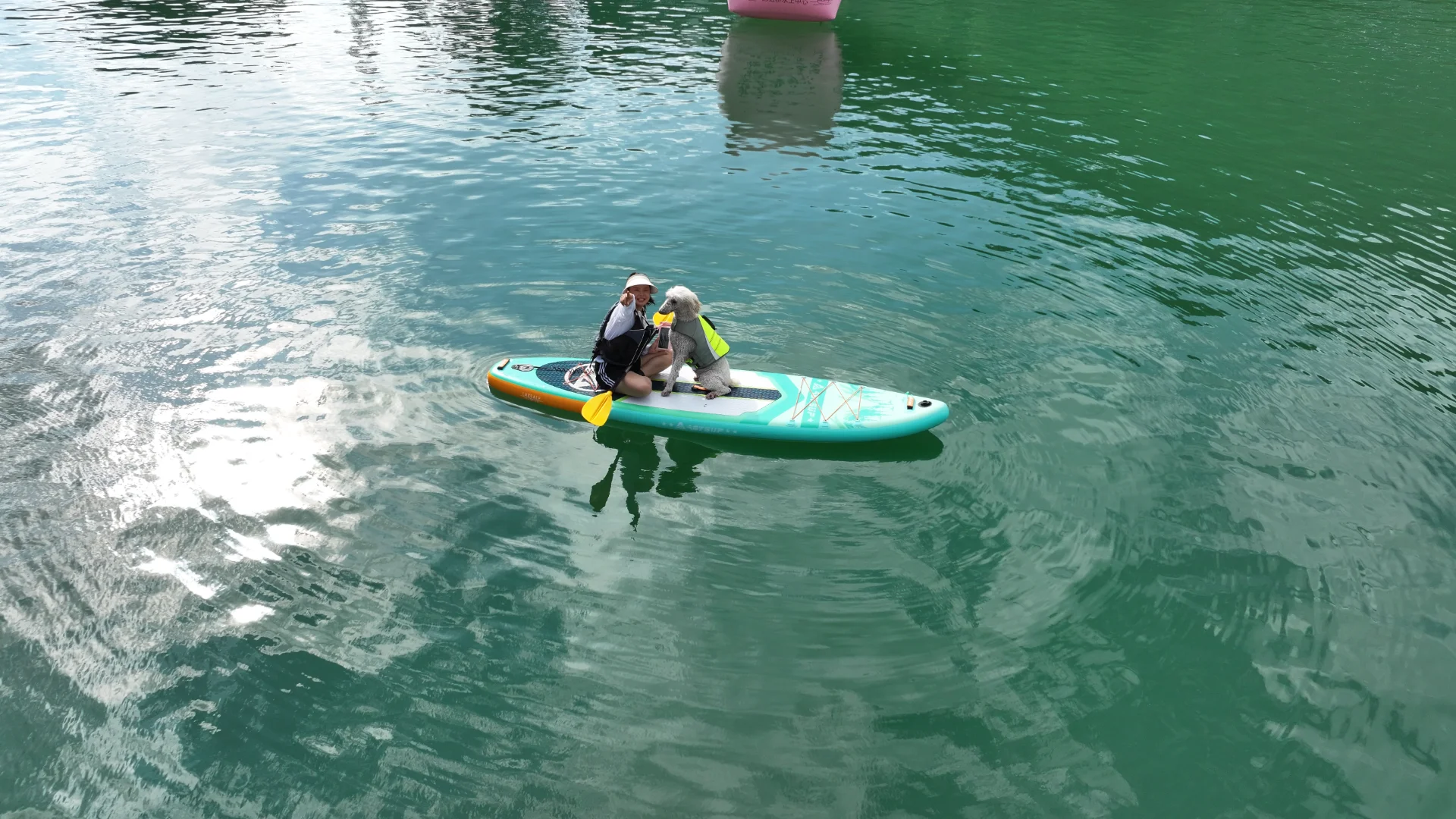
How Much Wind Is Too Much for Paddle Boarding?
There is no universal wind-speed limit that makes paddle boarding safe below one number and unsafe above it.
Your skill, board, location, wind direction, gusts, current, tide and distance from shore all change the answer.
That said, wind-speed bands are still useful for understanding what the water may start doing. The table below combines the NOAA / National Weather Service Beaufort descriptions with my practical interpretation for recreational SUP.
Important: this is a decision aid, not an official go/no-go safety threshold.
| Wind Speed | Typical Water Clues | Practical SUP Interpretation |
|---|---|---|
| 0–7 mph 0–11 km/h |
Calm to small wavelets; little or no breaking crest | Often the easiest range for learning on protected flatwater, assuming direction and local conditions are suitable |
| 8–12 mph 13–19 km/h |
Larger wavelets; crests may begin breaking; scattered whitecaps possible | Wind becomes a meaningful part of the session; route choice, experience and staying close to shelter matter more |
| 13–18 mph 20–29 km/h |
Small waves becoming longer; more frequent whitecaps | Demanding recreational conditions; many beginners should postpone rather than treat this as normal learning weather |
| 19+ mph 30+ km/h |
More pronounced waves, many whitecaps and increasing spray as wind strengthens | Not conditions I would use as a routine recreational SUP target; local expertise and specialist skills become increasingly important |
You can compare those visual clues with the National Weather Service Beaufort Wind Scale.
But don’t stop at the table. A 6 mph offshore wind can make a worse route decision than a higher wind speed blowing toward a safe shoreline. Direction comes next.
Wind Direction Can Matter More Than Wind Speed
If there’s one part of this guide I would want a new paddler to remember, it’s this: always know where the wind is trying to take you.
Onshore Wind
An onshore wind blows from the water toward the shore. That doesn’t automatically make strong wind safe, but the direction is generally less likely to carry you progressively farther away from land.
Offshore Wind
An offshore wind blows from land toward open water.
This is the condition I would not try to simplify with a “safe mph” number. The RNLI’s paddleboarding guidance specifically advises paddlers to avoid offshore winds because they can carry a board away from shore and make the return exhausting or impossible.
The deceptive part is that water close to the beach can look beautiful. The land may shelter the first section, so you launch into what appears to be calm water. As you move farther out, that shelter disappears.
Cross-Shore Wind
A cross-shore wind moves broadly along the coastline rather than directly toward or away from it.
That still affects route planning. If you travel downwind for a long time, your return may become a sustained headwind paddle when you’re already tired.
Speed tells you how hard the wind is blowing. Direction tells you where a mistake may take you.
Why Is Offshore Wind Such a Serious Problem on a Paddle Board?
An inflatable SUP presents a relatively large surface to the wind. Add a standing paddler and there is even more exposed area for the wind to act on.
Once your forward paddling speed stops overcoming that drift, simply “trying harder” may not bring you back.
Paddle UK commissioned research specifically into offshore wind and stand-up paddle boards. In the conditions described in that research, a stationary paddler in approximately 18–20 mph offshore wind could drift around one mile in 30 minutes. Paddle UK also found that standing produced more drift than kneeling, lying prone or sitting with the legs over the sides.
You can read the original Paddle UK offshore-wind research and guidance.
I wouldn’t use that one-mile figure to predict exactly how far every paddler will drift. The research itself notes that rider profile, board type, gusts, tide and other conditions can change the result.
The useful lesson is simpler: offshore drift can become significant surprisingly quickly.
That’s why I would never turn the research around and say, “18 mph is dangerous but 10 mph offshore is fine.” The official advice is to avoid offshore wind rather than search for a comfortable cutoff.
Sustained Wind vs Gusts: Why You Need to Read Both Numbers
Your weather app may show something like:
Wind: 8 mph — Gusts: 17 mph
Don’t mentally turn that into an “8 mph day.”
Sustained wind describes the averaged wind condition, while gusts are short peaks above that background flow. For a paddler, those peaks can arrive while you’re standing, turning, crossing exposed water or already paddling against the wind.
That matters because a sudden increase can:
- push the board sideways;
- increase the effort required to hold your course;
- create more surface chop;
- make a previously comfortable return harder;
- affect your balance when you’re standing high on the board.
So when I check a forecast, I look at both sustained wind and gusts.
If the average looks manageable but the gust number makes me uncomfortable for the location, I don’t ignore the gust because the smaller number looks nicer.
The same applies to forecast changes. A calm morning followed by a windy afternoon means your launch conditions are not necessarily your return conditions.
A Better SUP Wind Decision: Check Four Things Together
If someone asks me, “Allen, can I paddle in 10 mph wind?”, I need more information before I’d give an answer.
I would check four things.
1. Wind
- What is the sustained speed?
- What are the gusts?
- Is the wind increasing or decreasing?
- Which direction is it blowing?
2. Location
- Protected lake or exposed coast?
- How long is the open-water fetch?
- Are there cliffs, buildings or headlands creating wind shadows or sudden gusts?
- Is there boat traffic?
3. Route
- Will you stay close enough to shore to exit early?
- Does your route force you to paddle into a headwind to get home?
- Are there safe landing points along the way?
4. Ability
- Can you paddle efficiently from your knees?
- Can you control the board in crosswind?
- Can you remount after a fall?
- Have you paddled that location before?
If several of those answers create uncertainty at the same time, the sensible decision is often to shorten the session, change location or paddle another day.
For new paddlers, our SUP Beginner Learning Path covers the skills worth building before expanding into more demanding conditions.
What Does Increasing Wind Look Like on the Water?
A forecast is useful, but once you’re at the launch I also want you to look at the water.
The National Weather Service Beaufort descriptions give useful visual clues:
- Light breeze: small wavelets with glassy crests that are not breaking.
- Gentle breeze: larger wavelets and the first scattered breaking crests or whitecaps.
- Moderate breeze: waves become longer and whitecaps become more frequent.
- Fresh breeze: waves become more developed and many whitecaps may be visible.
If you launched on almost glassy water and start seeing increasingly frequent whitecaps, the session has changed even if you haven’t checked your phone again.
That’s an important habit for newer paddlers: don’t only assess conditions once.
Keep looking behind you. Look toward your return route. Notice whether the water outside the sheltered area looks different from the water beside your board.
A good paddler isn’t only controlling the SUP. They’re continuously reading the environment around it.
Wind on a Lake, Coast or River Can Create Different Problems
A number from the forecast means something different depending on the water beneath you.
Lake
On a small sheltered lake, trees and terrain may reduce wind exposure in some areas. On a large open lake, a long stretch of unobstructed water gives wind more distance to build surface chop.
Coast
At the coast, wind direction needs to be considered alongside tide, swell and shoreline shape. The RNLI also warns that wind opposing tidal flow can make water considerably rougher.
Offshore wind deserves particular caution because it can carry a SUP away from land even when the water beside the beach looks calm.
River
On a river, you need to think about wind and current together. A strong headwind against the direction you’re trying to travel can increase fatigue, while flowing water introduces additional hazards that require appropriate skills and equipment.
This is why I don’t like statements such as:
“10 mph is safe for paddle boarding.”
Ten miles per hour on one protected lake and ten miles per hour on an exposed tidal coast are not the same paddling problem.
What Should a Beginner Do When the Wind Starts Building?
My first recommendation is not to wait until you’re exhausted before changing the plan.
If the wind starts increasing:
- Stay closer to shore. Reduce the distance between you and an exit point.
- Turn back early. Don’t use half your remaining energy proving you can continue.
- Lower your centre of gravity. Kneeling can make the board easier to manage.
- Pay attention to drift. Use fixed landmarks on shore to see whether you’re moving sideways or away from your intended route.
- Reassess the return. Conditions behind you may be harder than the section ahead.
For paddlers with appropriate practice, prone paddling — lying on the board and paddling with the arms — can be used as a technique for making progress in some difficult wind situations. Paddle UK specifically notes that this technique requires conditioning and practice; someone trying it for the first time during an incident may tire quickly.
So don’t make your emergency technique something you have never practiced.
If you’re new to SUP, the safest progression is still boringly effective: calm water first, good board control second, more challenging conditions later.
Our beginner paddle boarding tips cover the basic stance and board-control skills to build before deliberately taking on windier water.
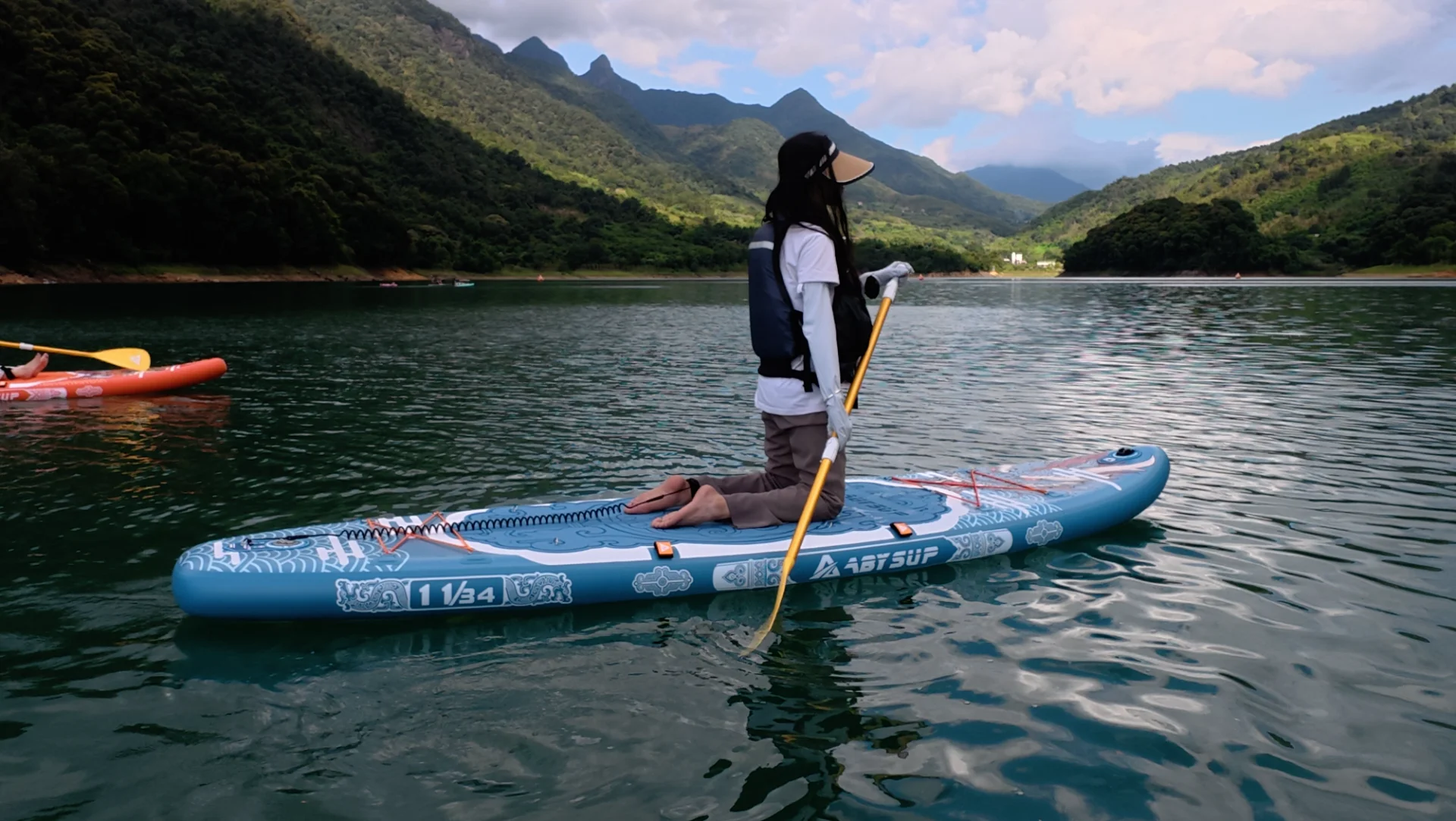
What Safety Gear Matters When Conditions Can Change?
Wind makes preparation more important because the distance between “everything is fine” and “I can’t get back easily” can grow quickly.
Before going out, I would want a recreational paddler to have:
- An appropriate buoyancy aid or PFD suited to the activity and local requirements.
- The correct leash for the paddling environment. Leash choice is especially important because moving water can require different safety systems from flatwater.
- A means of calling for help secured on your person, not buried somewhere on the board.
- Clothing suited to water temperature, not just warm air on shore.
- A route and return time shared with someone ashore when appropriate.
The RNLI also recommends checking the weather and tides, carrying communication equipment, wearing suitable flotation and choosing a lifeguarded beach where possible.
The board itself matters too, but I don’t want to oversell that part. A stable All-Round SUP can make recreational handling more forgiving, but no board design turns bad wind direction into good conditions.
Equipment helps you manage risk. It does not cancel the weather.
My 60-Second Pre-Launch Wind Check
Before putting the board in the water, I would run through this short check:
| Check | What You’re Looking For | Reason to Change the Plan |
|---|---|---|
| Direction | Where will the wind push me? | Offshore wind or an unsafe drift direction |
| Sustained speed | Does it match my skill and location? | Conditions already exceed what I’ve practiced in |
| Gusts | How strong are the peaks? | Large or unpredictable increases above the average |
| Water surface | Ripples, chop, breaking crests, whitecaps | Water already looks more developed than expected |
| Forecast trend | What happens before I return? | Wind is forecast to build during the session |
| Exit plan | Can I shorten the route or land early? | No practical escape route if conditions change |
This takes less time than inflating the board.
And to me, it’s part of paddling skill — not something separate from it.
Paddle Boarding Wind Speed FAQs
Is 10 mph too windy for paddle boarding?
Not automatically, but 10 mph is strong enough that wind should be part of your decision rather than ignored. On the Beaufort scale, 8–12 mph falls into a gentle breeze range where larger wavelets develop and scattered breaking crests may appear.
A confident paddler on sheltered water may handle those conditions very differently from a beginner on an exposed coast. Check direction, gusts, route and local water conditions before deciding.
What wind speed is best for beginner paddle boarding?
I would teach a beginner in calm or light-wind conditions rather than use one universal maximum number. Protected flatwater with little surface chop allows the paddler to focus on balance, stroke and steering instead of fighting drift.
As wind rises toward the range where breaking crests and whitecaps begin appearing, a beginner is learning wind management at the same time as basic SUP skills. Those are two separate lessons.
Can I paddle board in offshore wind if it is only a light breeze?
I would follow the RNLI and Paddle UK guidance and avoid offshore winds rather than try to find a safe cutoff.
Offshore conditions can carry a SUP away from land, and the sheltered appearance close to shore can be deceptive. The return paddle is the part that catches people out.
Should I check wind gusts or average wind speed?
Check both.
Sustained wind describes the background condition, while gusts show the stronger peaks you may experience during the session. A modest average with substantially stronger gusts should not be treated as if only the lower number exists.
What should I do if the wind gets stronger while paddle boarding?
React early. Stay closer to shore, shorten the route and turn back before fatigue becomes part of the problem. Lowering your centre of gravity by kneeling can make the board easier to manage.
If you’re in genuine difficulty, use your means of communication and follow local emergency guidance. Do not wait until you’re exhausted before asking for help.
Choose the Conditions Before You Choose the Board
Wind is one of the clearest examples of why SUP isn’t only about equipment.
A good board can help with stability and control, but it cannot change wind direction, remove a tide or guarantee that you’ll be able to paddle back against worsening conditions.
My rule is simple: if the forecast, water surface and return route don’t all make sense together, I would rather paddle somewhere else or come back another day.
If you’re still building your skills, continue with our SUP Beginner Learning Path. If you’re choosing a stable recreational board for calm-water progression, explore the ABYSUP All-Round Series.
For dealer partners, this guide can also be shared with new paddlers as part of responsible pre-purchase and post-purchase SUP education.