By Allen Xiao | Senior Industrial Designer at ABYSUP
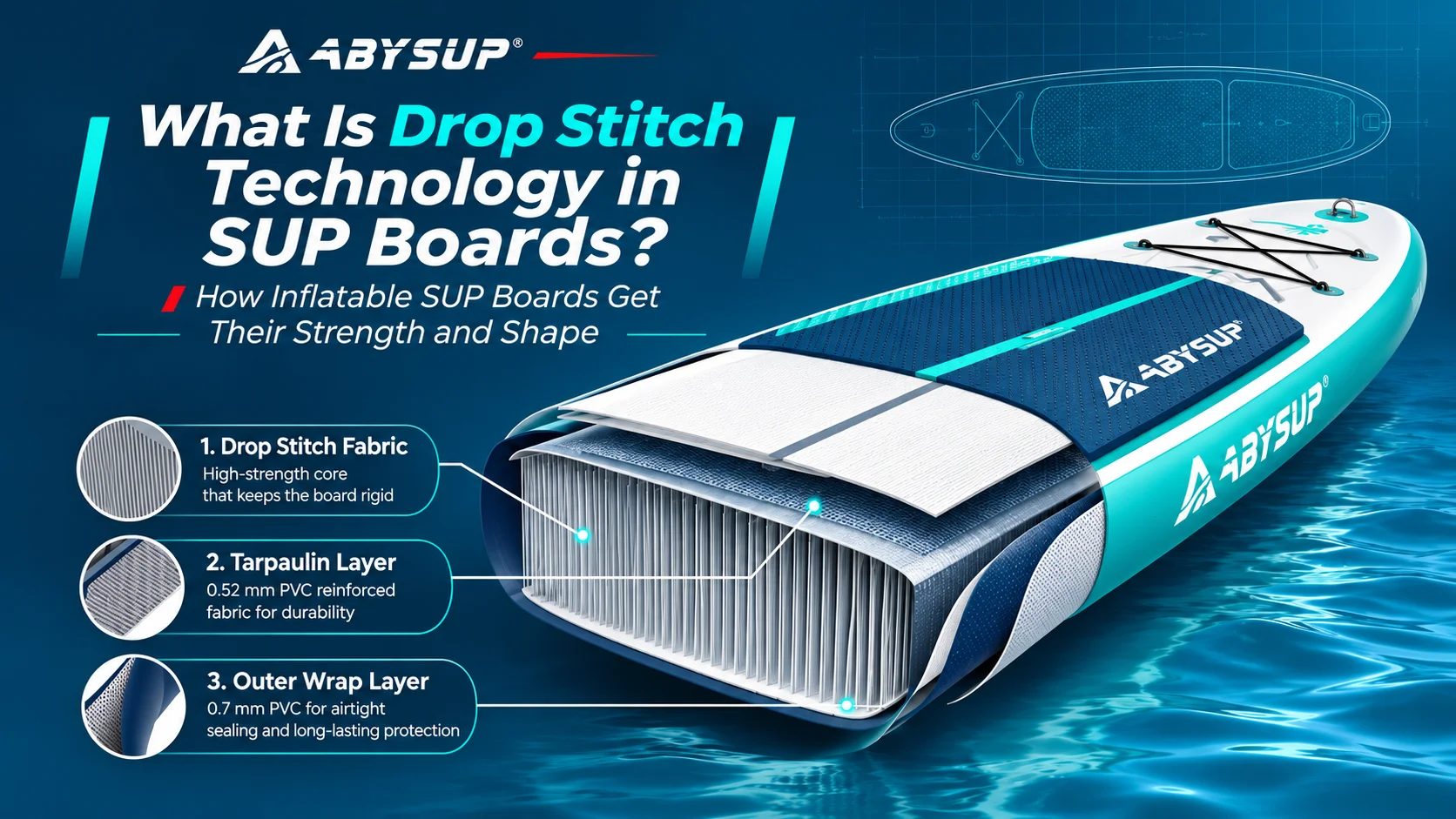
Unlike a simple inflatable tube, an inflatable SUP has thousands of internal connecting threads that hold its upper and lower surfaces at a controlled distance. When the board is inflated, these threads help it maintain a flat shape and resist outward expansion.
But the internal structure is only part of the story. The PVC layers, rail construction, bonding method, and inflation pressure all affect the finished board.
I’m Allen Xiao, Senior Industrial Designer at ABYSUP. My work involves inflatable SUP design, material selection, board construction, and the manufacturing details that affect how a paddle board performs on the water.
One question I often hear from customers and business partners is: how can an inflatable paddle board support an adult without bending like an ordinary air mattress?
The answer starts with drop stitch technology.
In this guide, I’ll explain how Drop Stitch works, what materials make up an inflatable SUP, and how different manufacturing methods affect board construction. I’ll also share examples from ABYSUP’s manufacturing process to help buyers understand what to look for when choosing an inflatable paddle board.
What Is Drop Stitch Technology?
Drop stitch technology is a fabric construction method used to create inflatable panels with relatively flat surfaces and controlled thickness.
The structure contains two fabric skins connected by thousands of internal threads. These threads have a fixed length and hold the upper and lower surfaces together.
When air enters the sealed structure, internal pressure pushes against both surfaces. The connecting threads resist this outward force and help maintain the panel’s shape.
This is why an inflatable SUP can have a relatively flat deck instead of becoming a round air tube.
How Does the Internal Structure Work?
Think of two fabric sheets connected by many short threads.
Without those connections, air pressure would push the surfaces outward. The panel would expand into a rounded shape.
With Drop Stitch, the internal threads limit that expansion.
The result is a panel that can maintain a controlled thickness under pressure.
- Upper fabric skin: Forms the top surface of the inflatable structure.
- Lower fabric skin: Forms the bottom surface.
- Internal connecting threads: Hold the two surfaces at a fixed distance.
- Sealed perimeter: Keeps the air inside the structure.
Research published in Materials in October 2023 examines how internal yarns, inflation pressure, panel depth, and fabric deformation influence the mechanical behavior of Drop Stitch panels. It also explains why bending and shear deformation matter when evaluating structural performance.
Read the research: Behavior of Inflatable Drop-Stitch Fabric Panels Subjected to Bending and Compression.
The important point is that Drop Stitch does not make an inflatable board completely rigid. It creates the internal structure that allows the board to become firm when properly inflated.
How Does Drop Stitch Construction Work?
The basic idea is simple, but making a reliable inflatable SUP takes several materials and production steps.
The drop stitch construction process begins with the internal fabric core. Reinforced outer materials are then integrated with the core, and the board perimeter is sealed to create an airtight structure.
1. Creating the Drop Stitch Core
The inner core is made of two fabric layers, linked by thousands of threads.
These connecting threads are arranged throughout the panel. Their length determines the distance between the two surfaces.
For ABYSUP premium models, the current technical specification describes a high-density structure. It has more than 1,000 threads per square inch.
This is a brand-made specification for the premium construction range. It is not a universal industry standard.
2. Adding Reinforced PVC Layers
The Drop Stitch core needs an outer material to protect the structure and form an airtight board.
PVC-reinforced fabric is commonly used for this purpose.
Its quality, thickness, coating, and bonding process all matter. A strong internal core cannot make up for poor outer-layer construction.
3. Sealing the Board
After the main materials are assembled, the board perimeter and other connection areas must be sealed.
The sealing method depends on the design. Manufacturers may use adhesive bonding, thermal welding, or both.
The objective is to create reliable airtight connections that can withstand repeated inflation and use.
4. Inflating the Finished Structure
Once sealed, the board is inflated according to its model specifications.
The internal pressure tensions the connecting threads and affects the board’s structural response.
This is why it matters to follow the recommended inflation pressure. Underinflation can make a board feel softer and more flexible. Too much pressure can put extra stress on materials and connections.
Inside an Inflatable SUP: Understanding the Three Main Structural Layers
One of the most useful ways to understand inflatable SUP construction is to look at the board from the inside out.
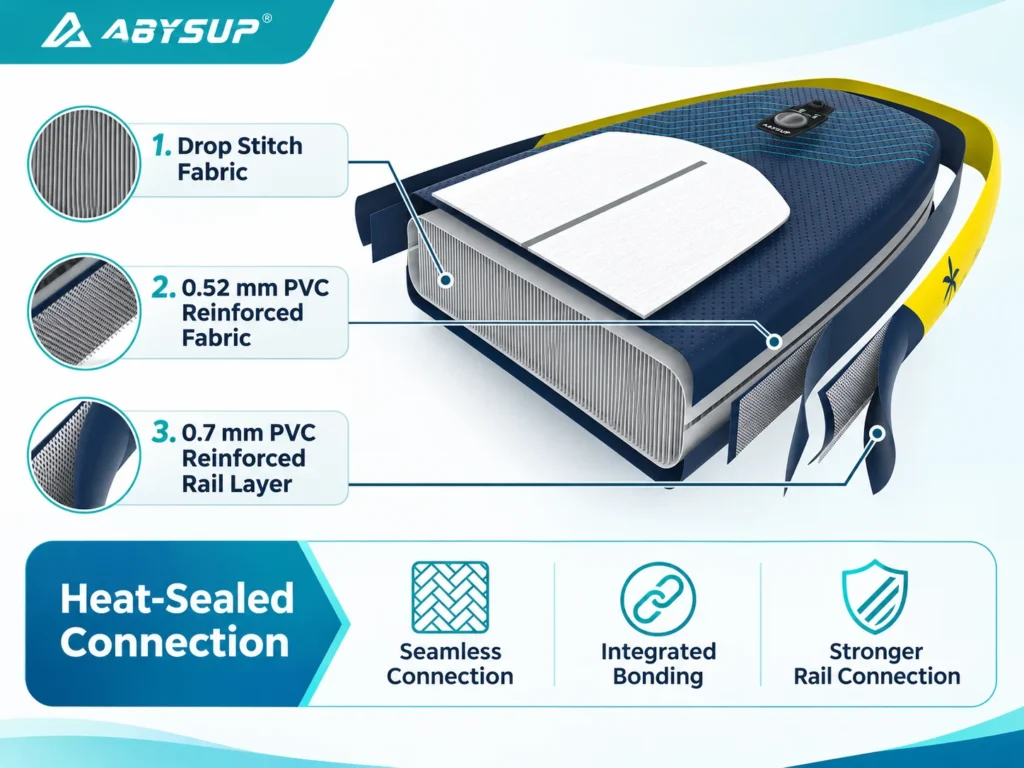
The ABYSUP factory construction illustration identifies three main material components. They are the Drop Stitch core, a PVC reinforced face layer, and a thicker PVC reinforced rail layer.
Each component has a different job.
The Three Main Components
- Layer 1: Drop Stitch Fabric
The internal structural core. Its connecting threads hold the upper and lower surfaces at a controlled distance during inflation. - Layer 2: 0.52 mm PVC Reinforced Fabric
The supplied ABYSUP construction diagram labels this as a 0.52 mm PVC mesh fabric or tarpaulin layer used in the main board construction. - Layer 3: 0.7 mm PVC Reinforced Fabric
The diagram identifies a 0.7 mm PVC mesh fabric or tarpaulin layer for the board’s edge or rail construction.
ABYSUP Structural Material Reference
| Component | Material | Thickness | Main Function |
|---|---|---|---|
| Internal core | Drop Stitch Fabric | Not specified | Connects upper and lower surfaces |
| Main skin layer | PVC Reinforced Fabric / Tarpaulin | 0.52 mm | Forms the main outer board layer |
| Rail layer | PVC Reinforced Fabric / Tarpaulin | 0.7 mm | Covers and reinforces the board edges |
Source: ABYSUP factory-provided structural illustration. The listed PVC thicknesses refer to the labeled materials, not the overall board thickness. Confirm applicability against the specific model specification.
These layers work together.
The internal fabric controls the board’s shape when inflated. The PVC material provides the outer structure and protection. The rails connect the board’s surfaces around the perimeter.
For buyers, this distinction is important. Asking about Drop Stitch density alone does not tell you everything about a board’s construction quality.
Why Does Drop Stitch Matter for SUP Performance?
A board’s internal structure affects how it behaves under a paddler’s weight.
However, inflatable SUP stiffness depends on more than the number of internal threads.
Inflation pressure, board thickness, width, material properties, rail construction, and overall geometry all contribute to the finished result.
1. Board Stiffness
A well-designed, fully inflated Drop Stitch panel can resist bending under weight.
This helps the board keep its intended shape when a paddler stands on the deck.
A board that flexes too much may feel less stable, especially when the rider moves to the nose or tail.
2. Stability and Load Distribution
The Drop Stitch core helps maintain the board’s cross-sectional shape.
However, overall stability also depends heavily on width, outline, thickness, and the paddler’s position.
For example, a wider All-Round board may offer more standing room than a narrow Touring board, even if both use similar internal fabric technology.
3. Paddling Efficiency
Excessive flex can affect how a board responds to a paddler’s weight and movement.
For longer-distance paddling, maintaining the intended board shape can help create a more consistent platform.
But Drop Stitch alone does not determine speed or tracking. Board length, nose shape, width, fin design, and rocker also matter.
What Does Scientific Research Tell Us?
A 2021 study in Thin-Walled Structures examined how inflatable Drop Stitch panels bend. It used physical tests and computational analysis.
The researchers studied how inflation pressure and panel shape affect stiffness and load capacity.
A 2023 study further examined bending, compression, shear deformation, and fabric wrinkling.
Both studies support an important engineering principle. Pressure and geometry matter, along with the fabric structure. Neither study should be seen as a direct performance test. They do not test ABYSUP paddle boards.
Read more: Experimental and Computational Assessment of the Bending Behavior of Inflatable Drop-Stitch Fabric Panels.
Single Layer vs Double Layer vs MSL Fusion Construction
Not all inflatable SUPs use the same outer-layer construction.
The three common approaches discussed in ABYSUP’s technical documentation are single-layer, hand-glued double-layer, and MSL Fusion.
The main difference is how the PVC materials are integrated with the Drop Stitch core.
Construction Comparison
| Construction | Manufacturing Method | Main Considerations |
|---|---|---|
| Single Layer | One PVC skin bonded to the Drop Stitch core | Lower weight and simpler construction |
| Hand-Glued Double Layer | Additional PVC layer applied with adhesive | Added reinforcement, but additional weight and adhesive quality matter |
| MSL Fusion | Machine lamination using heat and pressure | Integrates PVC layers without solvent-based glue between the fused layers |
A hand-glued double-layer board is not automatically poor quality. Its performance depends on the adhesive, application, material compatibility, and workmanship.
Likewise, Fusion construction is not automatically superior in every aspect. Temperature control, pressure consistency, material selection, and inspection still matter.
What Is MSL Fusion Technology?
ABYSUP describes MSL as machine-laminated single-layer.
In its published technical explanation, two PVC layers bond to the drop stitch core. This happens through a controlled heat-and-pressure process. No solvent-based glue is used between the fused layers.
The goal is to join the materials. It also reduces the need for traditional adhesive bonding.
For ABYSUP, this is an important part of its product construction approach.
You can read more about the process in our ABYSUP MSL Fusion construction guide.
How Heat Sealing Technology Works in SUP Manufacturing
Heat sealing is another important part of inflatable board manufacturing.
The process uses controlled heat and pressure to join compatible thermoplastic materials. When the materials are properly processed, they form a bonded connection.
ABYSUP’s supplied Heat Sealing Technology graphic highlights three intended features:
- Seamless connection: A more integrated connection between the relevant material sections.
- No glue: No adhesive in the specific thermal-fusion bond line shown.
- Stronger connection: The intended benefit of a properly controlled welded joint.
Why Does Seam Quality Matter?
The board’s perimeter is an important structural area.
It connects the upper and lower surfaces and helps contain the internal air pressure.
Poorly finished seams or inconsistent bonding can lead to air leakage and construction problems.
However, heat sealing alone does not guarantee that a board will resist every form of damage.
Material compatibility, welding conditions, joint preparation, and inspection all affect the result.
One point is worth making clear: heat-sealed construction should not be confused with a claim that every manufacturing operation uses no glue. Huale’s public factory documentation also describes adhesive assembly and bonding processes for inflatable products. The specific method must be identified for each board construction.
What About UV Resistance?
ABYSUP’s supplied graphic states that its heat-sealing technology does not deteriorate under UV exposure and can extend board life.
This is a product claim that should be supported by material or finished-board UV aging tests before being presented as a universal technical fact.
UV durability depends on the PVC formulation, coating, pigments, exposure conditions, and connection method.
For buyers, I would ask for the relevant test documentation rather than judging UV resistance from the welding method alone.
How Does ABYSUP Check Inflatable SUP Construction Quality?
Good materials are only one part of manufacturing.
A factory also needs to check whether the finished board matches the approved specifications.
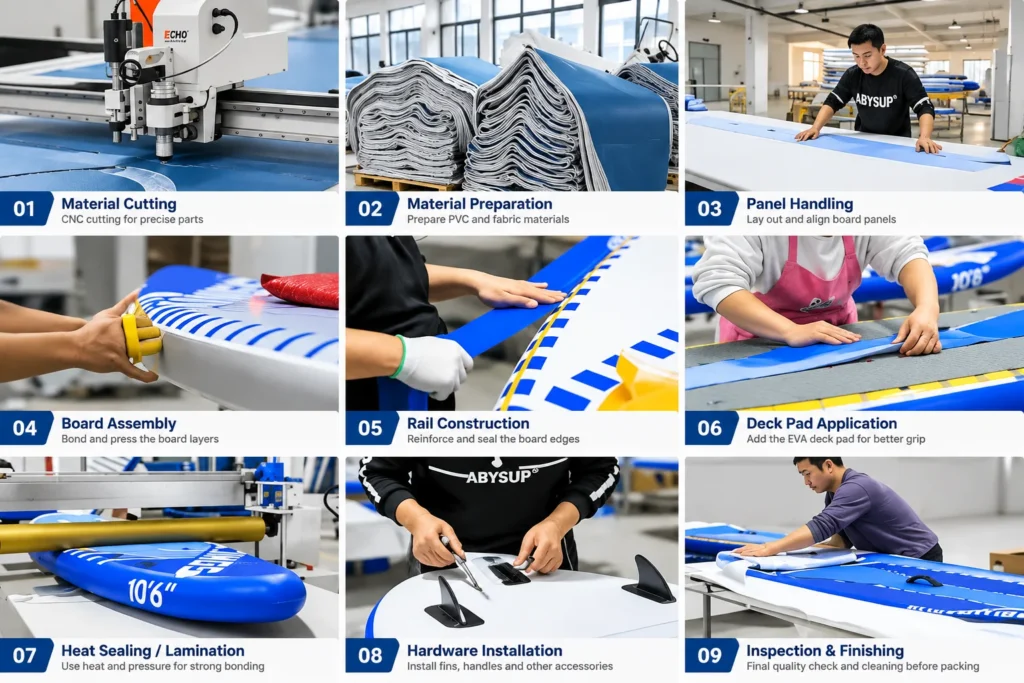
The Huale manufacturing facility that supports ABYSUP’s production publishes a series of SUP production and quality-control checkpoints.
These include inflation, board flatness, dimensional inspection, air-leak inspection, pressure retention, rail workmanship, and final finishing.
Key Factory Quality Checks
| QC Stage | What Is Checked | Why It Matters |
|---|---|---|
| Material inspection | PVC and Drop Stitch materials | Confirms incoming material specifications |
| Inflation and valve check | Valve installation and board shape | Identifies visible inflation problems |
| Flatness inspection | Surface alignment and board profile | Checks structural consistency |
| Dimensional check | Length, width, and thickness | Confirms the approved specification |
| Air-leak inspection | Suspected leakage areas | Checks airtight construction |
| Pressure retention | Pressure over an observation period | Identifies possible pressure loss |
| Rail and seam inspection | Edge bonding and visible connections | Checks construction workmanship |
| Final finishing | Surface, hardware, and appearance | Prepares the board for packing |
The Huale factory page also lists 24-hour inflation QC testing among its manufacturing capabilities. The exact pressure, holding time, and acceptance criteria should be confirmed for the specific SUP model and production order.
This matters to distributors because consistent quality across repeat orders is just as important as the quality of an individual sample.
For more information about the manufacturing facility and its production process, visit Huale Paddle Board Factory.
How to Evaluate Drop Stitch Quality Before Buying
If you are purchasing SUP boards for your store or distribution business, I would not make a decision based on a single specification.
Ask the manufacturer how the complete board is constructed.
1. Ask About the Internal Fabric
- What material is used for the connecting threads?
- How is thread density measured?
- Is the density specification consistent across the models you plan to order?
2. Check the PVC Layers
- What is the thickness of each reinforced PVC layer?
- Are the measurements based on the finished material or the base fabric?
- What coating and reinforcement materials are used?
3. Understand the Bonding Method
- Are the layers hand-glued or machine-laminated?
- Which joints use heat welding?
- Are adhesive and thermal bonding used in different areas of the same board?
4. Request Quality-Control Evidence
- Is there an inflation and pressure-retention procedure?
- How are dimensions and board flatness checked?
- Are rail connections and seams inspected?
- Can the factory provide model-specific material and test reports?
A reliable supplier should be able to explain these details without relying only on phrases such as premium quality or military-grade materials.
How ABYSUP Applies Drop Stitch Technology Across Its SUP Range
Different paddling activities place different demands on a board.
That is why board construction should be considered alongside length, width, thickness, and intended use.
ABYSUP’s range includes several product directions.
Lightweight SUP
The ABYSUP Lightweight Series includes boards weighing approximately 18.7 lbs (8.5 kg).
This range focuses on reducing carrying weight while retaining a practical inflatable construction.
The published specifications describe MSL Fusion construction and a high-density Drop Stitch core.
See the ABYSUP Lightweight SUP Series.
All-Round SUP
All-Round boards are designed for general recreational paddling.
Their dimensions and shape focus on a balance between standing space, stability, and everyday handling.
Touring SUP
Touring boards are designed for longer paddling routes.
Length, board outline, directional tracking, and longitudinal stiffness all influence the finished design.
XL Stability SUP
Wider, higher-capacity boards need to be evaluated as a complete structural system.
Board width, thickness, material reinforcement, and load distribution all contribute to their intended use.
For distributors, the important point is that the same basic Drop Stitch principle can support different product designs. The final performance comes from how the core, materials, board shape, and manufacturing process work together.