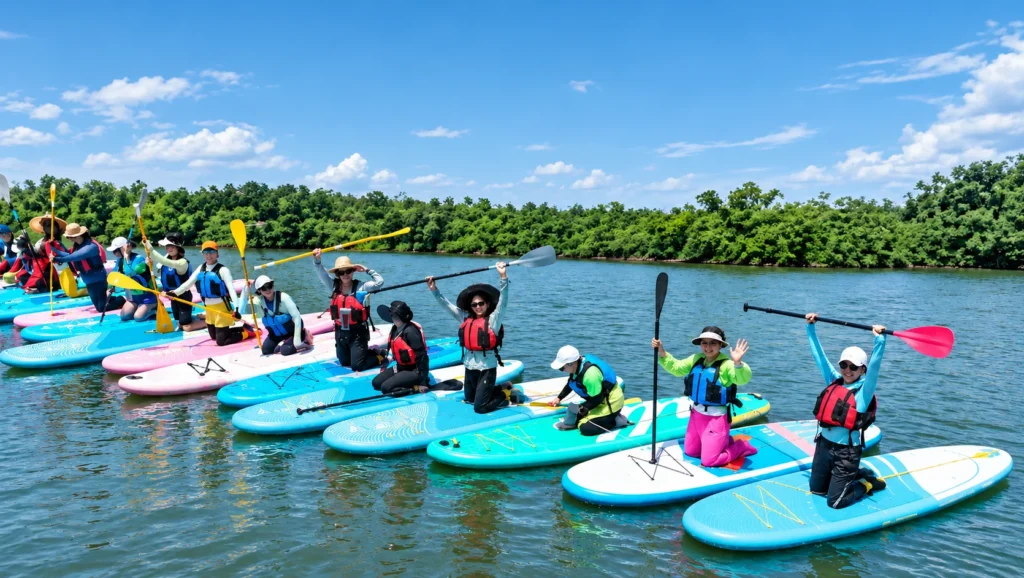
By Allen Xiao | Senior Industrial Designer at ABYSUP
Introduction
I’m Allen Xiao, Senior Industrial Designer at ABYSUP. My work focuses on inflatable SUP design, from board construction and dimensions to the small details that affect how people use a board on the water.
One thing I always consider when looking at a paddle board is how it will actually be used. A board may look great on a product page, but its design, accessories, and safety setup all matter once it reaches the water.
Before you take an inflatable paddle board on the water, there is one key question worth answering: do you need a life jacket, whistle, or other safety gear?
The answer depends in part on where you paddle. Under US Coast Guard rules for SUP, a stand-up paddleboard may count as a recreational vessel. This applies when you paddle outside a marked swimming, surfing, or bathing area. When that happens, federal boating rules can apply.
This surprises some beginners. They may think a paddle board is not like a kayak or small boat because it has no motor. Legally, though, a human-powered board can still fall under federal boating rules.
I’ve always seen safety gear as part of choosing the right SUP. It is not something to think about after you buy one. A board that works well on a calm lake may be used elsewhere soon. It could face very different conditions just weeks later.
In this guide, I’ll explain which rules matter, what equipment to carry, and what I would check before launching a paddle board in the United States.
When Is a Paddle Board Considered a Vessel Under U.S. Law?
Not every paddle board is treated as a vessel in every situation. The important factor is where you use it.
The U.S. Coast Guard says a SUP outside a swimming, surfing, or bathing area counts as a vessel. Under federal law, it is treated as a vessel. This means federal boating safety rules may apply. This can apply even with a light inflatable board and one paddle.
Where Does the Vessel Rule Apply?
- Designated swimming areas: A board used within the narrow limits of a designated swimming, surfing, or bathing area generally falls outside this vessel classification.
- Open lakes: If you paddle away from a designated swimming area, vessel requirements generally apply.
- Rivers and coastal waters: SUPs used outside designated swimming or bathing areas are generally subject to applicable boating rules.
For example, someone paddling near a marked swimming beach may face different legal rules.
This differs from someone crossing a large lake or exploring a coastal bay.
Do not assume a short trip or a small board automatically qualifies for an exemption.
You can check the official U.S. Coast Guard Boating Safety FAQs for its guidance on paddleboard classification.
SUP Life Jacket Requirements: Do You Need a PFD?
Yes. If your paddle board counts as a recreational vessel, federal rules usually require a wearable PFD.
You must have one approved wearable PFD for each person onboard. This is a key SUP life jacket rule to know before you go out.
Under 33 CFR §175.15, each recreational vessel must carry a wearable PFD for every person onboard.
Some specific exemptions may apply.
Each PFD must be used as the approval label and instructions require.
What Are the Federal SUP PFD Requirements?
For a typical recreational SUP, the main requirements are straightforward.
- One wearable PFD per person: Every person onboard must have an appropriate Coast Guard-approved wearable PFD available.
- Correct size: The PFD must be suitable for the intended wearer.
- Good condition: Check straps, buckles, fabric, inflation components, and other parts before use.
- Children under 13: Children generally must wear an approved PFD while the vessel is underway, unless a specific federal exception applies. State rules may be stricter.
- Throwable PFD: The additional throwable-device requirement generally applies to recreational vessels 16 feet or longer. A typical SUP is shorter, but always check the actual vessel length and applicable exceptions.
| Requirement | Federal Rule | Practical Advice |
|---|---|---|
| Wearable PFD | One per person onboard | Carry one correctly sized PFD for each paddler |
| PFD condition | Must meet approval requirements | Inspect before every trip |
| Children under 13 | Generally must wear an approved PFD underway | Check state-specific child requirements |
| Throwable PFD | Generally required for vessels 16 feet or longer | Check vessel length and exemptions |
Source: 33 CFR §175.15 – Personal Flotation Devices Required.
Which PFD Should You Choose for Paddleboarding?
I would start with fit and comfort rather than price.
A bulky life jacket can limit your arm movement and make paddling uncomfortable.
A well-fitted paddling PFD should let you rotate your upper body and reach forward.
You should not need to adjust the straps often.
Consider these options:
- Type III PFD: Often a practical choice for recreational paddling. Look for a model approved for the intended activity.
- Inflatable PFD: Takes up less space, but check its age, weight, approval, and maintenance restrictions. USCG guidance generally limits approved inflatable PFD use to people over 16 and over 80 pounds, subject to the specific label.
- Special-purpose PFD: May suit particular activities, but confirm its approval and intended use.
My recommendation is simple: try the PFD on before buying it. Sit, rotate your shoulders, and imitate a normal paddling stroke. If it keeps riding up or restricts your movement, choose another model.
“When I look at a complete SUP package, I separate convenience accessories from essential safety equipment. A leash can help keep your board close in suitable conditions, but it is not a replacement for a life jacket. A pump, paddle, fins, backpack, and repair kit make the setup more practical. They do not automatically make the board ready for every waterway. Always check what comes with your board and what you still need before launching.”
— Allen Xiao, Senior Industrial Designer at ABYSUP
SUP Whistle Requirements: Is a Sound Signal Necessary?
A whistle is easy to miss because it is small and low-cost. However, it can matter when you need to warn another water user.
Federal navigation rules say vessels must have an effective way to make a sound signal. For vessels under 12 meters (39.4 feet), the rules do not require a formal whistle device. They do require another effective way to make a sound signal.
For most recreational paddleboarders, a simple handheld whistle is a practical choice.
What Makes a Good SUP Whistle?
- Easy to reach: Attach it to your PFD rather than storing it inside your backpack.
- Reliable sound: Choose one that can be heard over wind and nearby boat noise.
- Water resistance: It should work after repeated exposure to water.
- Secure attachment: A clip or lanyard helps prevent accidental loss.
A whistle is not expensive, and it takes almost no room. I would rather have one attached to my PFD than discover I need it while it is packed away.
Paddle Board Navigation Lights: Can You Paddle at Night?
Night paddling needs more planning than most beginners expect.
Navigation rules apply to vessels from sunset to sunrise. They also apply during times of poor visibility. The exact light setup depends on how the vessel is classed and used.
For a human-powered SUP, the rules for vessels under oars matter most. Under Rule 25(d), a vessel under oars may show the required sailing-vessel lights. Or, it may use an all-round white light. It may also keep an electric torch or a lighted lantern ready at hand. The light must show white and warn other vessels in time to avoid a collision.
What Should You Check Before Paddling After Sunset?
- Make sure the required light is available and working.
- Keep a white light within immediate reach.
- Avoid busy navigation channels and poorly lit areas.
- Check local restrictions on nighttime paddling.
- Do not assume that a small decorative LED light meets navigation requirements.
A flashlight is useful, but it needs to be suitable for the purpose and ready to use. A light buried at the bottom of a dry bag will not help when another boat approaches.
My advice is to plan SUP trips during daylight. Only consider night paddling when you know the navigation rules and have the right equipment.
SUP Leash Safety: Is a Leash Required by the Coast Guard?
A leash is one of the most useful paddle board accessories, but it is not the same as a federally required PFD.
There is no universal federal Coast Guard rule requiring every recreational SUP paddler to wear a leash in every environment.
However, leash choice matters. A leash that works well on a calm lake may become dangerous in moving water.
When Should You Use a Paddle Board Leash?
- Calm lakes: A suitable leash helps prevent the board from drifting away after a fall.
- Sheltered bays: Wind and boat wakes can pull you away from your board, so a good leash can add extra control.
- Rivers: Be careful. A leash can snag on rocks, branches, or other obstacles and cause an entrapment hazard.
- Surf conditions: Use a leash made for your activity. Learn how the board moves in waves.
There is one point I always emphasize: your leash should match the water, not just the board.
A leash is not a substitute for a PFD. It also does not make rough water safe for an inexperienced paddler.
State Boating Laws: Do Paddle Board Rules Differ by Location?
Yes. Federal regulations provide a baseline, but they are not the only rules you need to consider.
Individual states, counties, parks, and waterway authorities may have extra rules. These rules can affect where you launch. They can also affect whether children must wear life jackets. They may limit which areas are open to paddleboards.
| Rule Category | What to Check | Where to Check |
|---|---|---|
| Life jacket laws | Child age limits and wearing requirements | State boating authority |
| Launch restrictions | Approved launch points and prohibited areas | Local parks |
| Operating rules | Restricted zones and navigation requirements | Local boating authority |
| Permits | Launch permits and access fees | State and local authorities |
| Night paddling | Lighting requirements and access restrictions | Local waterway manager |
For example, a lake inside a state park may have different access restrictions from a public coastal beach.
Before traveling, I would check the official state boating website and the rules posted at the launch location. Do not rely on advice from another paddler who may be using a different waterway.
Why Wearing a Life Jacket Matters: What the Data Shows
Legal requirements are important, but there is also a practical reason to take them seriously.
The U.S. Coast Guard’s 2024 Recreational Boating Statistics reports 556 deaths in 2024. In cases where the cause of death was known, 76% involved drowning. Among drowning victims with known PFD use, 87% were not wearing a life jacket.
These are boating-wide statistics, not SUP-specific figures. Still, they show why PFD use matters for all types of recreational watercraft.
U.S. Recreational Boating Safety Data (2024)
Fatalities involving drowning
76% — ██████████████████████████████████████
Drowning victims not wearing a PFD, where usage was known
87% — ███████████████████████████████████████████
Source: U.S. Coast Guard, 2024 Recreational Boating Statistics. The two percentages use different denominators and should not be compared as measurements of the same group.
The numbers make one thing clear: simply carrying a life jacket is not the same as wearing one.
If you fall into cold water, get separated from your board, or face sudden conditions, a well-fitted PFD can save your life.
Paddle Board Safety Equipment: A Practical Pre-Launch Checklist
Before launching, I recommend checking the board, accessories, and weather together.
A good board cannot compensate for a damaged valve, a missing fin, or a poor route choice.
| Safety Check | What to Confirm |
|---|---|
| PFD | Correct size, Coast Guard approval, and good condition |
| Whistle | Attached securely and easy to reach |
| Leash | Suitable for the water environment |
| Board | No visible damage or air leaks |
| Inflation pressure | Within the manufacturer’s recommended range |
| Fin | Properly installed and secured |
| Paddle | Sections lock securely |
| Weather | Wind speed, direction, waves, and water temperature |
| Communication | Phone or emergency communication device protected from water |
| Route | Launch point, return route, and expected trip duration |
Two checks deserve extra attention.
First, look at the wind direction, not just the wind speed. An offshore wind can make returning to shore much harder than expected.
Our Paddle Boarding Wind Speed Guide explains how wind affects paddling conditions and route planning.
Second, inspect your inflatable SUP often. Check the seams, valve, fins, and outer material. Fix small problems before you launch.
You can also refer to our Inflatable Paddle Board Maintenance & Repair Guide for practical inspection and maintenance advice.
What Accessories Should Come With an Inflatable SUP?
When buying an inflatable SUP, I would look beyond the board itself. The accessories included in the package can make a real difference in how easy the board is to transport, set up, and maintain.
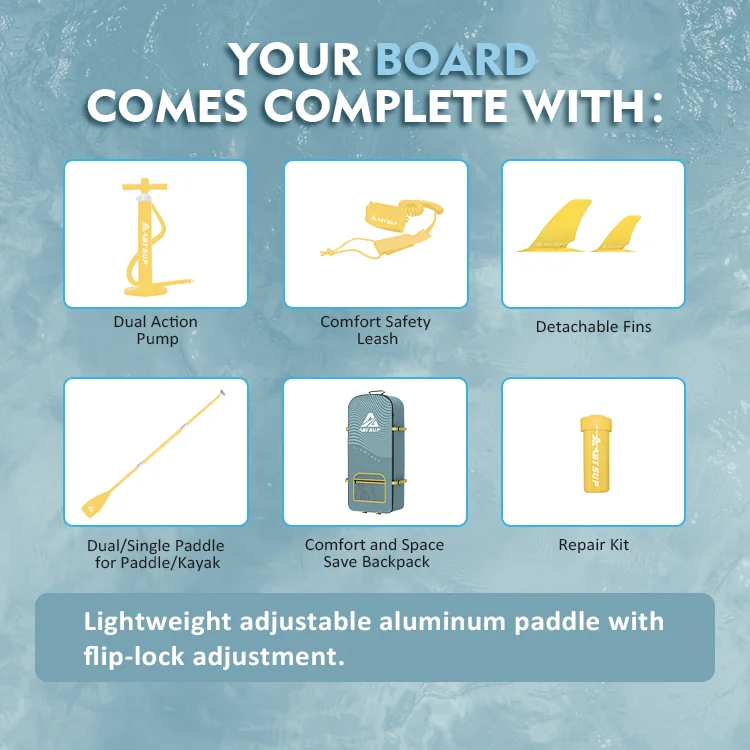
A complete ABYSUP paddle board package includes several practical accessories:
- Dual-action pump: Helps inflate the board efficiently before heading out on the water.
- Comfort safety leash: Helps keep the board close after a fall. Always choose a leash suited to the water conditions.
- Detachable fins: Help the board maintain directional stability and can be removed for easier storage.
- Adjustable aluminum paddle: Features flip-lock adjustment, allowing paddlers to set a suitable paddle length.
- Carry backpack: Makes it easier to transport and store the deflated board and its accessories.
- Repair kit: Provides basic supplies for dealing with minor repair needs, following the manufacturer’s instructions.
These accessories meet several practical needs, from inflation and paddling to transport and basic care. However, a standard accessory package is not a full safety kit.
You may still need to buy a Coast Guard-approved PFD separately. You may also need an approved sound-signaling device. This depends on local boating rules.
Choosing the Right SUP Safety Equipment for Different Paddlers
Not every paddler needs the same setup.
A beginner who spends an hour on a calm lake has different needs than an expert on a long coastal trip.
When I review a board for a customer, I check the full setup, not just length or listed capacity.
What Should Beginners Prioritize?
- A stable board with suitable width and weight capacity.
- A properly fitted, approved wearable PFD.
- A whistle attached to the PFD.
- A leash suitable for the intended water conditions.
- A secure way to carry a phone and essential items.
For example, an All-Round SUP is often a good starting choice for calm, sheltered water paddling. Its flexible shape and deck space suit beginners and casual users.
From a design perspective, I don’t think one SUP should be expected to perform equally well in every situation. An All-Round board is a practical choice for general recreational paddling, while a Touring SUP is better suited to paddlers who spend more time covering longer distances.
The same thinking applies to accessories. A wider board may provide more standing space, but the right paddle length, fin setup, and carrying system also affect the overall experience.
When I evaluate a board, I look at how all these components work together. The goal is not to add as many features as possible. It is to make sure the board and its accessories suit the paddler’s actual needs.
A Touring SUP is built for longer routes and straight tracking. But a touring shape is not right for all coastal conditions.
[PRODUCT IMAGE NOTE] Insert an authentic ABYSUP All-Round SUP lifestyle photo. Show a paddler wearing a life jacket while using the board on calm lake water.
What Should Retailers and Distributors Consider?
For businesses selling inflatable SUPs, safety information is also part of product education.
Customers often compare board size, weight limit, build quality, and accessories.
They may not know which safety gear is required.
They may also not know which accessories fit different water conditions.
I would recommend organizing product information around three practical questions:
- Where will the customer use the board?
- What type of paddler will use it?
- What equipment is needed for that environment?
A retailer serving lake users may focus on All-Round and family boards. A coastal retailer may need products for skilled paddlers and longer routes.
ABYSUP offers All-Round, Touring, Lightweight, and high-capacity inflatable SUP models. These models suit different paddling needs. The key point is to match the model’s specs to the intended use. Do not rely on broad marketing claims.
Frequently Asked Questions About U.S. Paddle Board Laws
Do I Need a Life Jacket on an Inflatable Paddle Board?
Generally, yes. If you use an inflatable SUP outside a marked swimming, surfing, or bathing area, it counts as a vessel. Under federal rules, you must carry one approved wearable PFD for each person on board.
Can I Paddle Board Without a Life Jacket in the United States?
It depends on where you paddle and which rules apply. The designated swimming, surfing, or bathing area exception can affect federal vessel classification. State and local requirements may still apply. Wearing a PFD is strongly recommended regardless of the location.
Is a Whistle Required on a SUP?
A SUP classified as a vessel must have an efficient means of making a sound signal under applicable navigation rules. For a board shorter than 12 meters, a handheld whistle is a practical option.
Do I Need a Leash on My Paddle Board?
There is no universal federal Coast Guard leash requirement for every recreational SUP situation. A suitable leash can help prevent separation from the board, but in rivers and moving water, entanglement risks must be considered.
Can I Use My Paddle Board at Night?
Night operation must follow navigation-light rules. A human-powered paddleboard may follow rules for vessels under oars. Check the proper lighting rules and local limits before paddling after sunset.
Know the Rules Before Your Next Paddle
Understanding paddle board laws in the US is not difficult once you know which requirements apply to your situation.
The main things to remember are:
- Know when your SUP is considered a vessel.
- Carry the required Coast Guard-approved PFD.
- Keep an effective sound signal within reach.
- Understand the applicable nighttime lighting rules.
- Check state and local restrictions before launching.
- Choose a leash and other accessories that suit the water conditions.
As a designer, my advice is to look beyond the board itself. Think about where you will paddle, how far you plan to go, and what equipment you need for those conditions.
A good SUP setup is not just about the board’s dimensions or construction. It is about how the board, accessories, and safety equipment work together.
Whether you are buying your first inflatable SUP or selecting products for your retail business, understanding these details will help you make a better decision.
— Allen Xiao
Senior Industrial Designer at ABYSUP