
Imagine having the opportunity to spend your vacation next to a peaceful lake or along a gorgeous beach. You have plenty of time to explore the waters; however, finding a rental paddle board may not always be easy. If you bring along your own paddle board, you will find that it will make your trip much more enjoyable.
However, the issue is with respect to transporting the board. A typical hard paddle board requires a lot of room. Additionally, even though an inflatable stand up paddle board (iSUP) is lighter than a traditional hard paddle board, it must still be light enough to allow you to transport it and small enough so that it fits inside your suitcase with your other belongings.
Therefore, this is where a travel iSUP becomes advantageous. An appropriate iSUP allows you to participate in stand up paddle boarding during road trips, weekend camping trips and vacations at lakes without having the equipment become the most difficult aspect of the trip.
So then what is the maximum weight of an iSUP? Is the size of the iSUP after being deflated more important than its weight? Also, can an iSUP truly be flown on an airplane?
In order to answer these questions let’s examine practical factors, actual product specifications and essential items needed for travel that will enable you to make a more informed decision.
Why Bring Your Own Paddle Board on Vacation?
If you own a paddleboard, you have the ability to choose your own times to go out on the water and the locations from which you will launch. This means you do not have to rely on what is available at the local rental shop, nor do you need to look for a place that rents paddleboards.
Inflatable boards are a great solution for the most common problem when traveling with paddleboards – transportation. When you let the air out of the board, you can roll it up and store it in its own special backpack. This allows you to easily transport the board to and from your accommodations, your car or truck, and any nearby body of water.
Three Practical Benefits
- Flexible: You can take your gear to other bodies of water (i.e. lakes, ocean) and different types of coastal environments than just the ones where you could rent equipment.
- Less space pressure: A deflated board will take less space than an inflated/rigid paddle board and therefore can be stored more easily in either a vehicle or at home.
- Your Own Gear: You are already familiar with your board, paddle, and other accessories. Therefore, there will be less worry regarding the condition of your gear and how it has been set up.
What Does the Paddlesports Market Tell Us?
The Outdoor Industry Association’s 2026 Paddlesports Report provides useful context for the wider paddling market.
| Industry Indicator | Reported Figure | Period |
|---|---|---|
| U.S. paddlesports participation | 34 million+ | 2025 |
| Additional participants | 446,000 | 2024–2025 |
| Stand-up paddling participation growth | 5.8% | Three-year period |
| Casual paddlers | Approximately 85% | Fewer than 8 outings annually |
Source: Outdoor Industry Association – 2026 Paddlesports Report.
These figures describe the wider U.S. paddlesports market, not travel SUP sales.
A critical aspect of the findings is that the majority of paddlers engage in this activity on a periodic basis, as opposed to a regular basis. Therefore, there appears to be a potential area of opportunity for paddle sport brand organizations to create products/services that will allow paddlers to incorporate the use of their product/service into their daily leisure time activities and/or vacation time.
The study does not show that the participants want to use a board designed specifically for traveling. However, product features like being able to transport easily, and the convenience of traveling with the board would be appropriate to consider for people who paddle on an infrequent basis.
What Makes a Paddle Board Travel-Friendly?
A comparison of inflatable stand up paddleboards (SUPs) should consider more than just how lightweight a board is as indicated on its label when evaluating convenience for traveling.
Board Weight vs. Complete Kit Weight
While board weight is an excellent starting point, it does not provide insight into what your equipment weight will look like once you have left your residence.
- Check the board’s published weight.
- Include the paddle, pump, back pack, fin, and repair kit to determine the overall weight of your load.
- Consider how far you need to carry the complete package.
When comparing the weight of a 17-pound board with other boards, always compare “like for like.” Even though you have a 17-pound board, it could be much heavier when you pack all of your travel gear.
Packed Dimensions and Backpack Design
The size of the deflated board determines whether or not it will be able to easily fit inside of your car, or in your luggage. Also, if you use a quality designed backpack to carry the board, this can make a big difference in the amount of effort required to walk from your car to the water.
- Look for comfortable shoulder straps and practical storage compartments.
- Check whether the pump and paddle can fit inside the bag.
- Measure the dimensions of your packed bag instead of assuming all inflatable paddleboards will be stored with the same size.
Stability, Size and Rider Requirements
A smaller board can make it easier to turn and carry; however, a rider’s ability to ride comfortably should never be sacrificed for portability.
Take a look at the board’s dimensions (width, length and thickness), along with its suggested maximum rider weight. Before you make your selection, take into consideration how much you weigh, what type of gear you plan to carry, and where you intend to paddle.
Construction and Durability
The way travel gear is constructed (i.e. boards) is as important as its weight. Travel gear gets packed, unpacked and transported repeatedly.
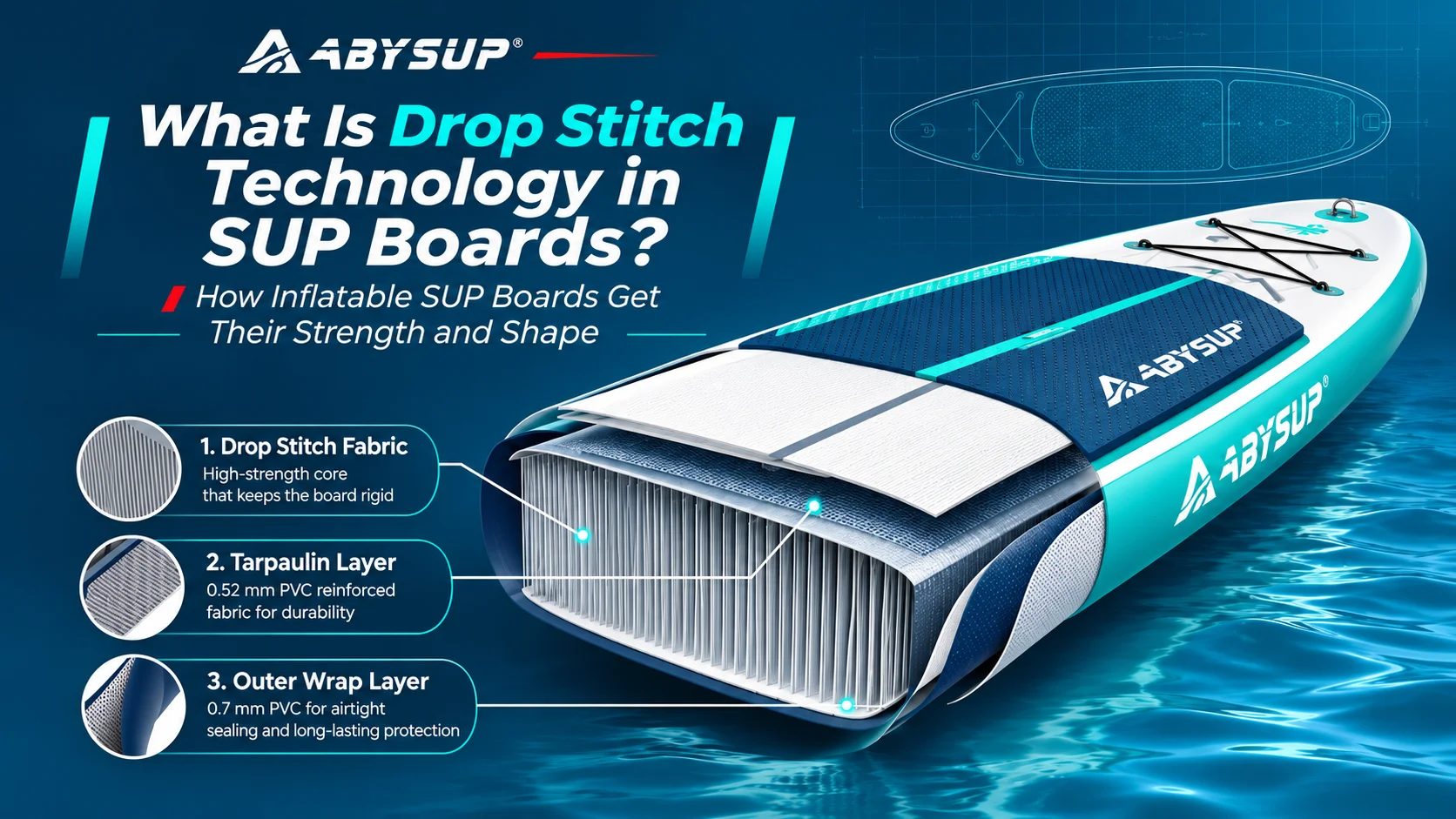
- Check the quality of the PVC outer material.
- Look for reliable drop-stitch construction.
- Inspect the seams, valves and rail reinforcement.
- Follow the manufacturer’s recommended inflation pressure.
A light weight board will still need to have enough stiffness and strength to support the application it is being used for.
How to Travel With an Inflatable SUP
The type of transportation that would be best for you will depend on where you are going. If you use a skateboard to go to school every day and want to take it on a road trip, you can probably just throw it into the back of your car. However, if you plan to fly with your skateboard or hike with it, then you will have to plan ahead.
Road Trips: Use Your Available Storage Space
An inflatable board is easy to travel with for road trips. You simply deflate the board, allow it to dry thoroughly, then pack it away in the provided backpack so you can put it in your car’s trunk.
- Measure your available trunk space before leaving.
- Keep the pump and small accessories together.
- Avoid leaving a wet board sealed inside its bag for extended periods.
Air Travel: Check the Airline Before Booking
An inflatable board can be packed in a travel bag, however, this doesn’t necessarily mean it is accepted as a standard check-in item.
Airlines establish their own limits for the dimensions, weight, and fees associated with checked luggage. In addition, the type of aircraft being used and whether there are any connecting flights may determine which items you will be able to check.
The U.S. Department of Transportation’s baggage guidance recommends checking the specific airline’s requirements rather than assuming one standard applies to every flight.
Before travelling:
- Measure the complete packed bag.
- Weigh the board and all accessories together.
- Check oversized and overweight baggage fees.
- Confirm the rules with every airline operating your journey.
Hiking and Camping: Think About the Distance
If you have to hike from the trailhead to a lake for your trip, every pound counts. Having a lighter board will help with the hike, however, the pump and paddle will add to the weight of your gear.
When planning for a camping trip, make sure to take into account the amount of space that the game board and all of the rest of your camping gear (including your tent, sleeping bag and personal items) will require in addition to each other.
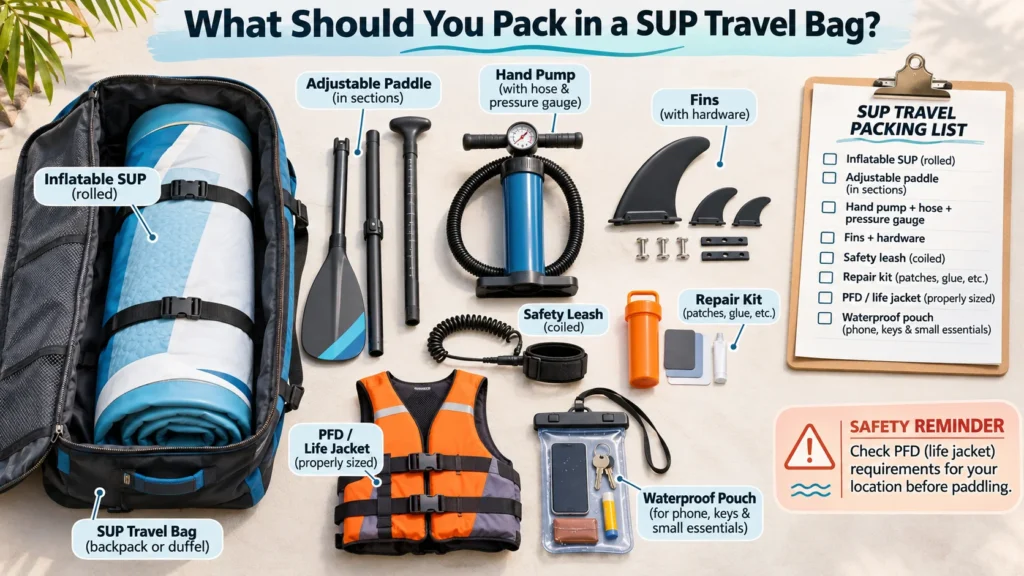
What Should You Pack in a SUP Travel Bag?
To prevent minor omissions from ruining your vacation, be sure you have properly prepared. Check your equipment prior to departure to ensure all components are present and compatible with the water environment.
Essential Equipment Checklist
- Inflatable SUP: Check the board for visible damage before packing.
- Adjustable paddle: Make sure all sections lock securely.
- Hand pump: Confirm that the hose and pressure gauge work.
- Fins: Pack the correct fin and its attachment hardware.
- Safety leash: Check its condition and suitability for the water environment.
- Repair kit: Bring the basic supplies recommended by the manufacturer.
- Personal flotation device: Choose an appropriate, correctly sized PFD.
- Waterproof storage: Protect your phone, keys and essential personal items.
A properly sized personal floatation device (PFD) is one aspect of being safe while paddling. The U.S. Coast Guard has stated that if a stand-up paddleboard (SUP) is being ridden in areas other than those that are strictly designated for swimming, surfing or bathing then it is typically viewed as a vessel, and the appropriate life jacket regulations should be reviewed.
Check out the U.S. Coast Guard’s boating safety FAQs and find out what rules apply to where you plan to go.
For a more thorough way to pack, create a checklist of items prior to sealing your inflatable paddle board travel case. Keep all of your small accessories in one place for ease of access once you arrive at the water.
ABYSUP Travel-Friendly Boards: A Comparison Using Real Specifications
The product specifications will give you a better idea of how each product compares to other products on the market. There are two different ABYSUP models that have published weight and dimension data that can assist in illustrating what to consider when comparing products.
| Specification | 10′ Ultra-Light Sport | 10′ Compact Agility |
|---|---|---|
| Length | 10′ | 10′ |
| Width | 31″ | 31″ |
| Thickness | 6″ | 6″ |
| Published Board Weight | 17.2 lbs / 7.8 kg | 17.6 lbs / 7.9 kg |
| Design Focus | Fitness and responsive paddling | Agility and compact handling |
Source: ABYSUP product specifications. These figures represent board weight only, not the complete packed kit.
How Much Difference Does Board Weight Make?
The difference between these two models is just 0.4 lbs, or approximately 0.18 kg. That is a relatively small difference. It shows why choosing a board based on weight alone can lead to the wrong decision.
ABYSUP Published Board Weight Comparison
Scale: 0–20 lbs. Board weight only.
- Ultra-Light Sport: 17.2 lbs — █████████████████
- Compact Agility: 17.6 lbs — ██████████████████
The graph shows a comparison between the published specifications for the ABYSUP model. It does not reflect all equipment or the total weight of the pack.
The Ultra-Light Sport emphasizes on fitness and response of the paddle, while the Compact Agility is designed for the turns and control that can be achieved in a small 10 foot kayak.
Both models should not be chosen just because they are lighter. There are several factors that are more important when choosing a model such as rider needs, types of water being ridden in, amount of storage space needed and total gear carried.
For more product options and specifications, see the ABYSUP Lightweight & Agile Series.
What Travel-Friendly SUPs Mean for Retailers
Retailers who sell Stand Up Paddleboards (SUPs) have an opportunity to position their products with a clear message by offering lightweight and portable SUP boards.
Participation data for the OIA indicates that the majority of people who use kayaks/canoes/paddleboards (paddlers) do so only occasionally. Therefore, retailers should consider offering products that help lower barriers to entry into paddling.
A Well-Planned Product Assortment Can Include:
- Lightweight models: For customers who prioritize carrying convenience.
- All-Round models: For recreational users who want a versatile board.
- Touring models: The touring model is designed for the customer that wants to paddle for long periods of time and wants a boat that tracks straight.
Before making a decision on what model will best serve your customer base, you need to look at each model’s actual board weight, total kit weight, packaging size, construction method, and rider capacity.
Product differentiation and product specifications are equally as important to distributors and retailers when considering whether to add a new inflatable SUP brand to their product line up as the cost of the products. ABYSUP offers multiple board categories and dealer partnership options depending on the type of retail market.
Frequently Asked Questions
Can I Take an Inflatable SUP on a Plane?
Yes, it may be possible to pack your inflatable stand-up paddleboard (iSUP) as checked baggage. This will depend upon whether the airline you are traveling with has policies that allow for this type of item to be transported as luggage.
It is important to measure and weigh the complete package including the iSUP itself, paddles, pump, fins, etc., prior to leaving for the airport. Also, contact each airline that you plan to travel with to find out about any additional charges or restrictions for packing such items.
How Heavy Should a Travel Paddle Board Be?
A travel board does not have a single weight limit. Lightweight models that weigh between 17 and 20 pounds are good reference points for comparison with other lightweight boards. However, the total weight of the board plus all your gear is what matters most when you are walking with your gear for extended periods of time.
Is a Compact Paddle Board Suitable for Beginners?
It is possible, as long as it has a width, shape, and weight capacity that are suitable for the rider. Beginners will find it much more important to choose a board that provides stability and has the right capacity for them than to simply pick the smallest or lightest board on the market.
Can I Use a Travel SUP in the Ocean?
Yes, but the board needs to fit the conditions. Before going into the water, check the wind, waves, currents, tides, and how long you’ve been paddling. A lightweight board isn’t necessarily appropriate for rough coastal waters.
Make More Room for Paddling on Your Next Vacation
A quality vacation board will provide you with an easy way to travel while maintaining the quality of your riding experience. There are several factors to take into account when choosing a vacation board, including: board weight; packability (dimension); stability; construction; and accessaries.
Start by determining where you will be traveling to, and the type of transport (i.e. car, plane) that you will use to move your equipment. Next, compare real-world specs, such as weight, volume, and material, instead of comparing marketing labels.
Whether you are looking for a relaxing lake vacation, a holiday at the coast, or simply want to go on a short weekend camping trip; the perfect inflatable SUP will allow you to pack your paddle and head off.
Looking for a Lightweight SUP Product Range?
ABYSUP collaborates with both retail stores and distribution companies who wish to create an inflatable paddleboard selection that is distinct from their competitors. Discuss with us the products’ details and your potential dealership opportunities.
Explore the ABYSUP Dealer Program: