You’ve found a paddle board that looks good. The colors work, the price fits your budget, and the supplier has sent over some nice product photos.
But will it hold air? Will the fin fit properly? And will the 100 boards you order actually match the sample sitting in your office?
Those are the questions worth asking before you place a wholesale order.
This inflatable SUP quality checklist walks through the things retailers should look at before buying: board construction, air leaks, accessories, packaging, and the documents that back up a supplier’s claims. Nothing complicated. Just the checks that can save you a lot of trouble later.
What Should Retailers Check First?
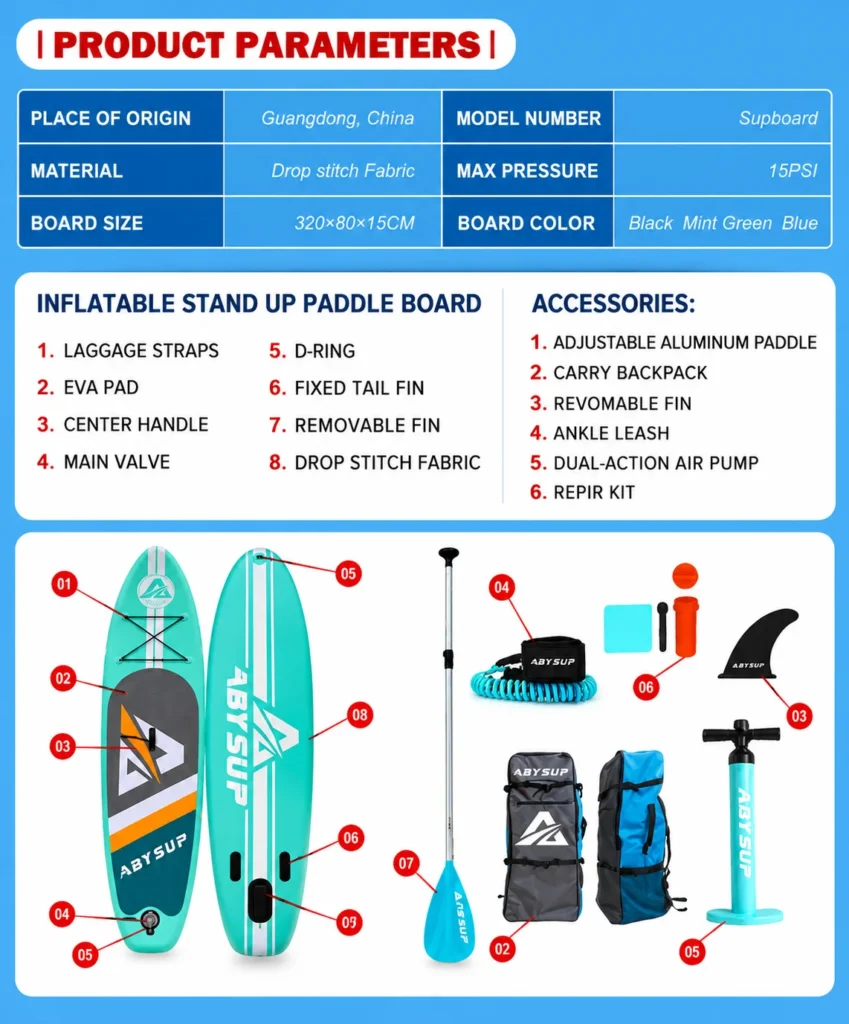
Get the specification sheet before you inspect anything. It should tell you the board’s dimensions, weight, recommended pressure, maximum pressure, and what’s included in the package.
Why start there? Because “lightweight” means very little without an actual weight. And a board listed as 10’6″ should measure 10’6″, within the tolerances agreed with your supplier.
Here’s a simple checklist you can use when the sample arrives.
| What to Inspect | What to Look For | What to Keep |
|---|---|---|
| Board specifications | Size, weight, PSI, capacity | Approved spec sheet |
| Rails and seams | Loose edges, gaps, damage | Close-up photos |
| Air retention | Valve seal, suspected leaks | Pressure test record |
| Deck and fittings | EVA pad, handles, D-rings, fin box | Detail photos |
| Accessories | Correct items and quantities | Packing list |
| Packaging | Labels, instructions, carton condition | Package photos |
Take photos as you go. Include the model number and inspection date. If something changes between the sample and the bulk shipment, you’ll have something concrete to compare.
How Do You Inspect Materials and Construction?
Two inflatable SUPs can look the same but have different construction.
One may use reinforced drop-stitch fabric. Another may use a different fabric or PVC layer structure. You can’t confirm these details just by looking at the finished board.
Ask the supplier for a written material specification. Then compare it with the approved sample.
Start With the Materials
• Drop-stitch fabric: Check which type the supplier uses. Ask whether the construction matches the approved product specification.
• PVC layers: Ask how the layers are joined and what material specifications apply. A label such as “military-grade PVC” isn’t enough to verify the construction.
Look Closely at Rails and Seams
Check the edges of the board. Look for lifting material, visible gaps, or damaged sections.
Compare these areas with your approved sample. If something looks different, photograph it and ask the supplier to explain.
Check the Deck Pad and Fittings
The EVA deck pad should be firmly attached. Look for loose corners, peeling edges, or uneven placement.
Check the handles and D-rings. Then inspect the fin box for visible damage or poor alignment.
Keep cosmetic issues separate from defects that affect function or safety. Use the acceptance criteria agreed with your supplier.
How Can You Check an Inflatable SUP for Air Leaks?
A board doesn’t have to go completely flat to have an air leak. Sometimes the problem is a valve that doesn’t seal properly. Other times, air escapes slowly around a seam.
Use the Right Pressure
First, check the pressure rating for that exact model. Don’t assume every inflatable SUP should be inflated to 15 PSI. The inspection pressure and the recommended riding pressure may also be different.
Write down the starting PSI, time, and temperature. If you’re checking pressure again later, those details matter.
Look for Escaping Air
Soapy water is a simple way to check suspected leaks. Apply it around the valve or another area being inspected. Repeated bubbles forming in the same spot may indicate escaping air.
In ABYSUP’s factory footage, workers inflate boards to 15 PSI for inspection, check for leaks with soapy water, and leave the boards under observation for roughly 24 hours.
That’s an example of the process shown in the video, not a promise that every ABYSUP model follows identical test conditions. For a purchase order, ask for the inspection method used on the specific boards you’re buying.
What About Accessories and Packaging?
Imagine a customer opening a new SUP kit on Saturday morning. The board looks great. Then they discover the fin doesn’t fit.
Now they’re contacting your store instead of heading to the lake.
Test the Main Accessories
• Pump: Connect the hose to the board’s valve. Make sure the connection fits securely.
• Paddle: Assemble the paddle. Check that the adjustment mechanism works and holds its position.
• Fin: Slide the fin into its box. It should fit correctly and lock into place without forcing it.
Check That Nothing Is Missing
Lay out the leash, backpack, repair kit, and other included items. Compare them with the packing list for that specific model.
Take a photo of the complete kit. It gives you a useful reference if a customer later reports a missing accessory.
Check the Labels and Instructions
Look at the carton label. Does it show the correct model number, color, and barcode?
Open the manual and check that it matches the board. If you sell in different countries, confirm that the instructions and warnings meet each market’s requirements.
Keep a Packing List for Each SKU
Don’t use one packing list for your entire SUP range. Different models may come with different fins or accessory packages.
A model-specific list makes it easier to check incoming stock and deal with missing-item claims.
How Should You Inspect a Bulk SUP Order Before Shipment?
The sample you approved may be fine. But what about the other 100 boards in your order?
That’s where a wholesale paddle board inspection comes in. Before shipment, compare finished boards against the approved sample and the specifications you agreed on.
Agree on a Sampling Plan
You don’t always have to inspect every board. For larger orders, buyers often use a sampling plan. ISO 2859-1:2026 describes acceptance sampling schemes indexed by AQL (Acceptance Quality Limit).
But AQL isn’t a magic number. You and the supplier still need to agree on the inspection level, defect definitions, and what happens when a lot fails.
Not Every Defect Is Equal
| Defect Type | Example | What to Do |
|---|---|---|
| Critical | A problem that presents a serious safety risk | Hold affected goods and investigate |
| Major | A valve that won’t seal properly | Request correction and reinspection |
| Minor | A small cosmetic mark within agreed limits | Record and assess against the agreed criteria |
These are examples, not fixed industry-wide classifications. Agree on your defect criteria before inspection.
If the shipment doesn’t pass, get the problems documented and corrected. Then inspect the affected goods again before they’re released.
What Quality Documents Should Retailers Request?
You can’t judge every part of an inflatable SUP by looking at it. Some things need paperwork.
Before placing a bulk order, ask for the documents that apply to the exact model you’re buying. A SUP supplier quality control checklist should include more than a few photos of finished boards.
Start With These Records
• Product specification sheet: Dimensions, construction, pressure limits, and accessories.
• Approved sample record: Which sample did you sign off on? When was it approved?
• Inspection records: What was tested, when, under which conditions, and what were the results?
For European retailers, product safety requirements also matter. The EU’s General Product Safety Regulation (EU) 2023/988 applies from December 13, 2024. Importers and distributors should check the requirements relevant to their products and markets.
One more thing: ask whether the documents cover the actual SKU you’re ordering. A general factory certificate doesn’t automatically prove that a particular board passed a particular test.
Which Inflatable SUP Series Should Retailers Compare?
Start with the people who will use your boards. A family paddling on a lake needs something different from a customer planning longer trips.
That difference should guide your product checks.
What to Check for Each SUP Series
• All-Round SUPs: Check the board’s width, load capacity, and deck space. Make sure the included accessories match the approved product list. These details matter for everyday recreational paddling.
• Lightweight SUPs: Ask for the actual board weight and packed dimensions. Your customers may need to carry the board from their car to the water. A lighter board can make that easier.
• Touring SUPs: Compare the board’s length, shape, and fin setup with the approved sample. These features affect how the board handles longer paddling trips.
• XL Stability SUPs: Check the stated weight capacity and board width. Look at the usable deck space, especially for customers carrying extra gear.
Compare Models Before Choosing Your Stock
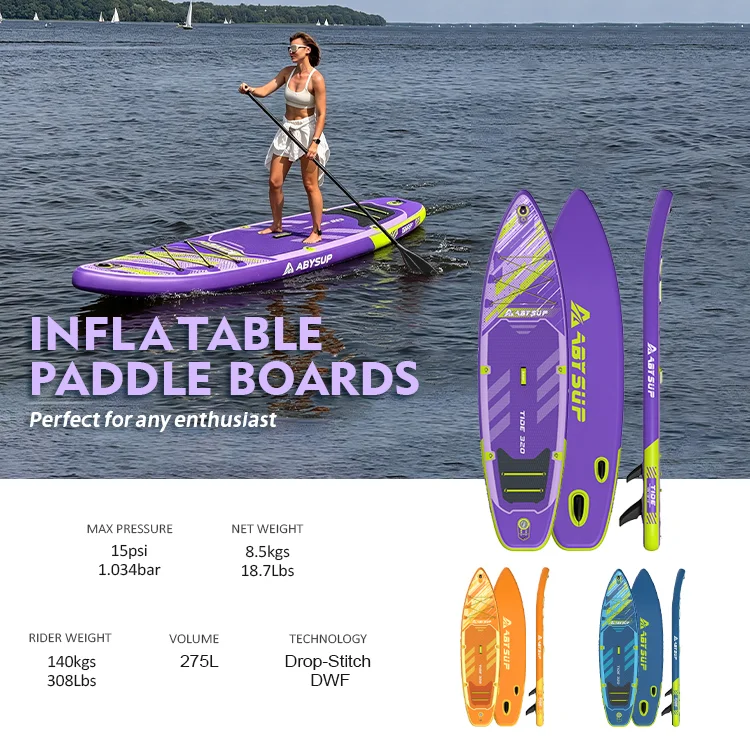
Building a recreational SUP range? ABYSUP’s all-round inflatable paddle boards are a useful place to start.
Compare the specifications for each model. Board size, pressure limits, and accessories may differ, even within the same series.
Frequently Asked Questions
How do you inspect an inflatable paddle board before buying?
Start with the product specification sheet. Check the board’s size, weight, pressure limits, and included accessories.
Next, inspect the seams, valve, deck pad, and fin box. Inflate the board using the approved test procedure to check for air leaks.
Take photos of any problems. Keep the inspection results with the product records.
What are common inflatable SUP quality problems?
Look for air leaks around the valve and seams. Check for peeling deck pads, damaged fittings, and fins that don’t lock properly.
Missing accessories are another problem worth checking. Open the package and compare every item with the packing list.
What is AQL inspection for inflatable SUPs?
AQL inspection uses samples from a production batch to check against agreed quality limits. It helps buyers decide whether to accept a shipment.
It doesn’t mean every board in the batch has been inspected or is free from defects.
Should retailers inspect every board in a bulk order?
Not always. Larger orders may use an agreed sampling plan.
The decision depends on the order size, product risks, previous inspection results, and the requirements agreed with the supplier.
What documents should a SUP supplier provide?
Ask for the product specification sheet, approved sample details, packing list, and relevant inspection records.
Also check which product safety documents are required in your sales market.
How do you know the bulk boards match the approved sample?
Compare the finished boards with the approved sample. Focus on dimensions, materials, colors, graphics, fittings, and accessories.
If anything has changed, ask the supplier to explain and document the difference before you approve shipment.
Before You Place That Order
A good sample is encouraging. It isn’t the whole picture.
Check the board itself. Make sure the accessories fit. Compare the bulk shipment with what you approved, and ask for inspection records where you need them.
It takes some extra work upfront. But it’s usually easier to resolve a loose fin or a specification mismatch before 100 boards arrive at your warehouse.
Considering ABYSUP for your retail range? Get in touch for product specifications and available inspection information for the models you’re interested in.