The moment a kid or a 70-pound Labrador climbs onto the nose of your paddle board, you discover something the spec sheet never told you: this is now a completely different sport. Different balance dynamics, different stability priorities, different definitions of “good paddle.” And if you’ve done it once and felt your board tip sideways under unfamiliar weight distribution, you know exactly what I’m talking about.
I’m Allen, Senior Industrial Designer at ABYSUP. I’ve spent nearly a decade designing inflatable paddle boards, and a fair amount of that time has involved testing prototypes with my own dog (a Golden Retriever named Mochi who thinks every board belongs to her) and the kids of my coworkers. The good news: paddling with dogs and kids is one of the best things you can do on a SUP. The other news: it requires different gear, different technique, and a few setup choices nobody tells you about.
This guide covers both — what works for dogs, what works for kids, what works for both at the same time, and the honest trade-offs that come with each. By the end, you’ll know exactly which board to buy, how to prepare, and what to expect on your first family paddle.
Why Family SUP Demands a Different Kind of Board
The board you’d choose for solo recreational paddling is rarely the right board for family paddling. Three specs change everything when you add a dog or a kid to the deck.
Width matters more than length
For solo paddling, 32″–33″ wide is the sweet spot. For family paddling, push that to 33″–35″ minimum. Two extra inches of width absorbs all the unpredictable weight shifts that come with a kid leaning over the rail to look at fish or a dog stepping unexpectedly toward the nose.
The trade-off: those extra inches cost you 5–8% of cruising speed. For solo paddlers training for distance, that matters. For a parent paddling at 2 mph with a 4-year-old, that doesn’t matter at all. Width earns its keep every time something unexpected happens.
Weight capacity is not just about adding pounds
The mistake most family paddlers make: they look at weight capacity, add their weight plus the kid’s weight plus the dog’s weight, and assume any board rated above that total works. It doesn’t.
Weight capacity ratings are typically given for even, centered weight distribution. Add a 60-pound Labrador who insists on standing at the very front of the board, and the dynamic load on the nose can spike to 2–3x the dog’s bodyweight during paddle strokes. The board doesn’t sink, but the nose drops, the tail rises, and your tracking becomes garbage.
Rule of thumb: for family paddling, choose a board rated for at least 50–70% more than your combined occupant weight. A 180-lb adult + 40-lb kid + 50-lb dog = 270 lbs combined; you want a board rated 400+ lbs.
Deck pad coverage becomes critical
For solo paddling, a 50–60% deck pad coverage is fine. For family paddling, you want 70%+ deck pad coverage — extending toward the nose specifically.
Why? Because dogs gravitate to the nose. Kids sit on the nose. And when paws or hands or bare feet land on smooth PVC instead of grippy EVA, slips happen — usually at the worst possible moment. Extended deck pads turn the front of the board from a slick danger zone into a stable platform.
This is one of the design decisions we made on our All-Round line specifically because of family feedback. Our deck pads extend further forward than most competitors’ boards — covering about 70% of the board’s length. That extra coverage adds roughly 0.4 lbs to total board weight. Worth it.
“The first time I put Mochi on a prototype with a smaller deck pad — about 55% coverage — she walked confidently to the nose, hit the slippery PVC section, and slid sideways into the water with the most betrayed expression I’ve ever seen on a dog. That was the day we redesigned our deck pad templates. Dogs don’t read spec sheets, but they will absolutely show you which part of your board is poorly designed.” — Allen Xiao, ABYSUP Design Team
Bringing Your Dog: From Land Training to First Paddle
Most failed dog-SUP attempts fail before the board ever touches water — because the owner skipped the land training phase. Dogs don’t naturally understand balance on a moving surface. They need to learn it deliberately.
The 3-stage land introduction
Before your dog gets on a paddle board in water, run through this sequence at home:
- Stage 1: Dry board, in the living room. Inflate the board fully and lay it flat on the floor. Let your dog sniff it, walk on it, eat treats on it. The goal is associating the board with safety and reward. Do this for 2–3 days, 5 minutes at a time.
- Stage 2: Wet board, in the yard. Move the inflated board outside, spray it lightly with a hose so the deck pad is wet. Have your dog walk on it again. This introduces the wet-surface sensation without water below.
- Stage 3: Board in shallow water, you standing in water beside it. In a calm pond, lake, or even a backyard pool with the board partly grounded, encourage your dog to step on. Reward with treats. Stay in the water beside the board so they don’t feel abandoned.
Skip these stages and your first real paddle session is statistically likely to end with your dog jumping off in panic. Done correctly, this whole training takes 3–5 days and dramatically increases your success rate.
Dog-specific gear that actually matters
The non-negotiable list:
- Dog life vest (PFD) — every dog, every paddle, no exceptions. Even strong-swimming breeds tire faster than humans expect, especially in cold water. The handle on top of the vest is also how you’ll lift them back onto the board if they jump off.
- Toweled deck or grip pad extension — if your deck pad doesn’t extend to the nose, place a non-slip yoga towel on the smooth PVC areas. Dogs panic when they slip.
- Water bowl strapped to bungee cord — dogs dehydrate fast in sun and exertion; collapsible silicone bowls work well
- Treat pouch on your hip — for ongoing positive reinforcement during the paddle
- Towel for after — wet dog in car is a different sensory experience
Where the dog should sit (and why)
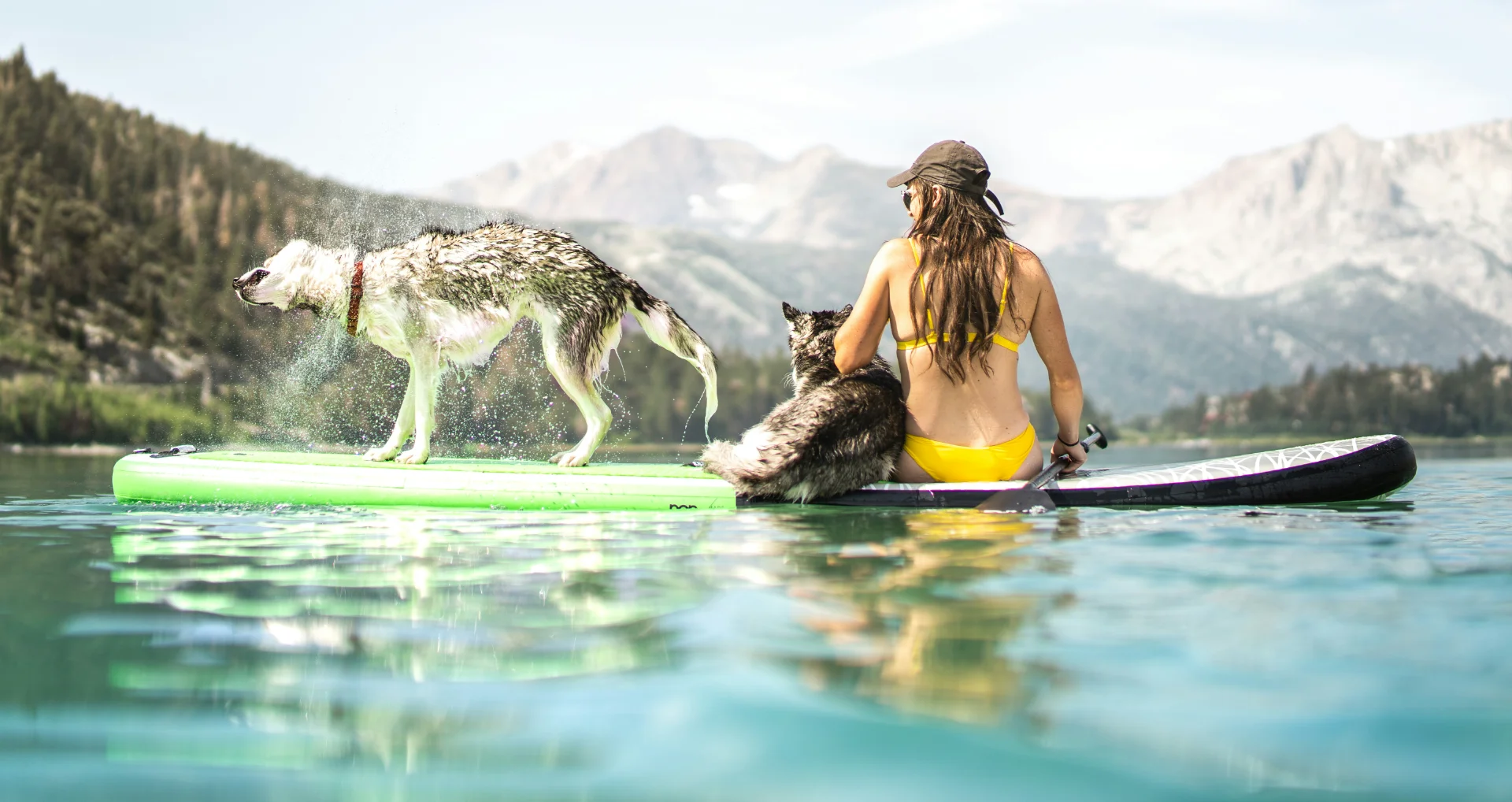
Most dogs naturally want to be at the front of the board, looking forward. Let them — front position is correct for two reasons: it counterbalances your weight at the stern, and it gives them the visual stimulation they need to stay calm.
The exception is for very large dogs (60+ lbs): their weight at the nose may sink the front and disrupt tracking. For larger dogs, encourage them to lie down approximately 1/3 of the way back from the nose — close enough to feel “at the front,” far enough back that the trim stays balanced.
What to expect on the first water session
Plan for 20–30 minutes maximum on your first paddle with your dog. Stay in calm, shallow water. Expect your dog to:
- Move around a lot in the first 5 minutes — this is normal, they’re processing
- Possibly jump off once or twice — also normal; reward them when they let you help them back on
- Bark or whine if they see other dogs on shore — keep moving past distractions
- Lie down and relax after about 10–15 minutes — this is the goal
By session 3–5, most dogs are completely calm on the board. Some breeds (retrievers, water spaniels, labradors) take to it almost immediately. Others (small terriers, anxious rescues) may need 8–10 sessions before they’re truly relaxed. Patience pays off.
Bringing Your Kids: Age-Appropriate Approaches
Kids and dogs have one thing in common on a paddle board: they shift weight unpredictably. They also have one critical difference: kids understand instructions. Use that.
Ages 2–4: Passenger mode only
Kids in this age range cannot help you balance, cannot reliably stay still when asked, and cannot swim independently. The only sensible setup is:
- You stand or kneel on the board, paddling normally
- Kid sits between your feet or just in front of you — close enough that you can physically stabilize them with your leg if needed
- Full PFD on the kid, properly fitted, with a crotch strap — they will slip out of an adult-style vest
- Short sessions only — 15–25 minutes maximum; toddler attention spans are short and so is their patience for sitting still
- Calm, shallow water — and stay close enough to shore that you can wade back if needed
Don’t try to teach SUP to a 3-year-old. They’re passengers, not students. The goal at this age is positive water exposure and family time, not skill development.
Ages 5–7: Co-pilots in training
This age range is where kids start being genuinely useful crew members. They can follow simple instructions, sit relatively still when asked, and even paddle a little with their hands.
- Same position as toddlers — kid in front of you, you paddling
- Give them a job — looking for fish, counting waterbirds, pointing out the next destination; engagement reduces fidgeting
- Let them try short paddle-handle attempts when conditions are calm — gives them ownership
- Sessions can extend to 30–45 minutes as long as they stay engaged
- PFD remains non-negotiable, even if they’re confident swimmers — water temperature and exhaustion are the dangers, not swimming ability
Ages 8–12: Independent paddlers on their own board
By around age 8, most kids can paddle their own SUP under supervision. The right approach changes completely: instead of carrying them, you teach them.
Specs for a child’s first board:
- Length: 8’–9’6″ — shorter than adult boards, scaled to body size
- Width: 30″–32″ — still wide enough for stability
- Thickness: 5″–6″ — full thickness gives them rigidity even at lower body weight
- Weight capacity: 150–200 lbs — enough for the child plus accessories
Don’t put a small kid on a full-size 11′ adult board. They can’t reach the rails effectively, the board is too heavy for them to maneuver, and they’ll lose interest quickly. A properly sized board makes them feel competent immediately.
Teens: Treat them as adults
By 13–14, most teens can use a standard adult inflatable SUP and learn proper technique within 2–3 sessions. The same beginner rules apply — All-Round 10’6″–11′ board, calm conditions, kneeling start before standing. The full first time on the water guide applies just as well to a 15-year-old as to a 35-year-old.
Doing Both at Once: Dog, Kid, You (And Whether You Should)
The honest answer first: bringing both a dog and a kid on a single paddle board, with one adult, is the hardest combination in family SUP. It can be done. It should not be your first attempt.
What needs to be true before you try this
- Your dog has at least 5 solo SUP sessions and is consistently calm on the board
- Your kid has at least 3 solo (with you) SUP sessions and follows instructions reliably
- Water is dead calm — under 5 mph wind, no boat wakes, no current
- You’re paddling on a wide board (34″+) rated for at least 400 lbs capacity
- Air and water temperature are warm enough that a fall is uncomfortable, not dangerous
- You have a second adult on shore, or paddling alongside, who can help if things go wrong
If any of these aren’t true, paddle with just the kid or just the dog, not both. The risk multiplies non-linearly when you add the second variable.
The right weight distribution
From nose to tail:
- Dog at the front — lying down ideally, head toward the nose
- Kid seated middle-front — about 1/3 of the way back from the nose, facing forward, between the dog and you
- You standing or kneeling middle-back — about 1/3 of the way back from the tail, paddling normally
This distribution keeps the board’s trim balanced and gives you clear sightlines to both passengers. It also positions you to physically grab either of them if needed.
What changes about your paddling
Forget about technique refinement, distance, or efficient strokes. With a dog and kid on board, your paddling job becomes:
- Slow, controlled strokes — quick or aggressive strokes shift weight too dramatically
- Constant low-level scanning — eyes moving between horizon, kid, and dog every few seconds
- Short paddle sides — switch sides every 2–3 strokes instead of 4–5, to keep the board tracking straight without big corrections
- Talking the whole time — your voice keeps both the dog and kid calm; narrate what you see, what you’re doing, what’s coming next
This is not a workout paddle. This is a slow-motion family activity that happens to occur on water. Adjust your expectations accordingly.
When to abort
Have a clear “we’re heading back” signal. Things that should trigger an immediate return to shore:
- Wind picks up beyond what you launched in
- Dog becomes agitated and won’t settle within 1 minute of redirection
- Kid says they want to go back (don’t push through — that’s how you create a kid who hates SUP)
- Either passenger is shivering, even slightly
- You feel any fatigue starting to affect your balance
The point of family paddling is not the paddle. It’s the family. End the session early and they’ll want to come back next weekend.
The Safety Setup You Cannot Compromise
Family SUP is safer than family swimming in open water, with one absolute condition: your safety setup is non-negotiable. Every item below stays in place every single session.
The non-negotiables for adults
- Coast Guard-approved PFD — worn, not just on the board; legally required in most jurisdictions for vessels, which paddle boards are classified as
- Ankle leash — keeps you connected to the board if you fall; never paddle without one on flat water
- Phone in waterproof dry bag — strapped to bungee cords on the nose, accessible for emergencies
- Whistle — clipped to your PFD; international distress signal is three short blasts
The non-negotiables for kids
- Properly fitted PFD with crotch strap — adult PFDs don’t fit kids; they slide up over the head in the water. Size-appropriate vests only.
- No leash on the kid — counter-intuitive, but a leashed kid who falls in moving water can be dragged underwater. Strong-grip handhold on the board’s center handle is the right alternative.
- Sun protection — UV-protective long-sleeve shirt, hat with strap, reef-safe sunscreen on exposed skin
- Snack and water — kids dehydrate and bonk faster than adults, especially in heat
The non-negotiables for dogs
- Dog PFD with handle on top — handle lets you lift them back on the board; vest keeps them buoyant if they tire
- No leash on the dog while paddling — never; if the dog jumps off and the leash gets snagged, the dog can drown. Leash off, PFD on, treat-trained recall is the safety stack.
- Trimmed nails — long claws scratch the deck pad and create slippery patches. Trim before water sessions.
- Familiarity with water — don’t introduce SUP to a dog who’s never swum. Swimming comfort comes first.
Water and weather conditions
For family paddling, the conditions checklist is stricter than solo paddling:
- Water temperature above 18°C (65°F) — cold-water immersion is the most common cause of paddle board fatalities; in cooler water, everyone wears wetsuits or you don’t paddle
- Wind under 5 mph for first family paddles — kid and dog can’t help if conditions deteriorate
- No moving water — rivers, currents, tidal estuaries; family paddling is flat-water-only until everyone is highly experienced
- Time of day before 11 AM or after 4 PM — avoids midday heat and the typical 1–3 PM wind window
- Shore visible at all times — never paddle further out than you’d be willing to swim back carrying a small person and possibly a dog
The U.S. Coast Guard standup paddleboarding safety guidelines reinforce most of these points — the leash and PFD combination is the foundational safety setup, regardless of swimming ability.
Choosing the Right Board for Your Family Configuration
One board doesn’t fit every family setup. Here’s how to match board specs to your specific situation.
Solo adult + one small dog (under 30 lbs)
A standard All-Round 10’6″–11′ inflatable SUP at 32–33″ wide handles this combination fine. The small dog’s weight isn’t enough to disrupt trim significantly. Slight upgrades:
- Confirm deck pad extends close to the nose (70%+ coverage)
- Choose a board with multiple D-ring tie-down points on the front bungee — useful for clipping a dog water bowl or chew toy
Solo adult + one medium-large dog (30–80 lbs)
Now we’re firmly in “wider is better” territory. Recommended specs:
- Length: 11′ (the extra length gives the dog more room to sprawl)
- Width: 33″–34″ minimum
- Thickness: 6″
- Weight capacity: 300+ lbs
- Full-length deck pad coverage (70%+, extending nearly to the nose)
Solo adult + one young child (under 6 years)
Similar to medium dog setup. The child weighs less than a dog typically, but moves more unpredictably. Specs:
- Length: 10’6″–11′
- Width: 33″–34″
- Thickness: 6″
- Weight capacity: 280+ lbs
- Center handle clearly accessible for the kid to grip if scared
Two adults + small kid or dog (light family load)
This combination demands a board purpose-built for capacity. Standard 11′ All-Round boards work at the upper limit but feel sluggish. Better choice:
- Length: 11’6″–12’6″
- Width: 34″–35″
- Thickness: 6″
- Weight capacity: 400+ lbs
- Often called “XL” or “Family” or “Tandem” boards in product lines
One adult + kid + dog (full load)
This is the hardest configuration. You want maximum stability and capacity. Specs:
- Length: 12’–12’6″
- Width: 35″+
- Thickness: 6″
- Weight capacity: 450+ lbs
- Premium-grade construction (fusion or double-layer) for durability under repeated heavy use
I’ll be honest: for this last configuration, you should consider whether a single SUP is really the right answer or whether two SUPs is better — one adult paddles with the kid, the other adult paddles with the dog. The math on board size, stability, and enjoyment often favors splitting the load across two boards.
For families who paddle frequently with mixed configurations, our complete SUP beginner learning path includes a section on building a household quiver — multiple boards sized for different scenarios — which is genuinely the most flexible long-term approach.
Why We Design With Families Specifically in Mind
I’ll be transparent about something most brand reps won’t say: at ABYSUP, we don’t try to design boards that win racing podiums. We design for the reality of the family paddler — the dad who paddles with his Labrador, the mom who takes her 5-year-old to the lake on weekends, the grandparents who want to bring their grandkids out for an hour of slow exploration.
The 33″+ width decision
Our All-Round series starts at 32″ and our XL line goes up to 35″. We deliberately avoid the narrower 30″ boards some performance brands push. Two inches of width feels like nothing on paper. In practice, those two inches absorb a dog stepping unexpectedly, a kid leaning over the rail, a wake hitting the side from a passing boat.
For solo experienced paddlers, those two inches cost 5–8% of cruising speed. For families, they’re the difference between a confident relaxing paddle and a tense balancing act. We chose stability margin every time.
The 70% deck pad decision
Our deck pads cover significantly more of the board than industry standard. Why? Because we tested with real dogs and real kids during the design phase. Both species gravitate to the nose. Both species slip on smooth PVC. Both species need grippy EVA underfoot from nose to tail.
The extra deck pad adds about 0.4 lbs to the total board weight. For us, that’s the simplest math in our spec sheet — the cost is negligible, the benefit is “your dog doesn’t slide off your board.” Easy call.
The 1.2mm DWF base layer decision
Family paddling involves more wear than solo paddling: dog claws, kid-dragged sand, accidental scrapes on gravel beaches, weight stresses from unbalanced loads. We use a heavier 1.2mm drop-stitch base layer instead of the 0.9mm fabric some competitors use. Board weighs about 1.5 lbs more. In exchange, you get a board that handles real family use without developing micro-leaks in year two.
The multiple D-ring decision
Our boards have D-rings at nose and tail plus side attachment points. Why? Because family paddlers need to clip on more gear than solo paddlers — dog water bowl, kid’s toy net, dry bag for sunscreen and snacks, possibly a small cooler. The extra D-rings cost almost nothing to add during manufacturing and give families the attachment versatility they actually need.
These are trade-offs. Every design decision is. But they’re the right trade-offs for the buyer reading this article — because that buyer needs a board that performs reliably under unpredictable family use, not a board that wins time trials.
According to recreational paddling participation data, family-oriented paddling represents the fastest-growing segment of SUP. That’s the buyer we design for.
Common Family Paddling Mistakes (And How to Avoid Them)
After years of watching family paddlers, the same mistakes show up repeatedly. Skip these and you’ll be in the top 10% of family-SUP experiences.
Mistake 1: Skipping the land training for the dog
Owners assume their dog will “just figure it out” on the water. About 30% of dogs do. The other 70% panic, jump off, and create a traumatic association with the board that takes weeks to undo. Three days of land training prevents this almost entirely.
Mistake 2: Putting the kid on first, dog second
The right loading order is: paddler boards first, dog boards second (so you can stabilize the board), kid boards last (so they’re handed up to you and don’t need to climb in a wobbly board). Reverse this and you risk capsizing during the loading process itself.
Mistake 3: Paddling out too far on the first family session
The instinct is to “make it count” — paddle out for 30 minutes, take a photo, paddle back. The reality is that family paddles need to be very short for the first few sessions: 15–20 minutes max. Build distance gradually as everyone gets comfortable.
Mistake 4: Skipping the PFD for “calm conditions”
The argument: “It’s just a calm lake, we’re staying close to shore, the kid can swim.” The counterargument: the most common SUP-related drownings involve experienced paddlers in calm conditions who fell unexpectedly. PFD goes on regardless. No exceptions for adults, kids, or dogs.
Mistake 5: Forcing the dog or kid to stay on past their limit
If a dog won’t settle after 5–10 minutes, paddle to shore and let them off. If a kid says they want to go back, go back. Forcing through their discomfort creates negative associations that make future sessions harder. Short, positive sessions build long-term enjoyment.
Mistake 6: Underestimating the cumulative weight load
An adult plus a 50-lb dog plus a 40-lb kid totals 290 lbs — which sounds fine for a board rated 350 lbs. But weight ratings assume static, centered loads. Dynamic family loads with movement, unbalanced positioning, and wave action stress the board far more than 290 static lbs would. Always size up the weight capacity by 30–50% over your actual combined weight.
Mistake 7: Bringing too much gear
Family paddlers often overpack — towels, multiple water bottles, snacks, toys, doggy treats, extra clothing. All of it adds weight, takes deck space, and creates more things to fall in the water. Bring the safety essentials plus one bag of focused gear. Leave the rest in the car.
Who This Guide Is For (And Who’s Past It)
This article is built for a specific reader. Make sure you’re that reader before applying every recommendation literally.
This guide is for you if you…
- Own or are about to buy your first family-friendly SUP
- Have a dog you’ve never paddled with, regardless of breed or size
- Have kids between 2–12 you’d like to bring on the water
- Have paddled solo before but never with passengers
- Are buying a SUP specifically because you want family activities
- Operate a family-focused rental fleet and want to advise customers properly
This guide is probably past you if you…
- Have paddled with your dog or kids more than 10 times each
- Have already developed your own family-paddling rhythm and gear loadout
- Are looking for advanced techniques (multi-board family touring, kid SUP racing, dog agility on SUP)
- Are paddling in challenging conditions regularly (cold water, moderate chop, longer touring)
If you’re past this guide, the next stage is building scenarios — family touring weekends, multi-board paddles, kid skill progression, breed-specific dog training. Different content, different audience.
If you’re still in this guide, that’s completely normal. Every family paddler I know was here at some point. The first family session is always the hardest, and every paddle after it gets easier.
Frequently Asked Questions
Can I bring my dog on a paddle board?
Yes, with proper preparation. Most dogs adapt well to paddle boarding within 3–5 sessions, especially water-friendly breeds like retrievers, labradors, and water spaniels. The keys are land training first (let your dog get familiar with the inflated board at home), a dog-specific PFD with a handle on top, and starting in very calm shallow water for short sessions.
Some breeds adapt faster than others. Small terriers and anxious rescues may take 8–10 sessions before they’re truly relaxed; sporting breeds often take to it within their first 2 sessions. Either timeline is normal. The dog will tell you when they’re comfortable — the goal is patience, not performance.
What size paddle board do I need for me and my dog?
For an adult plus a small dog under 30 lbs, a standard All-Round 10’6″–11′ inflatable SUP at 32–33″ wide works well. For an adult plus a medium-large dog (30–80 lbs), upgrade to 33″–34″ wide and an 11′ length with at least 300 lbs weight capacity. The board should be rated for 50% more than your combined weight to handle dynamic load shifts properly.
Width matters more than length for stability with a dog on board. Wider boards absorb the dog’s unpredictable weight shifts. Extended deck pad coverage (70%+ of the board’s length) is also critical so your dog has grip surface from nose to tail — dogs naturally gravitate to the front of the board.
What age can a child start paddle boarding?
Kids as young as 2 years old can be passengers on a parent’s SUP, sitting between the adult’s feet with a properly fitted PFD. Independent paddling on their own kid-sized board is typically realistic around age 8, when most kids have enough coordination, strength, and instruction-following to handle a SUP under supervision.
Between ages 5–7, kids are “co-pilots” — still on the parent’s board but capable of helping (looking for fish, holding a paddle handle, sitting still when asked). The transition to independent paddling depends on the individual kid more than strict age. Some are ready at 6, others closer to 10. Properly sized boards (8’–9’6″ long, 30″–32″ wide) make a huge difference in whether a young paddler feels competent.
Do dogs and kids need life jackets for paddle boarding?
Yes, always, with no exceptions. For kids, use a properly fitted PFD with a crotch strap — adult-style vests slide up over the head in the water. For dogs, use a dog-specific PFD with a handle on top, which doubles as a way to lift them back on the board if they jump off. Both items are non-negotiable regardless of swimming ability or water conditions.
For kids specifically, never use an ankle leash like adults wear. If a kid falls in moving water with a leash attached, the leash can drag them underwater. The right alternative is a strong handhold on the board’s center handle and a parent within arm’s reach at all times.
How long should a family paddle boarding session last?
For your first few sessions with a dog or kid, plan for 15–25 minutes maximum. Both passengers have shorter attention spans than adults expect, and both will tire (or get bored) faster than you predict. The point of family paddling is the positive shared experience, not the duration or distance.
As everyone gets comfortable across 5–10 sessions, you can extend gradually to 30–45 minutes for kids and 45–60 minutes for dogs. Watch for signs of fatigue or discomfort: a kid getting fidgety, a dog standing up repeatedly, anyone shivering even slightly. End sessions before either passenger reaches their limit and they’ll want to come back next weekend.
Find the Family Board That Makes This Easier
Family paddling is one of the best things you can do on a SUP — and the right board makes the difference between a stressful balancing act and a relaxed afternoon on the water. Wide enough to forgive shifting weight, thick enough to handle a dog jumping for the nose, with deck pads grippy enough that nobody slips. That’s the design we built our All-Round and XL lines around.
If you’re still choosing your family SUP, our [Link to ABYSUP All-Round and XL Collection] is organized by load capacity rather than just by size — so you can match the board directly to “me plus my dog,” “me plus my kid,” or “me plus dog plus kid.” Every board in the line is built for the realities described in this article.
For B2B dealers and rental operators stocking family-friendly inventory, our [Link to ABYSUP Wholesale Program] offers volume pricing on wider All-Round and XL boards with private-label options and direct factory support. Family rentals are one of the highest-margin segments in SUP rental, and the right inventory drives both repeat business and ownership upsells — we’ll talk through what’s moving in your market before sending a catalogue.
Whichever board you end up with, the most important advice is the simplest: start short, start calm, start safe. Every family paddler I know remembers their first session — make it a memory you all want to repeat.