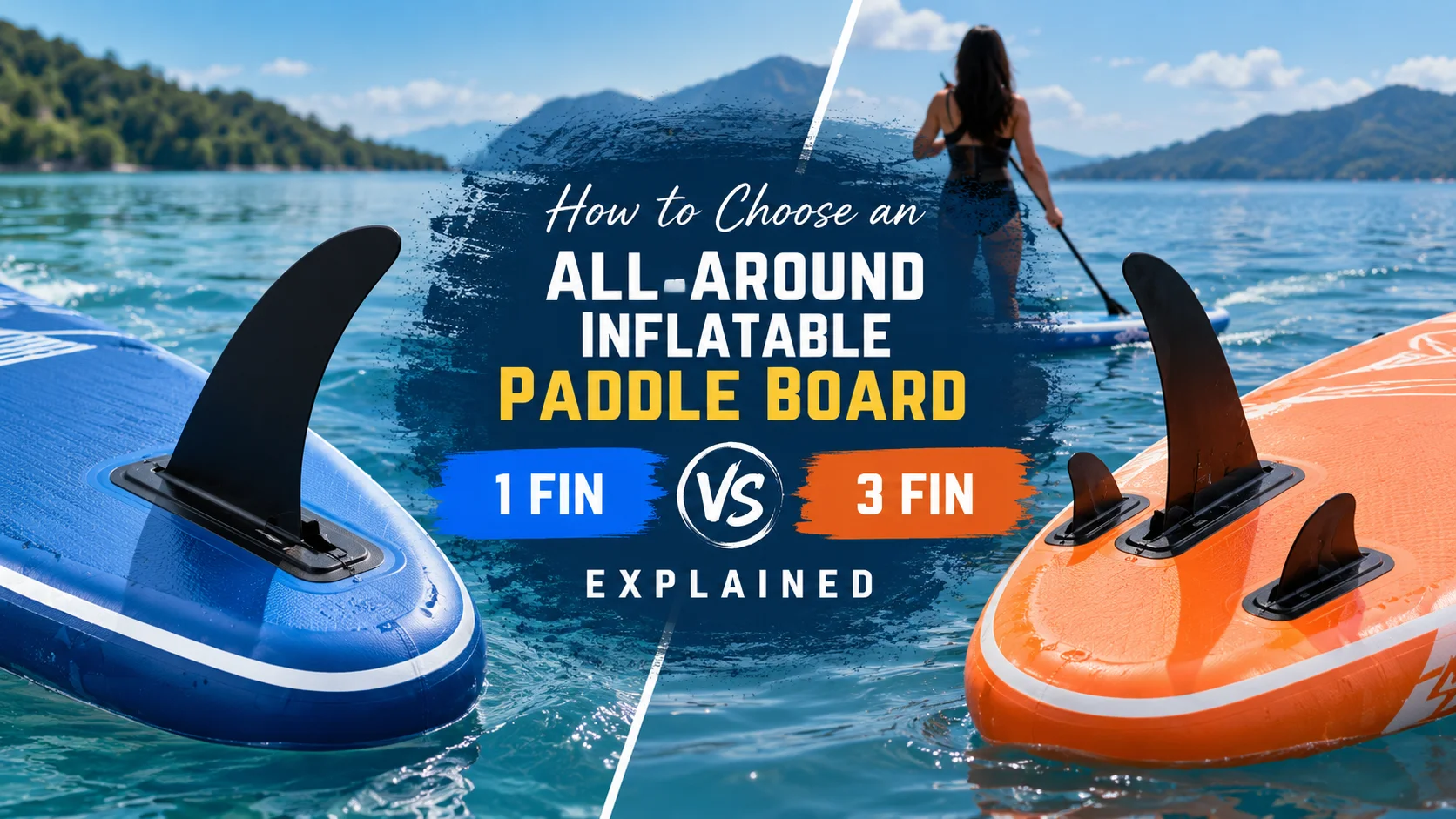
Flip over two inflatable paddle boards. One has a single fin at the back. The other has three.
So, which one should you buy?
If you mostly paddle on calm lakes, a single center fin may be all you need. Three fins can change how a board handles turns, but they don’t automatically make it faster or easier to balance on.
There’s another detail worth knowing. Not all three-fin setups are the same. Some have one large center fin and two small side fins. Others have three fins of similar size.
Here’s what those differences mean when you’re actually out on the water, and what to check before choosing an all-around inflatable paddle board.
Why Do Paddle Boards Have Fins?
Ever tried paddling a board that keeps drifting left and right? That’s one of the things a fin helps with.
Each paddle stroke pushes the board forward, but it can also make the nose swing slightly to one side. The fin helps the board resist that sideways movement. You spend less time correcting your direction and more time paddling.
Here’s what you’ll notice on the water:
• Straighter paddling. A center fin helps the board hold its course, especially on flat water.
• Different turning feel. A larger fin generally resists sideways movement more than a smaller one. That can make the board feel less willing to swing its tail around.
• More predictable handling. A suitable fin can make the board easier to control, although wind and paddling technique still matter.
One thing to clear up: fins don’t do the same job as board width. A wide board can feel steady under your feet, while its fin helps it travel in a straighter line. Those are two different things.
Single Fin vs Three Fins: What’s the Difference?
At first glance, it’s just one fin versus three. But there’s a catch. A three-fin board might use a 2+1 setup or a thruster setup, and they’re built for different kinds of paddling.
• Single Fin: Simple and Easy to Maintain
A single-fin board has one center fin near the tail. It’s a common choice for flatwater paddling because a suitable center fin helps the board travel straight.
There’s less to deal with when packing, too. One fin to remove, clean, and put away.
• 2+1 Setup: Common on All-Round SUPs
This is the layout you’ll see on many recreational 3 fin paddle boards. There’s one larger center fin and two smaller fins on either side.
The center fin handles much of the straight-line tracking. The side fins can affect how the board grips the water during turns. How much difference they make depends on their size and shape.
Some boards have fixed side fins and a removable center fin. Others let you remove all three.
• Thruster: More Common on Surf SUPs
A thruster has three fins of roughly similar size. It’s often used on boards made for riding waves, where turning is a big part of the experience.
Don’t confuse a thruster with the 2+1 system on a typical recreational inflatable board. They may both have three fins, but they don’t behave exactly the same way.
| Feature | Single Fin | 2+1 Setup | Thruster |
|---|---|---|---|
| Fin layout | One center fin | One large center fin and two smaller side fins | Three similarly sized fins |
| Common use | Flatwater and touring | Everyday recreational paddling | SUP surfing |
| What to check | Center fin depth and shape | Side fin design and removability | Fin placement and turning response |
| Packing | Usually straightforward | Depends on fixed and removable fins | Depends on the fin system |
So don’t judge a 3 fin inflatable paddle board by fin count alone. Look underneath the board. The layout tells you much more.
Which Fin Setup Works Best for Your Water Conditions?
Think about where you paddle most weekends. A quiet lake? A shallow river? Somewhere along the coast?
That matters more than choosing a board simply because it has extra fins.
• Calm Lakes: A Single Fin Is Often Enough
On flat water, you usually want the board to travel straight without constant corrections. A single center fin can do that well.
A 2+1 setup can work just as well for relaxed lake paddling. There’s no need to avoid a board because it has two extra side fins.
• Shallow Rivers: Watch the Fin Depth
Picture paddling through a river that’s only knee-deep in places. A long center fin might hit the bottom before the board does.
A shorter, compatible fin can give you more clearance. But don’t assume it makes shallow water risk-free. Rocks and submerged branches can still catch the board or cause a fall.
• Coastal Water: Check the Wind Before Anything Else
Side fins may help with certain turns on small waves. But a paddle board with 3 fins won’t suddenly become easy to control in strong wind.
The National Weather Service’s Beaufort scale gives a useful picture of how quickly conditions change.
| Beaufort Force | Wind Speed | What You May See |
|---|---|---|
| 1 | 1–3 knots | Small ripples |
| 2 | 4–6 knots | Small wavelets |
| 3 | 7–10 knots | Larger wavelets; some crests start to break |
| 4 | 11–16 knots | Longer waves and more frequent whitecaps |
Source: NOAA / National Weather Service Beaufort Scale. These figures describe wind conditions, not safe wind limits for paddle boarding.
If the wind is picking up, the answer isn’t to add another fin. Check the forecast and choose a sheltered place to paddle, or leave the trip for another day.
How to Remove and Pack Inflatable Paddle Board Fins
Here’s something that’s easy to overlook when buying a SUP: you’ll need to deal with the fins every time you pack the board away.
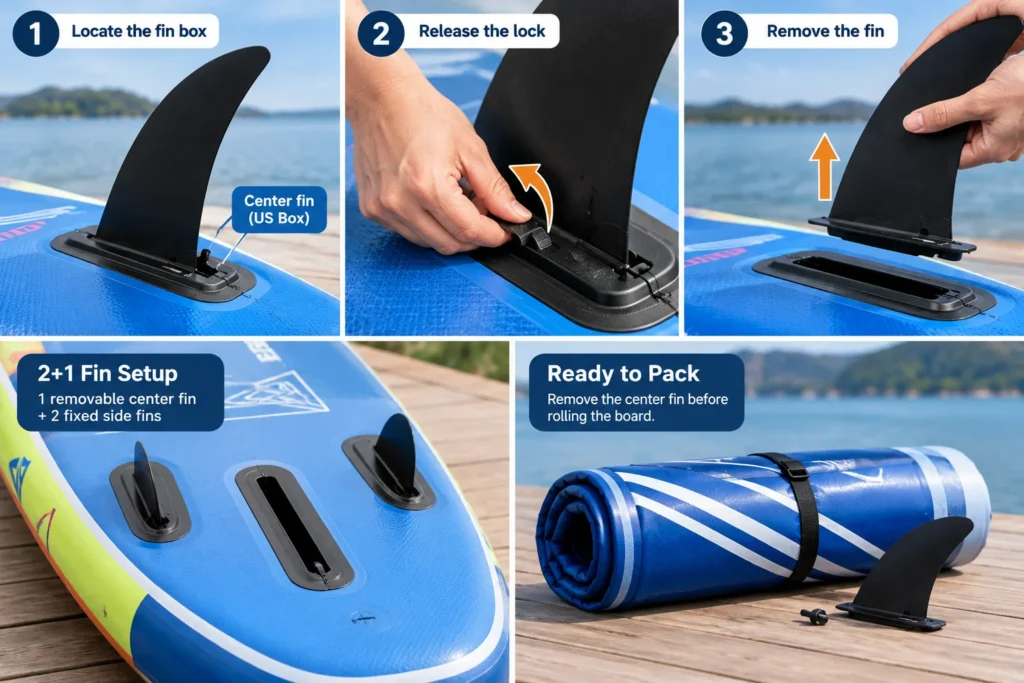
• Removing a Detachable Fin
Put the board on a clean surface, with the fin facing up. Check how the fin is locked in place.
Some fin boxes use a clip. Others have a screw or a sliding mechanism. Release the lock, then remove the fin as directed by the manufacturer.
If it won’t move, don’t yank it. Sand or dirt may be stuck inside the fin box. Rinse the area with fresh water and try again.
• Can You Roll Up a SUP With the Fins Attached?
For most inflatable boards with a removable center fin, take that fin off before rolling the board.
Small fixed side fins usually stay attached. Follow the recommended folding direction so you don’t put too much pressure on their bases.
Once everything is dry, keep the removable fin and its hardware together. A missing screw is a frustrating way to start your next paddle.
How to Choose the Right Fin Setup Before Buying
Let’s say you’re choosing between two boards of similar size. One has a single fin. The other has a 2+1 setup.
Before making your choice, ask yourself a few questions.
• Where will I paddle most? If it’s mainly a calm lake, a good center fin may be all you need. For other activities, check how the complete board is designed.
• Is the water shallow? Check the depth of the center fin. A long fin can become a problem around rocks and sandbars.
• Can I replace the fin? Fins get lost. It happens. Make sure you know which fin box the board uses and whether compatible replacements are available.
• Will the board fit my needs? Width, length, and recommended load capacity still matter. A narrow board won’t suddenly feel like a wide recreational SUP just because you add side fins.
• How easy is it to pack? If you inflate and deflate your board every weekend, a removable center fin and simple locking system are worth checking.
For most casual paddlers, there’s no reason to chase a complicated fin setup. Choose a board that fits your weight, your usual water, and the way you like to paddle.
What Fin Setup Does an ABYSUP All-Round Board Use?
Here’s a real product example.
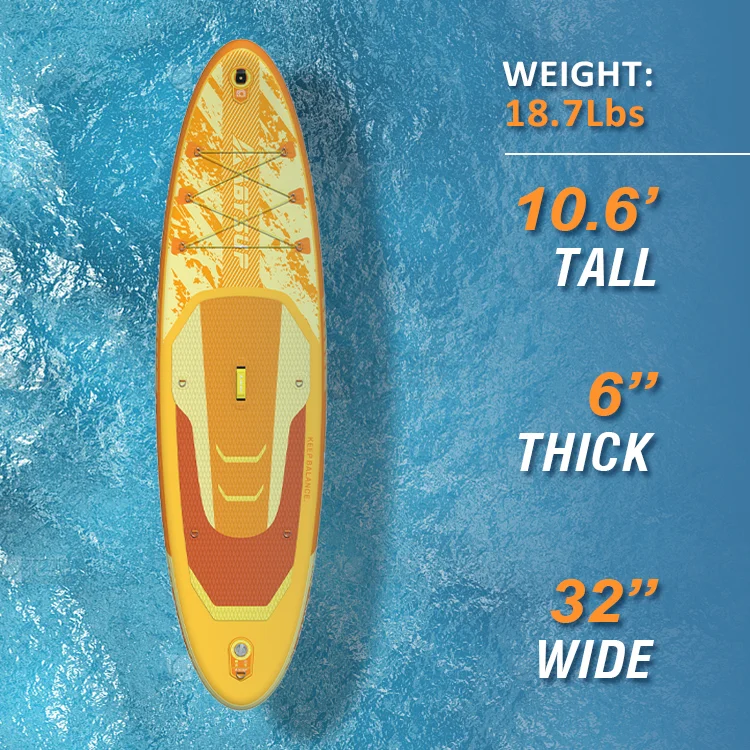
ABYSUP’s published All-Round Series specifications include a 10’6″ × 32″ × 6″ inflatable board with one removable US Box center fin and two fixed side fins.
The listed board weight is 18.7 lb (8.5 kg), with a recommended inflation pressure of 15 PSI.
That gives you a fairly clear picture of the setup. The center fin can be removed before packing, while the two smaller side fins stay on the board.
These numbers are product specifications, not the results of a speed test. They don’t prove that this board is faster or more stable than a single-fin model.
Want to compare board sizes and available configurations? See the ABYSUP All-Round Paddle Board collection.
What Should SUP Retailers Look for in a Fin System?
If you sell paddle boards, here’s a question worth asking your supplier: what happens when a customer loses a fin?
It’s a small part, but it can leave a perfectly good board sitting unused.
Before stocking a 3 fin stand up paddle board, check whether replacement center fins are available. Ask how the fins attach, whether different models use the same fin box, and which parts come in the package.
Clear product photos help, too. A customer should be able to see which fins are fixed and which can be removed before they buy.
Retailers interested in ABYSUP products can find partnership information through the ABYSUP dealer program.
Frequently Asked Questions About SUP Fins
• Why do some paddle boards have three fins?
Three fins can change how a board tracks and turns. But check the layout. A recreational 2+1 setup isn’t the same as a surf-style thruster.
• Is one fin or three fins better for beginners?
Both can work. If you’re new to SUP, board width, load capacity, and calm water are usually more important than having extra fins.
• Do three fins make a paddle board more stable?
Not necessarily. Fins help with directional control. How steady the board feels under your feet depends more on its shape, width, and how you stand.
• Can I use a three-fin board with only the center fin?
That depends on the board. Some have removable side fins, while others have fixed ones. Check the manufacturer’s instructions before changing the setup.
• How do I remove a fin from an inflatable paddle board?
Find the locking mechanism on the fin box. Release the clip or screw, then slide the fin out as instructed. Don’t force it if sand is blocking the track.
• Can I roll up an inflatable SUP with the fins attached?
Remove the detachable center fin first unless the manufacturer says otherwise. Fixed side fins normally stay in place, but you need to fold the board carefully around them.
• Are shorter fins better for shallow water?
A shorter fin can give you more clearance over shallow areas. The trade-off is that the board may not track quite the same way. You’ll still need to watch for rocks and submerged obstacles.
Final Thoughts: One Fin or Three?
If you spend most of your time paddling across calm lakes, a single center fin is a good place to start. A 2+1 setup is also a practical choice for everyday recreational paddling.
Planning to surf small waves? Then it’s worth looking at how a surf-oriented fin setup works with the board’s shape.
Whatever you choose, don’t overlook safety. According to the U.S. Coast Guard, there were 3,887 reported recreational boating incidents and 556 deaths in 2024. Among fatal incident victims whose cause of death was known, 76% drowned. Of drowning victims whose life-jacket use was known, 87% weren’t wearing one.
Source: U.S. Coast Guard, 2024 Recreational Boating Statistics. These figures cover recreational boating overall, not a comparison of SUP fin configurations.
In the end, the number of fins is only part of the story. Check the board’s size, the actual fin layout, and how you’ll use it. That’s a much better way to choose than assuming three fins must be better than one.