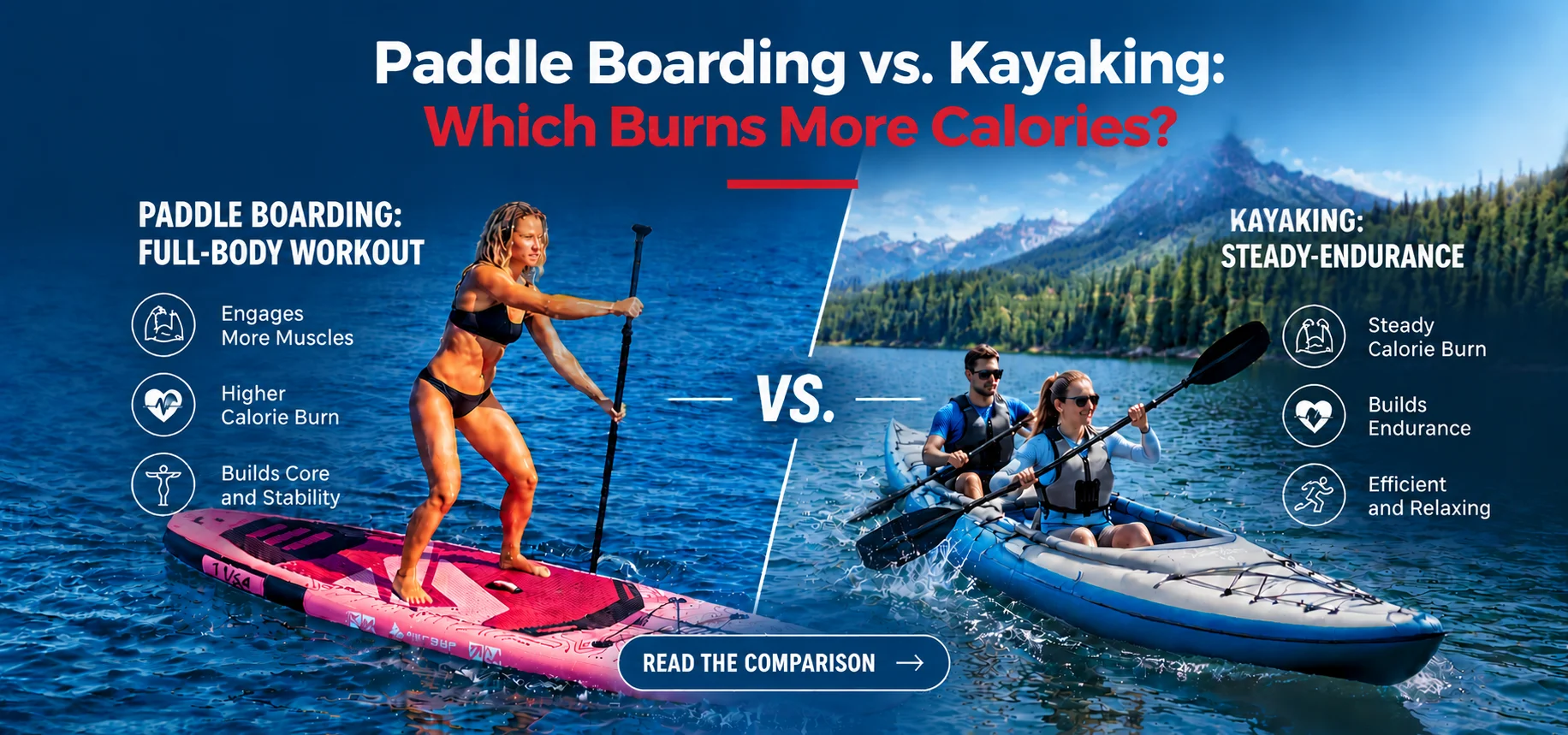
Thinking about getting out on the water for a workout? You might be wondering whether paddle boarding or kayaking burns more calories. Both can get you moving, but they feel quite different once you’re out there.
On a SUP, you’re usually standing and adjusting your balance as you paddle. In a kayak, you’re seated and use a double-bladed paddle. Neither position automatically makes one workout better than the other. How hard you paddle, how long you stay on the water, and how often you stop all make a difference.
Let’s look at the available activity data, work through a few calorie estimates, and compare what each sport is like in practice. That should give you a better idea of which one fits your fitness goals.
Paddle Boarding Calories Calculator: How Much Can You Burn?
If you want a rough idea of how many calories a session might burn, you can estimate it using your body weight, the activity’s MET value, and how long you paddle. It’s not an exact measurement, but it gives you a starting point.
A commonly used estimate is:
Estimated calories per minute ≈ MET × 3.5 × body weight (kg) ÷ 200
Multiply the result by the number of minutes you spend exercising. For example, the table below uses a 70 kg adult paddling for 60 minutes. The numbers are calculated estimates, not results from a test of real paddlers.
| Activity | MET | Estimated Calories in 60 Minutes |
|---|---|---|
| SUP, 10–19 strokes/min | 2.8 | 206 kcal |
| SUP, 20–29 strokes/min | 3.8 | 279 kcal |
| SUP, 30–39 strokes/min | 5.0 | 368 kcal |
| Kayaking, moderate effort | 5.0 | 368 kcal |
These figures assume the listed activity intensity continues for the full hour. If you stop for photos, drift with the current, or spend part of the session resting, your actual energy use will be different.
Body weight also affects the estimate. Two people can paddle for the same amount of time at a similar effort and still get different results. Treat the figures as a guide, not a calorie target you have to hit.
What About Calories Burned Paddle Boarding While Sitting?
Some inflatable SUPs can be fitted with a compatible kayak seat. Sitting down changes the way you balance and paddle, so the standing-SUP figures above may not fit your session very well.
The cited activity data doesn’t provide a separate MET value for every seated-SUP setup. If you mainly paddle while sitting, choose an activity estimate that best matches what you’re doing and keep in mind that the result will still be approximate.

Does Paddle Boarding or Kayaking Burn More Calories?
Paddle boarding can burn more calories when you paddle at a higher intensity, but it doesn’t always beat kayaking. Your body weight, pace, and time spent paddling all matter.
For a 155 lb (70 kg) adult exercising for one hour, the following estimates use MET values from the 2024 Adult Compendium of Physical Activities and a standard calorie formula.
| Activity | MET | Estimated Calories/Hour |
|---|---|---|
| SUP, low stroke rate | 2.8 | 206 kcal |
| SUP, moderate stroke rate | 3.8 | 279 kcal |
| SUP, higher stroke rate | 5.0 | 368 kcal |
| Kayaking, moderate effort | 5.0 | 368 kcal |
These are calculated estimates, not results from a direct SUP-versus-kayak experiment. Actual calorie burn varies by person and conditions.
Two Simple Examples
• Relaxed lake paddle: You spend an hour on your SUP, paddling slowly and taking breaks. Your calorie burn will likely be lower than during a continuous, harder session.
• Steady kayak workout: You paddle at a moderate pace for an hour. At 5.0 MET, a 70 kg adult burns an estimated 368 kcal—about the same calculated amount as SUP at 5.0 MET.
The takeaway: Neither activity always burns more calories. A harder SUP session may use more energy than an easy kayak trip, but the fairest comparison is based on similar effort and time.
Calories Burned Paddle Boarding Sitting vs. Standing
Standing and seated paddling can feel like two different workouts. When you’re standing on a SUP, you need to keep your balance while moving the paddle from side to side. Sitting in a kayak, or using a kayak seat on a compatible SUP, changes your posture and the way you apply force to the paddle.
But sitting doesn’t mean you’re not exercising, and standing doesn’t automatically mean you’re burning more calories. A slow paddle on a SUP may take less effort than a steady kayak session. The reverse can also be true if you’re paddling hard on your board and taking it easy in a kayak.
| Factor | Standing SUP | Seated Kayaking |
|---|---|---|
| Balance | Requires standing balance and frequent small adjustments | A seated position changes the balance demands |
| Paddle | Usually a single-bladed paddle | Usually a double-bladed paddle |
| Effort | Depends on pace, technique, and water conditions | Depends on pace, technique, and water conditions |
| Calorie estimate | Use an activity category that matches your session | Use an activity category that matches your session |
If you want to compare your own sessions, keep a note of how long you actually paddle, how often you stop, and how hard the session feels. A heart-rate monitor can add useful context, but wearable calorie estimates aren’t exact either.
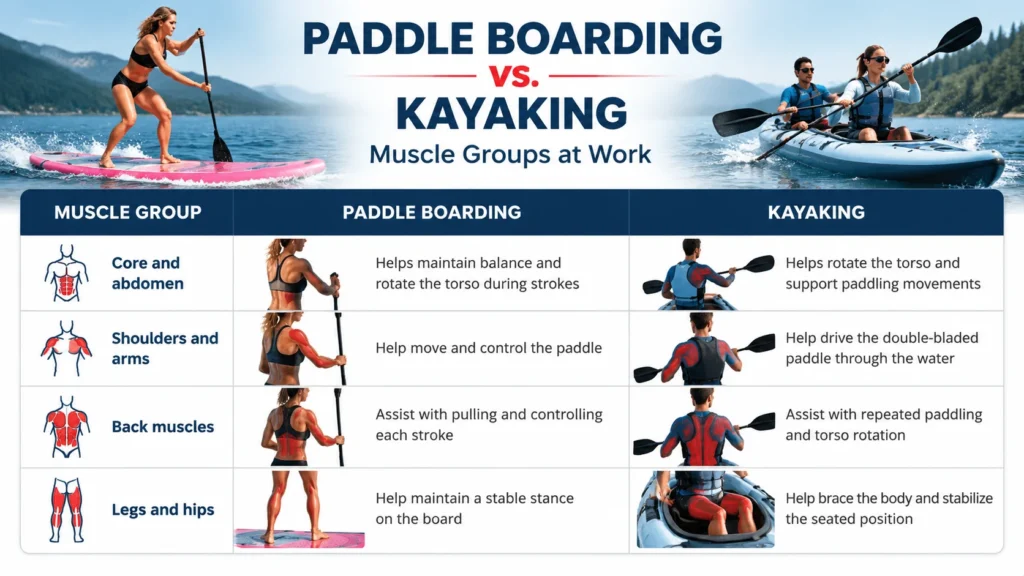
Which Muscles Do Paddle Boarding and Kayaking Work?
Both paddle boarding and kayaking work the upper body and core, but they feel different. On a SUP, you paddle while standing and make small adjustments to stay balanced. In a kayak, you sit and use a double-bladed paddle. Your muscles work differently, even though both activities involve repeated paddling strokes.
| Muscle Group | Paddle Boarding | Kayaking |
|---|---|---|
| Core and abdomen | Helps maintain balance and rotate the torso during strokes | Helps rotate the torso and support paddling movements |
| Shoulders and arms | Help move and control the paddle | Help drive the double-bladed paddle through the water |
| Back muscles | Assist with pulling and controlling each stroke | Assist with repeated paddling and torso rotation |
| Legs and hips | Help maintain a stable stance on the board | Help brace the body and stabilize the seated position |
• Does SUP Work More Muscles?
Yes. Paddle boarding works your arms, shoulders, back, core, and legs. Your upper body powers each stroke. Your core and legs help you stay balanced on the board.
For example, paddling on calm water at an easy pace may feel like a light workout. Paddling faster or dealing with small waves can make it more demanding. Always choose water conditions that match your skill level.
• Which Activity Is Better for a Full-Body Workout?
Both SUP and kayaking work several muscle groups, but they challenge your body in different ways.
Choose SUP if you want to work on balance while training your upper body and legs.
Choose kayaking if you prefer seated paddling and want to focus on repeated strokes using your arms, shoulders, back, and core.
Neither activity is always the harder workout. For example, a fast 30-minute kayak session may require more effort than a slow SUP trip. Choose based on your fitness goals, preferred paddling style, and the pace you can maintain.
If you’re new to SUP, start with short sessions on calm water and focus on comfortable, controlled strokes. You can learn more about different paddling activities in the ABYSUP guide to SUP uses and activities.
Which Is Better for Weight Loss: Paddle Boarding or Kayaking?
Both paddle boarding and kayaking can help you burn calories. Neither one guarantees weight loss. The main factors are how long you exercise, how hard you paddle, and how often you get on the water.
• Paddle Boarding for Weight Loss
On a stand-up paddleboard (SUP), you paddle while standing. Your arms and shoulders move the paddle. Your core and legs help you keep your balance.
Start with a comfortable pace. As your fitness improves, try paddling for longer or adding short bursts of faster strokes. You don’t need to paddle at full speed for your entire session.
• Kayaking for Weight Loss
In a kayak, you usually sit and use a double-bladed paddle. You can maintain a steady pace without needing to balance while standing.
For example, you might kayak for 30 minutes after work or take a longer trip at the weekend. The calories you burn will depend on your body weight and how hard you paddle.
• Which Burns More Calories Over a Week?
Imagine two people who each exercise three times a week. One paddleboards for 30 minutes per session. The other kayaks for 45 minutes per session.
The kayaker spends 45 more minutes exercising each week. That extra time may increase their total calorie burn, even if their hourly calorie burn is lower. The actual difference depends on each person’s effort and body weight.
This is why workout time matters as much as the activity itself. A longer, steady session can be more useful than a short session that you rarely repeat.
• What Matters Most for Weight Loss?
Choose an activity you can do regularly. Try these simple steps:
- Start with a session that fits your current fitness level.
- Build up your workout time gradually.
- Keep track of how long you actively paddle.
- Combine regular exercise with balanced eating habits.
Both sports can be part of a weight-loss plan. The better choice is the one you enjoy and can keep doing safely.
Frequently Asked Questions
Does paddle boarding burn more calories than kayaking?
Not always. It depends on how hard you paddle, your body weight, and how long you stay active. Published MET values can help estimate energy use, but they don’t prove that one sport always burns more calories.
How many calories does paddle boarding burn per hour?
It varies with body weight and effort. Using a standard MET formula, a 70 kg adult at 5.0 MET would burn an estimated 368 calories in an hour. This is a calculation, not a guaranteed result.
Does paddle boarding build muscle?
Paddle boarding works the shoulders, arms, back, core, and legs. It can help build muscular endurance and balance, although it isn’t a replacement for dedicated strength training.
Can you burn calories while sitting on a paddleboard?
Yes. Seated paddling still takes effort. However, estimates based on standing SUP activities may not accurately reflect a session using a kayak seat.
What’s the difference between a kayak and a surfboard?
A kayak is a watercraft that is usually paddled while seated, using a double-bladed paddle. A surfboard is designed mainly for riding waves. A SUP is made for paddling while standing, though some models can also be used with a compatible seat.
How do I choose the right paddleboard?
Start with your experience, body weight, usual water conditions, and intended use. All-round boards suit a range of recreational activities, while touring boards are generally designed for longer-distance paddling.
Conclusion: Choose the Water Workout You Enjoy
So, which burns more calories: paddle boarding or kayaking? There’s no single answer that fits everyone. Both can be good ways to get outside, keep moving, and build endurance. The amount of energy you use depends more on your effort and time on the water than on the name of the activity alone.
If you enjoy standing, balancing, and taking in the view, SUP may be a good fit. If you prefer sitting and paddling with a double-bladed paddle, try kayaking. And if SUP is the one you’re leaning toward, compare board styles before choosing one for your usual trips.
For everyday recreational paddling, take a look at the ABYSUP All-Round paddle boards. If longer outings are more your style, see the touring paddle boardt range.