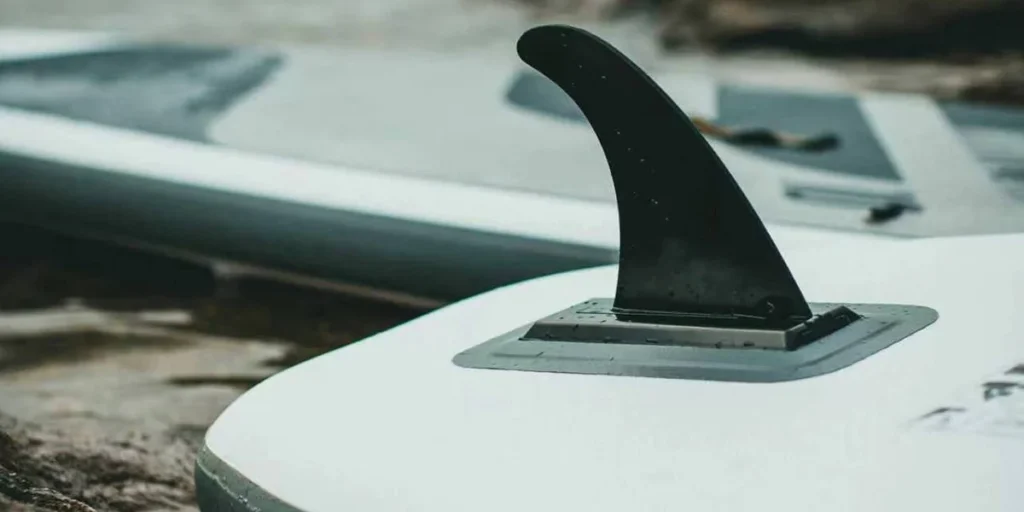
You’ve inflated the board, clipped on the leash, and pushed off from shore. Three strokes in, the board is pointing 30 degrees off where you wanted to go. Three more strokes and you’re spinning gently in circles, paddling harder, getting nowhere. The board isn’t faulty. You almost certainly forgot to attach the fin.
I’m Allen, Senior Industrial Designer at ABYSUP — I’ve spent nearly a decade designing inflatable SUPs, and I can tell you the “spinning board” call is the single most common first-day support question we get. The fix takes 30 seconds. But the more useful answer isn’t the fix — it’s understanding what the fin actually does, why size matters, and why we ship our boards with the specific fin configuration we do.
Once this clicks, you’ll paddle differently the next time you’re on the water. Not harder. Smarter.
What a Fin Actually Does (Hint: It’s Not Steering)
Here’s the most useful mental model I’ve found for explaining fins to first-time paddlers: a SUP fin doesn’t steer the board. It refuses to let the board turn sideways.
Without a fin, your board behaves like a long flat raft — it has no preferred direction. Every stroke you make on the right side pushes the tail to the left, and there’s nothing under the water resisting that sideways slip. So the board pivots. You take another stroke to correct. The board pivots the other way. You’re paddling in S-curves and wondering why your shoulders are tired.
Drop a fin into the slot at the tail and the physics changes immediately. The fin is a vertical blade sitting in the water, and water doesn’t want to flow sideways across a vertical blade — it generates lateral resistance. Now when you stroke on the right, the tail can’t slide left because the fin is anchored against that movement. Instead, the energy from your stroke goes where you want it: forward.
This is also why your board tracks straighter the faster you go. Higher water speed across the fin generates more lateral resistance, which translates into a stiffer “directional lock” on your line. It’s the same principle that lets a sailboat sail upwind — the keel resists sideways slippage so the wind energy converts into forward motion.
“The first dealer demo I ever ran in 2017, a customer asked me to inflate a board and let him try it. I forgot to clip in the fin. He paddled out twenty meters, spun completely around, paddled back, and asked if the board was defective. When I showed him the empty fin slot, his face changed — and then we both laughed. I’ve never forgotten the fin since.” — Allen Xiao, ABYSUP Design Team
Why Fin Size Changes Everything About How Your Board Feels
If a fin generates lateral resistance, it follows that more fin equals more resistance. That’s true — but the trade-off isn’t free. Bigger fins make your board track better in a straight line. They also make it harder to turn. Here’s how that plays out across real-world fin sizes.
| Fin Size (height) | Behavior | Best For |
|---|---|---|
| 5–6 inches | Loose, very responsive, easy turning, weak tracking | SUP surfing, river running |
| 7–8 inches | Balanced — predictable tracking, still maneuverable | All-round flatwater paddling |
| 9 inches | Strong tracking, requires more deliberate turning | Touring, long-distance flatwater |
| 10+ inches | Locked-in straight-line, slow to turn | Racing, dedicated touring |
The rule of thumb: bigger fin = better at going straight, worse at changing direction. Smaller fin = the opposite. There’s no “best” fin in isolation — there’s only the right fin for what you’re trying to do that day.
This is also why most all-round inflatable SUPs ship with a 9-inch detachable center fin. We tested a range of sizes during development on our 10’6″ all-round model — paddling the same board on the same lake with 7″, 8″, 9″, and 10″ center fins. The 9-inch consistently produced the longest glide-per-stroke for recreational paddlers without making the board feel locked in. The 10-inch tracked slightly better but felt sluggish during the U-turns most paddlers make at the end of a lap. The 7-inch felt nimble but required noticeably more correction strokes over a 1-kilometer paddle.
Nine inches isn’t a marketing decision. It’s where the data converged for how recreational paddlers actually use the board.
The Three-Fin Setup: Why Your Board Has a Center Fin and Two Smaller Ones
Look at the underside of your board near the tail. On most modern inflatable SUPs you’ll see one large fin slot in the middle and two smaller fixed fins on either side. This is called a 2+1 configuration — two side bites flanking a removable center fin.
The two side fins are smaller (typically 3 to 4 inches) and angled slightly outward from vertical. They don’t do much for tracking on their own — they’re not big enough — but they do something else important: they keep the board stable during turns and prevent the tail from “washing out” when you lean into a stroke aggressively.
Think of it this way. The big center fin is your highway lane keeper — keeping you tracking straight when you’re paddling forward. The two side fins are your cornering grip — keeping the board predictable when you change direction. Remove the center fin and you have a surf-style setup, twitchy and quick. Remove the side fins and you have a pure tracking setup, fast in a straight line but with a slidey tail in turns.
Most paddlers never need to think about this. The 2+1 setup with a 9-inch center fin is the default because it works for the broadest range of conditions and skill levels. Leave the side fins permanently fixed where they are, only remove the center fin for storage or travel, and the board behaves the way it’s designed to behave.
For a deeper look at how multi-fin configurations evolved from surfing into modern SUP design, the surfboard fin entry covers the history of single-fin, twin-fin, thruster, and quad setups — most modern SUP fin layouts are direct descendants of those design lineages.
Installing the Center Fin (And the Mistake Almost Everyone Makes Once)
The center fin attaches via a slide-in box on the underside of the board. There are two systems you’ll commonly see: a US-box with a fin screw and plate, and a click-fin (sometimes called a tool-less fin) that locks in with a sprung pin. Our boards use the click-fin system because it eliminates the loose hardware that always seems to disappear into the grass at boat ramps.
Here’s the install sequence, fin facing the correct direction:
- The fin’s leading edge — the curved front edge — points toward the nose of the board. The straight trailing edge points toward the tail.
- Slide the fin’s tab into the rear of the fin box at an angle, then lower the fin and slide it forward until you hear or feel the locking pin engage.
- Pull gently upward on the fin. If it doesn’t release, you’re locked in. If it lifts out, slide it forward again until it clicks.
The mistake almost every paddler makes at least once: installing the fin backwards. Curved edge facing the tail. The board will feel sluggish, drag noticeably, and turn in unpredictable ways. If your board is paddling worse than you remember and you can’t figure out why, look at the fin. Check the curve. Curve forward, always.
“At a community demo day on Lake Como two summers ago, I had a customer convinced his rental board was defective because it was ‘pulling to one side.’ Walked over, looked at the fin — backwards. Flipped it, three minutes later he was carving figure-eights and laughing at himself. The fin orientation is the single most common installation error in SUP, and it’s also the easiest to miss because you can’t see it once the board is in the water.” — Allen Xiao, ABYSUP Design Team
Who Should Think About Changing Their Fin Setup
For most paddlers, the answer is “never.” The included fin works for the use case the board was designed for, and swapping fins is a refinement, not a fix. But there are a few specific situations where a different fin makes a real difference.
Stick with your stock 9-inch fin if:
- You’re a recreational paddler on lakes, calm bays, or slow rivers
- You’re a beginner or intermediate still building stroke technique
- You’re using the board for SUP yoga, fitness, or family sessions
- You’re paddling under 5 km per session in moderate conditions
Consider a different fin if:
- You’re SUP surfing — drop to a 5–6 inch flexible center fin for responsiveness in waves
- You’re touring 10+ km regularly in calm water — a 9.5-inch weed-shedding touring fin reduces effort over distance
- You’re paddling shallow rivers or weedy lakes — a swept-back river fin won’t snag debris
- You’re racing — talk to your race class for legal fin specifications
One honest trade-off worth flagging: the click-fin system is faster and easier than US-box hardware, but the click-fin selection is narrower than the universal US-box ecosystem. If you’re someone who wants to experiment with five different aftermarket fins, US-box gives you more options. If you want to inflate, paddle, and not lose tiny screws on the lawn, click-fin wins. We made that call deliberately for the boards we ship as recreational kits.
Frequently Asked Questions About SUP Fins
Why is my paddle board spinning in circles?
The most common answer — by a wide margin — is that you forgot to attach the center fin. Without a fin, your board has nothing under the water resisting sideways movement, so every paddle stroke pushes the tail off-axis. You end up turning instead of tracking.
Check the underside of the board near the tail. If the central fin slot is empty, that’s your answer. Slide the fin in (curved edge toward the nose), lock it in, and the board will track normally. If the fin is attached and the board is still spinning, double-check the orientation — a fin installed backwards behaves badly.
Can I paddle a SUP without a fin?
Technically yes, but it’s exhausting and slow. Without a center fin you’ll be making constant correction strokes to stay on a straight line, you’ll burn through your shoulder energy in half the time, and your average speed will drop noticeably. It’s the difference between paddling on highway and paddling on ice.
The only situation where fin-less paddling makes sense is in extremely shallow water where the fin would catch on the bottom. Even then, most paddlers swap to a shorter river or surf fin rather than removing the fin entirely.
Which way does a SUP fin face — curve forward or backward?
Curved edge forward, toward the nose of the board. The straight edge points toward the tail. This is the same orientation as a shark’s dorsal fin — the curve is the leading edge, designed to part the water cleanly as you move forward.
If you install it backwards (curve toward the tail), the board will feel draggy and turn unpredictably. The fin won’t break, but you’ll know something’s off within the first minute of paddling. Flip it. Problem solved.
What size fin is best for a beginner paddle board?
A 9-inch center fin is the standard for recreational all-round inflatable SUPs, and it’s the right starting point for almost every beginner. It tracks well enough to feel rewarding when you stroke evenly, but stays maneuverable enough to forgive the wobbly turns and over-corrections that come with learning.
Don’t be tempted by the “bigger is better” assumption. A 10-inch racing fin will track straighter, but you’ll find it stubborn during turns — and as a beginner, you turn more often than you think. Stick with the 9-inch your board ships with for the first season.
Do I need to remove my SUP fin for storage or travel?
Yes — always. The center fin is the most exposed part of the board’s structure when it’s deflated and rolled, and a fin left attached will press into the folded PVC, eventually leaving an imprint or stressing the seam around the fin box. It also makes the rolled board taller than it needs to be in your carry bag.
Removing the click-fin takes about ten seconds: depress the locking pin, slide the fin out, drop it in the side pocket of your bag. Reinstall it before your next session in another ten seconds. The two fixed side fins stay attached permanently — only the central removable fin needs to come off.
Find the Fin Setup That Matches How You Paddle
Every ABYSUP all-round board ships with our 9-inch click-fin as standard equipment, plus two pre-installed side fins. There’s nothing extra to buy on day one for recreational flatwater paddling — the included setup is what we tested and tuned the board around.
If you want to see our full fin range — including touring fins for distance paddlers, surf fins for wave riders, and weed-shedding river fins for shallow water — visit our SUP fins collection. Replacement fins, spare locking pins, and fin upgrade kits are all on the same page.
Wholesale and dealer inquiries: our team works directly with regional retailers and rental fleets on volume pricing for spare fins and replacement hardware — useful for any operation managing more than ten boards. Reach out through the trade contact form and someone from our team will respond within 48 hours.
The fin is the smallest meaningful part of your board, and it’s the one most paddlers think about least. Once you understand what it’s doing under there, every stroke makes more sense. Curve forward. Locked in. Now you’re paddling.