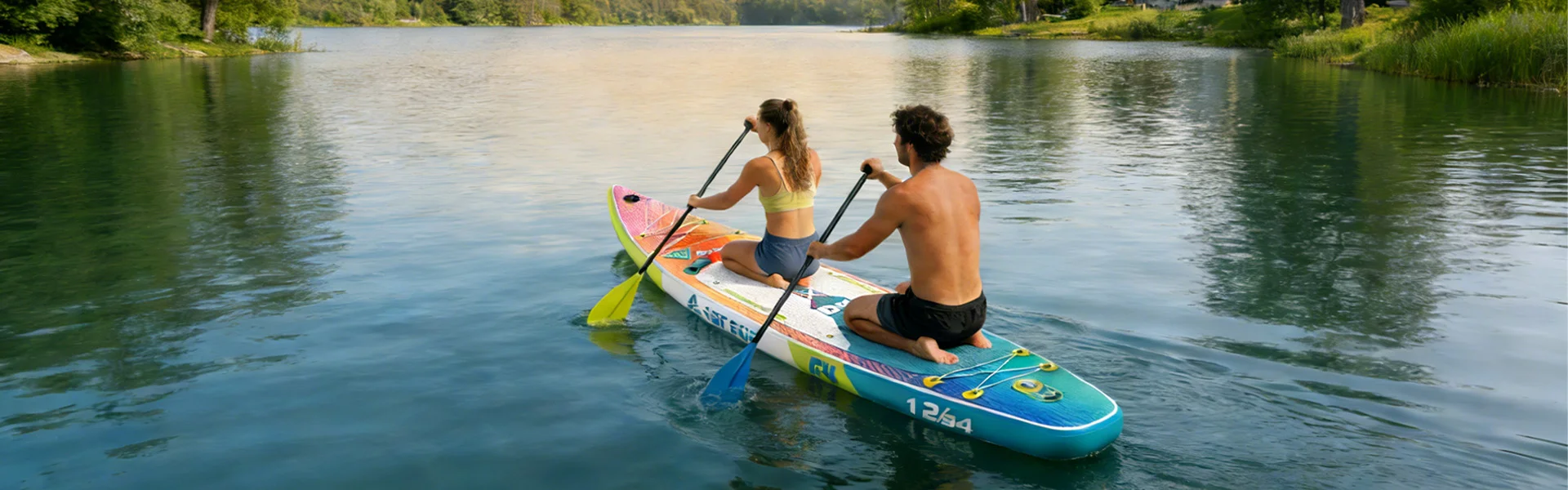
You’ve just unboxed your board. The paddle is in three pieces in front of you, and you have absolutely no idea how long it should be. You’re not alone — this is the question I get asked more than almost any other, and it’s one that genuinely matters. Get it wrong by even a few inches and your first session will leave your back aching and your shoulders burned out before you’ve even found your rhythm.
I’m Allen Xiao, Senior Industrial Designer at ABYSUP. I’ve spent nearly a decade designing paddle boards — and one thing I’ve learned from years of customer feedback and on-water testing is that paddle length is the most underestimated setup decision in the whole kit. The board gets all the attention. The paddle length gets ignored. Then people wonder why paddling feels so hard.
This guide gives you the formula, the activity-based adjustments, and the confidence to set up your paddle correctly before you ever touch the water. It takes about two minutes. It changes everything.
The Core Formula: Your Height Plus 10 Inches
Let’s start with the foundation. The standard formula that works for the vast majority of flatwater paddlers is:
Ideal paddle length = your height + 10 inches (approximately 25cm)
So if you’re 170cm (5’7″) tall, you’re looking at a paddle set to around 195cm. If you’re 185cm (6’1″), you want approximately 210cm. Simple, fast, and accurate enough for recreational flatwater paddling in almost any conditions.
Why 10 Inches — Not 8, Not 12?
The “plus 10” formula places the paddle blade tip at roughly the right depth for a clean forward stroke — reaching just past full arm extension at the catch point, entering the water at a clean angle without forcing you to hunch or over-reach. Less than 8 inches above your height and you’ll be bending forward to reach the water on every stroke. More than 12 and your stroke mechanics become stiff, with your arms doing too much work and your core doing too little.
I’ve tested this across hundreds of sessions with riders of different heights and builds. The 10-inch rule holds remarkably well for paddlers between 155cm and 195cm tall on a standard all-round or touring board at flat to moderate pace. It’s not arbitrary — it’s the result of consistent biomechanical observation on water.
How to Measure Without a Tape
Stand the assembled paddle vertically in front of you. With your arm naturally raised — not stretched on tiptoes, not slumped — your wrist should be able to curl comfortably over the top of the T-grip handle. If you have to strain upward to reach it, the paddle is too long. If your elbow is bent when your hand reaches the grip, it’s too short. That’s the quickest on-the-spot check you can do before you hit the water.
Activity-Based Adjustments: When the Formula Needs a Tweak
The height + 10 formula is your starting point — not your final answer. Different paddling styles apply different forces at different angles, and a 3–4 inch adjustment in either direction can genuinely transform how a session feels depending on what you’re doing.
Flatwater Cruising and Recreational Paddling
The formula applies here exactly as written. Height + 10 inches gives you a clean, efficient forward stroke for lake paddling, harbour exploring, and general recreational use. This is the configuration most people will paddle at most of the time, and it’s the setting our design team optimised the ABYSUP paddle geometry around.
SUP Yoga: Go Shorter by 2–4 Inches
Yoga paddling is different. You’re not focused on forward propulsion — you’re focused on balance, transitions, and poses. A shorter paddle gets out of your way during wide-stance poses and gives you more control when you use it as a stability aid or for low-sweep corrections. Height + 6 to 8 inches is where most yoga paddlers settle, and it makes an immediate difference to how grounded the practice feels.
“During a testing day at a lake outside Guangzhou, I had a group of yoga instructors try the same board with three different paddle heights. The unanimous preference was 8cm shorter than their standard setting. Not because it helped them paddle faster — but because it completely stopped getting in the way of Warrior II.” — Allen Xiao, ABYSUP Design Team
Touring and Long-Distance Paddling: Go Slightly Longer
If you’re covering distance — multi-hour paddles, coastal routes, river touring — a paddle set at height + 11 to 12 inches gives you a slightly longer reach per stroke, which reduces total stroke count over long distances and eases the cumulative load on your shoulders. The trade-off is marginally less control in choppy conditions, so it’s not a setting I’d recommend for beginners in variable water.
Surfing and Dynamic Water Conditions
Shorter. Full stop. When you’re in moving water, you need fast, low, powerful strokes — not the long sweeping catch of a flatwater touring stroke. Height + 4 to 6 inches gives you lower hands, more leverage on the water, and faster recovery between strokes. If you’re predominantly surfing your SUP, this adjustment matters more than almost any other equipment decision.
| Activity | Recommended Length | Why It Works |
|---|---|---|
| Flatwater / All-Round | Height + 10″ (25cm) | Optimal stroke angle for forward propulsion |
| SUP Yoga | Height + 6–8″ (15–20cm) | Shorter paddle stays clear during poses and transitions |
| Touring / Distance | Height + 11–12″ (28–30cm) | Longer reach reduces total strokes over distance |
| Surfing / Whitewater | Height + 4–6″ (10–15cm) | Low, fast, powerful strokes in dynamic conditions |
Why Getting the Length Wrong Hurts Your Body — Not Just Your Performance
This isn’t a minor inconvenience. Research on paddling biomechanics consistently shows that paddle height directly affects spinal loading, shoulder rotation, and the degree to which core muscles versus arm muscles drive each stroke. A paddle that’s even 5cm too long shifts the stroke mechanics in ways that accumulate into real fatigue and, eventually, injury.
Too Long: The Back Pain Setup
When your paddle is too long, you’re forced to lean your torso forward and reach down to plant the blade at the catch point. This removes your core from the stroke and places the entire load on your lower back and shoulders. After 20–30 minutes, your lower back starts to talk to you. After an hour, it’s the only thing you’re thinking about. This is by far the most common complaint we hear from first-time paddlers who set the paddle straight to maximum length “just in case.”
Too Short: The Shoulder Strain Setup
Counterintuitively, a paddle that’s too short isn’t the safe option. When your paddle is too short, your top hand drops too low, your stroke angle becomes almost horizontal, and your shoulder has to do all the rotation work with no mechanical advantage from lever length. The result is a grinding fatigue in the rotator cuff that takes days to recover from. Neither extreme is kind to your body. The formula exists for a reason.
The Right Length Activates Your Core
A correctly sized paddle positions your hands so that each stroke naturally engages your core rotation — your torso turns, your core drives the blade through the water, and your arms guide rather than power the movement. This is not just more efficient. It’s dramatically more comfortable over a long session, and it’s the biomechanical foundation of every good paddling technique guide you’ll ever read.
The ABYSUP 3-Piece Paddle: Designed to Cover Every Paddler in One Kit
One of the most deliberate design decisions we made with the ABYSUP paddle was the adjustment range. Our 3-piece adjustable SUP paddle covers a range of 165cm to 220cm — which means it correctly fits paddlers from approximately 155cm (5’1″) tall right up to 195cm (6’5″). In a household of four different-height paddlers, one paddle handles every setup. No additional purchase needed.
Why Three Pieces Instead of Two
A 2-piece paddle breaks at the mid-shaft — which is convenient for storage but limits how the paddle carries. Our 3-piece design breaks at both the upper and lower shaft joints, which means it packs down to a length that fits neatly alongside a rolled board inside the carry bag. No external strapping. No awkward over-length item poking out the side. When you’re packing for a road trip or a flight, this is the difference between one bag and two.
The trade-off with any multi-section paddle versus a fixed one-piece is that the ferrule joints add a small amount of flex under heavy load. For recreational paddling at any pace short of sprint training, you won’t feel it. For competitive racing, a carbon one-piece is the right choice — and that’s not what the kit paddle is designed for. It’s designed for the 95% of paddling sessions that happen on recreational water, and for those it performs exactly as it should.
Aluminium Shaft: The Right Material at This Level
Aircraft-grade aluminium alloy gives us the right balance of stiffness, weight, and impact resistance for an adjustable kit paddle. It’s heavier than carbon — a full kit paddle runs around 900–950g compared to 500–600g for a quality carbon equivalent — and that weight is worth acknowledging honestly. Over a short recreational session, you don’t notice it. Over a 3-hour touring session, you might. If you paddle for hours regularly, a dedicated carbon upgrade paddle is worth considering. For everyone getting started, the aluminium shaft is the correct choice.
The Nylon Blade: Built for Entry, Water, and the Odd Shallow Encounter
The nylon blade is the part of the kit paddle that surprises people most. Nylon is genuinely impact-resistant — far more so than fibreglass or carbon at the same price point — which matters when you’re learning technique and your blade occasionally meets a dock, a shallow rocky bottom, or the side of another board. The blade geometry is designed for a clean catch angle and good water release, which are the two things that actually affect how a paddle feels in use.
Practical Setup: How to Adjust Your Paddle Before You Get on the Water
Formula in hand, the physical adjustment takes less than 90 seconds. Here’s exactly how to do it, once, so it becomes automatic.
Step 1: Assemble All Three Sections First
Connect the three sections firmly — push each joint until you feel resistance, then give a quarter turn to lock. Don’t force them, but don’t leave them loose. A loose joint flexes under stroke load and will slowly work itself to a different length mid-session. When assembled correctly, there should be no rotation between sections and no visible gap at the ferrule joint.
Step 2: Set the Length Using the Wrist Test
Stand the assembled paddle vertically. Raise one arm naturally — no tip-toes, no deliberate reach — and rest your wrist over the top of the T-grip. Your wrist should sit comfortably over the top of the handle. Adjust the lower shaft section (the joint above the blade) until this position feels natural. Lock the ferrule firmly and repeat the wrist check.
Step 3: Check the Blade Orientation
This is the mistake that accounts for a significant proportion of “the paddle feels wrong” sessions. The blade faces forward — meaning the angled (concave) face of the blade should face toward you, and the back of the blade faces the water on the catch. When you plant the paddle, water should fill the concave face. It feels counterintuitive to most people the first time, but once you paddle both ways, the difference is unmistakable. The ABY blade has a small orientation indicator on the shaft — look for it before you lock the joint.
Step 4: Test Before You Commit
Paddle 10 strokes. If your lower back is already tensing up in the forward lean, the paddle is too long — lower it 2cm and test again. If your hands feel uncomfortably low and your shoulder is doing all the rotation work, it’s too short — raise it 2cm. Finding the exact right length for your body and your stroke style takes one session, not a summer. Give yourself permission to adjust mid-session on your first few outings.
Frequently Asked Questions
What length should a SUP paddle be for a 5’6″ paddler?
At 5’6″ (approximately 168cm), the height + 10 inch formula puts you at around 195cm — or just under that, between 192 and 196cm. This assumes flatwater recreational paddling. If you’re primarily doing yoga, bring that down to 188–192cm. If you’re touring long distances, you might push it to 198cm. The formula gives you a starting point; small personal adjustments refine it.
One thing I always tell people: the adjustment range on the ABYSUP 3-piece paddle is wide enough that you don’t need to nail it perfectly on day one. Set it roughly right, paddle for 20 minutes, and notice what your body is telling you. The right length becomes obvious quite quickly.
Can the same paddle be used by different height people in the same family?
Yes — this is exactly what the adjustable 3-piece design is built for. Our paddle covers 165cm to 220cm, which handles paddlers from approximately 155cm to 195cm in height across all activity types. A household of four people with heights ranging from 5’2″ to 6’0″ can all use the same paddle with a 15-second adjustment between sessions.
The only case where a single paddle becomes genuinely limiting is if you have a very tall paddler (190cm+) who also wants to paddle in surf or dynamic water — at the shorter settings needed for those conditions, the lower shaft reaches close to its minimum travel. For households with a wide height range, owning two paddles (one set long, one set short) is a practical upgrade worth considering after the first season.
Does paddle blade size matter as much as paddle length?
For recreational paddlers, length matters more in day-to-day experience than blade size. Blade size affects stroke power and cadence — a larger blade moves more water per stroke (higher power, slower cadence), a smaller blade gives faster cadence with less resistance per stroke. For beginners and all-round recreational paddlers, a medium-sized blade in the 500–600cm² range is the appropriate spec.
Where blade size becomes more significant is in longer touring sessions and for smaller, lighter paddlers. A 55kg paddler using a large-bladed paddle designed for an 85kg paddler will feel like they’re pulling through concrete on every stroke. The ABYSUP kit paddle blade is sized for the mid-range recreational paddler — it works well across a wide weight range without being extreme in either direction.
How do I know if my paddle is too long without using the formula?
The clearest body signal: your lower back starts complaining within the first 10–15 minutes of paddling. This means you’re leaning forward to compensate for a paddle that’s asking you to reach too far down to catch the water. A secondary signal is that your top hand is consistently at or above eye level during the stroke — which is typically a sign the paddle is forcing you into a high, reach-heavy position.
The wrist test is faster than the formula. Stand the paddle vertical next to you, raise your arm naturally, and your wrist should rest comfortably over the T-grip without stretching. If you have to raise to your fingertips to reach it, shorten by 2–3cm and retest. Most people find the right length within two or three adjustments.
Should I buy a separate paddle or use the one included with the board?
For your first season, the included paddle is the right tool. It’s designed to work correctly across the height range our boards are designed for, it’s correctly specced for recreational flatwater use, and it saves you from adding a purchase decision to what is already a lot of new information.
Upgrading to a carbon paddle becomes genuinely worth considering once you’re paddling more than twice a week — the weight saving (approximately 300–400g) compounds meaningfully over a 2-hour session and becomes noticeable fatigue savings by session’s end. But for getting started, getting your length right matters more than what the paddle is made of. Master the setup before optimising the gear.
Find Your Paddle — or Talk to Our Team
If you want to go deeper on paddle selection, or you’re looking at the full ABYSUP range as a retailer or dealer, our complete paddle collection covers every level from first-season recreational paddlers to serious distance touring.
For individual paddlers: the paddle included in every ABYSUP complete kit is designed to cover exactly what this guide describes — with nothing extra to buy for your first season on the water. If you’re ready, so are we.
For wholesale partners and B2B dealers: we work directly with distributors, outdoor retailers, and watersports specialists. If you’re building a range or evaluating ABYSUP for your catalogue, reach out through our trade enquiry form and we’ll come back to you promptly with catalogue pricing and minimum order details.
The right paddle length is two minutes of adjustment. The right board takes a little longer to choose — but we can help with that too.