I fell in six times on my first SUP yoga session. Full splashdowns — feet overhead, board flipping, phone in a dry bag thank God. I’m a paddle board designer, not a yoga practitioner, and when our design team started developing a dedicated yoga-width board in 2021, I figured I should at least try the activity I was designing for.
Here’s what surprised me: by the third session, I was holding Warrior II for 90 seconds on open water without wobbling. Not because I suddenly became flexible or found some hidden athletic talent. Because my body adapted faster than I expected — and because the board under me was wide enough, stable enough, and grippy enough that the learning curve was measured in days, not months.
I’m Allen Xiao, Senior Industrial Designer at ABYSUP, and I’ve spent nearly a decade designing inflatable paddle boards. This article is my honest take on the question I hear constantly from people who are curious about SUP yoga but convinced they can’t do it: “Is it really for beginners?” The short answer is yes — with the right board and the right expectations. The longer answer involves some physics, some practical pose recommendations, and a few things Instagram will never tell you about what SUP yoga actually looks like for normal people.
The Instagram Problem: Why SUP Yoga Looks Harder Than It Is
Let’s address the elephant in the room. If your impression of SUP yoga comes from social media, you’ve been watching the highlight reel. Those images of headstands on paddle boards at sunset? That’s the equivalent of watching an Olympic gymnast and deciding you can’t do a forward roll.
The people posting advanced arm balances on SUP boards are experienced yoga practitioners who have spent years building the core strength and proprioception those poses require — on land first, then on water. They’re the top 1%. They’re also standing on boards specifically designed for stability, in carefully chosen sheltered water, at the calmest time of day. What you don’t see: the 40 takes before they got the one clean shot.
Real-world beginner SUP yoga looks nothing like that. It looks like this:
- Sitting cross-legged on the board doing breathing exercises while the water gently rocks you
- Moving through a kneeling cat-cow sequence with your hands on the deck pad
- Standing in a wide-legged forward fold, feeling your toes grip the EVA foam
- Holding Warrior II for 30 seconds, wobbling slightly, laughing when you almost tip
- Lying in Savasana on the water, hearing nothing but gentle lapping and your own breath
That last one — Savasana floating on open water — is genuinely one of the most peaceful experiences I’ve ever had. And it requires zero athletic ability. You literally lie down.
Why Your Body Adapts Faster Than You Think
Here’s something that doesn’t get discussed enough: your balance system is designed to improve rapidly under new challenges. The vestibular system in your inner ear — the biological hardware that manages balance — is remarkably adaptive. When you step onto an unstable surface for the first time, it’s overwhelmed with new input. By the second or third exposure, it’s already recalibrating.
I tracked my own experience during those initial testing sessions in 2021, and the progression looked like this:
| Session | Falls | Standing Poses Held | How It Felt |
|---|---|---|---|
| Session 1 | 6 | Mountain Pose only — and barely | Constantly catching myself, core engaged the entire time |
| Session 2 | 2 | Mountain, Warrior I, Chair | Noticeably more stable, started to relax |
| Session 3 | 0 | Warrior II held 90 seconds, Tree Pose attempted | Started enjoying it instead of surviving it |
| Session 5 | 0 | Full standing flow including Triangle and Half Moon | Forgot I was on water — fully in the practice |
I’m not a flexible person. I don’t have a yoga background. I’m a 30-something designer who spends most of his week at a desk or in a workshop. If I went from six falls to zero falls in three sessions, most people can do the same or better.
The key insight: falling in isn’t a failure signal. It’s your vestibular system collecting data. Every fall teaches your inner ear and your stabiliser muscles something new. By session three, they’ve built a working model of the board’s movement patterns and know how to compensate before you even feel yourself tipping.
The Board Matters More Than Your Balance
Here’s a truth that the yoga community understands but the SUP community sometimes forgets: equipment shapes the experience. A 28-inch-wide racing SUP will make even an experienced yogi feel unstable. A 34-inch-wide yoga-specific board will make a complete beginner feel planted. The board is doing half the work for you — if you choose the right one.
Three Specs That Make or Break Your First SUP Yoga Session
1. Width: 32 inches minimum, 34 inches ideal.
Board width is the single biggest factor in stability. Every additional inch of width increases the board’s resistance to tipping. At 34 inches, you have a platform wide enough to place your feet in Warrior II with a full hip-width stance and still have margins on both sides. At 30 inches, that same stance puts your feet near the rails — the least stable part of the board. Width is the spec that separates a yoga-capable board from a yoga-friendly board.
2. Deck Pad Coverage: Full-length, not just the standing area.
Most all-round SUP boards have a deck pad that covers the centre third of the board — enough for standing and paddling. For yoga, you need full-length EVA coverage from nose to tail. You’ll be kneeling, lying down, pressing your palms flat, and placing your feet in positions that go well beyond the standard standing zone. Bare PVC is slippery when wet. A full-coverage deck pad with diamond-groove or brushed texture gives you grip everywhere you need it.
3. Volume and Thickness: 6 inches (15 cm), 300+ litres.
A 6-inch-thick board inflated to 12–15 PSI provides a rigid, stable platform that doesn’t flex noticeably under your weight during transitions. Thinner boards (4 inches) can feel spongy underfoot during single-leg poses, which sends confusing signals to your balance system and makes everything harder than it needs to be.
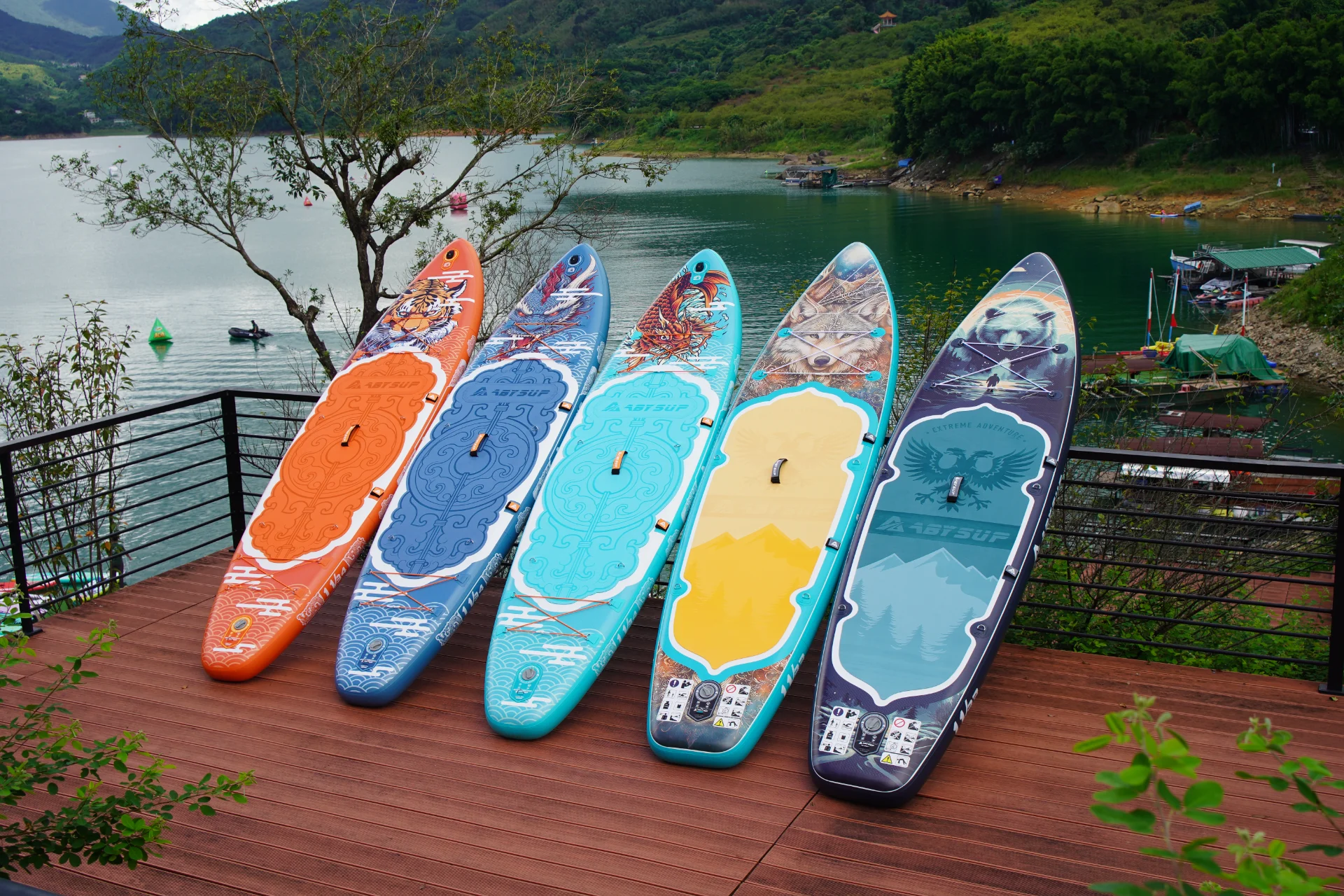
When we designed the ABYSUP yoga and lifestyle board range, these three specs were non-negotiable. We could have trimmed weight by going narrower or thinner, but the stability trade-off wasn’t worth it for the target use case. A yoga board that compromises on width to save a pound isn’t a yoga board — it’s an all-round board with a marketing label.
Five Beginner-Friendly Poses That Work From Session One
You don’t need a yoga background to start SUP yoga. These five poses work on water from day one, even if you’ve never set foot on a yoga mat. I’ve listed them in order of difficulty — start at the top and only progress when the previous one feels stable.
1. Seated Meditation (Sukhasana)
Sit cross-legged in the centre of the board, hands on knees, eyes closed. This is the easiest position on a SUP because your centre of gravity is as low as possible. It’s also the most underrated — meditating on open water with the gentle rocking of the board is genuinely a different experience from meditating on land. The micro-movements of the water create a natural rhythm that most people find deeply calming. Stay here for 3–5 minutes before moving on.
2. Cat-Cow (Marjaryasana-Bitilasana) — Kneeling
Come to all fours with your knees on the deck pad and hands shoulder-width apart. Arch your back (cow), then round it (cat). This is a low-gravity pose with four contact points on the board, so it’s very stable. On water, you’ll feel the board respond to your weight shifts — rocking gently forward as you arch, backward as you round. This is where your balance system starts learning the board’s movement language.
3. Downward Dog (Adho Mukha Svanasana)
From all fours, press your hips up and back into an inverted V. Your hands and feet are on the deck pad, giving you four grip points. On a wide board, this feels almost identical to doing it on a mat — the board barely moves. On a narrower board, you might feel a slight side-to-side rock. If this feels easy, you’re ready for standing poses.
4. Warrior II (Virabhadrasana II)
This is the gateway standing pose for SUP yoga. Stand with feet wide, front knee bent, arms extended. The key on water: place your feet along the board’s centre line, not across it. Your front foot should point toward the nose, your back foot perpendicular. Keep your gaze fixed on a point on the horizon — this gives your vestibular system a stable visual reference and dramatically reduces wobble.
On a 34-inch board, Warrior II feels solid from the first attempt. On a 30-inch board, your back foot sits close to the rail and the stability margin shrinks noticeably. This is where board width earns its keep.
5. Savasana (Corpse Pose)
Lie flat on your back, arms at your sides, eyes closed. The board becomes a floating mat. You’ll feel the water move underneath you — gentle tilts, the occasional ripple from a distant boat wake. This is what most people remember from their first SUP yoga session. Not the poses. Not the workout. The five minutes of lying on the water, hearing nothing but water and sky.
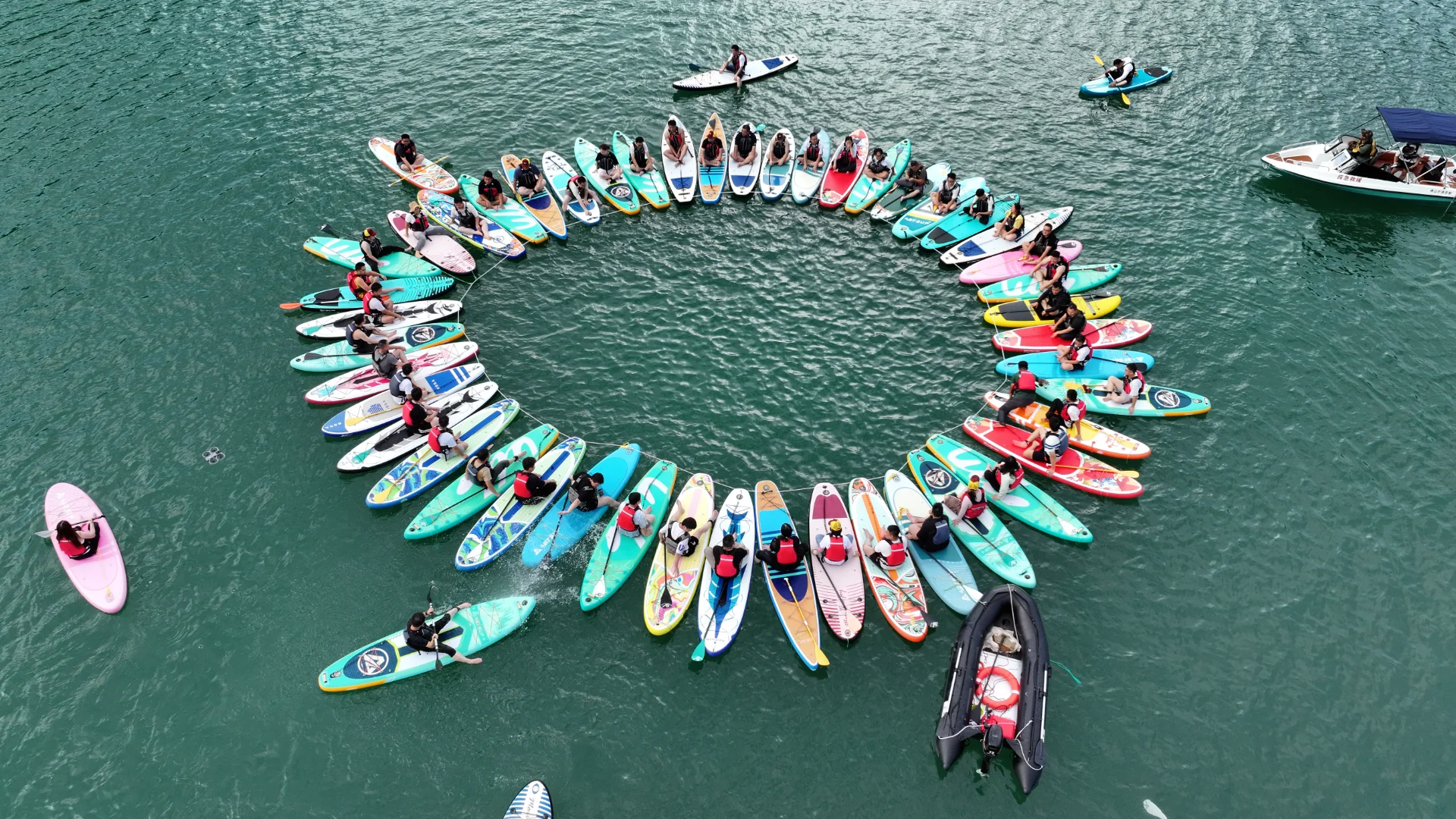
“We brought a group of eight first-time SUP yoga participants to a lake outside Shenzhen during a 2023 product testing round. Ages ranged from 26 to 54. Nobody had SUP experience. Every single person completed Seated, Cat-Cow, Downward Dog, and Savasana on their first session. Five of the eight held Warrior II. The two who fell in during Warrior II got back on and held it on the second try. The feedback wasn’t about difficulty — it was about how different the same poses felt on water versus in a studio.”
— Allen Xiao, ABYSUP Design Team
Practical Tips That Make Your First Session Better
These are the things nobody mentions in the “SUP yoga for beginners” posts because they’re too mundane for content. But they’re the details that separate a frustrating first attempt from one that makes you want to come back.
Choose the Calmest Water You Can Find
Sheltered lakes, calm bays, marina basins — anything without significant boat traffic, current, or wind. Early morning is your best friend. Wind typically picks up by mid-morning, and most recreational boat traffic hasn’t started yet. The flatter the water, the easier every pose becomes.
Anchor the Board
If your board drifts during practice, you’re constantly compensating for movement that has nothing to do with your poses. A lightweight mushroom anchor (1–2 kg) dropped from a D-ring near the nose keeps the board in one spot. Some paddlers tie off to a dock cleat or mooring buoy instead. Either way — a stationary board is dramatically easier to practise on than a drifting one.
Drop the Paddle, Keep the Leash
You won’t need the paddle during your yoga session, but keep the leash attached. If you fall in, the board stays within arm’s reach. Stow the paddle under the bungee cords on the deck or on the dock/shore. Having a paddle on the board while you’re doing poses just gets in the way.
Wear What You’d Swim In
You’re going to get wet — either from falls, splashes, or just the water that sits on the deck surface. Wear a swimsuit, rash guard, or moisture-wicking activewear. Leave the cotton yoga pants at home. Bare feet are essential — shoes eliminate the grip your toes need on the EVA foam.
Forget About Looking Good
This is harder advice than it sounds. The self-consciousness of being visible on open water — everyone on shore can see you wobble — is the biggest psychological barrier for most beginners. Let it go. Nobody watching from shore can tell the difference between a wobble and a flow. And honestly, most people on shore are thinking “That looks amazing, I wish I could do that” — not judging your form.
Who SUP Yoga Is For — and Who Might Want to Start Elsewhere
SUP Yoga Is a Great Fit If You:
- Have any yoga experience at all — even a handful of beginner classes. Knowing the basic pose shapes means you can focus on balance rather than learning positions from scratch.
- Are comfortable in and around water. You don’t need to be a strong swimmer, but you do need to be calm about the possibility of going in.
- Want a full-body workout that doesn’t feel like a workout. The constant micro-adjustments your stabiliser muscles make on an unstable surface mean your core is working even during “easy” poses.
- Enjoy outdoor fitness and are looking for something that feels more like an experience than an exercise session.
- Have zero yoga experience but are open-minded. You’ll learn basic poses on the water — it just takes one or two extra sessions compared to starting on land.
Consider Starting on Land First If You:
- Have a genuine fear of water — not mild nervousness, but real anxiety about being in or around open water. SUP yoga should feel freeing, not stressful. Address the water comfort first.
- Are recovering from a serious knee, hip, or shoulder injury that limits your ability to catch yourself during a fall. Falling off a SUP is low-impact, but the unexpected nature of it can strain a joint that isn’t ready for sudden loading.
- Want to learn advanced inversions (headstands, handstands) immediately. Master those on a mat first. Attempting them on water before you have the muscle memory is an injury risk, not a balance challenge.
I want to be direct about this: SUP yoga is genuinely accessible to most people. But “most people” isn’t “everyone,” and pretending otherwise does a disservice to people who would benefit from a slightly different starting point. The goal is to get you on the water enjoying the practice — not to push you into a situation that creates a negative first experience.
Frequently Asked Questions About SUP Yoga for Beginners
Can I do yoga on a paddle board as a complete beginner?
Yes. You don’t need prior yoga experience or exceptional balance. The seated and kneeling poses — meditation, cat-cow, child’s pose — are accessible from your very first session on any wide, stable board. Standing poses typically come together by session two or three as your body adapts to the board’s movement.
The learning curve is steeper in the first 20 minutes than in the next 20 hours. Your balance system recalibrates quickly. The majority of people who tell me they “can’t do SUP yoga” haven’t actually tried it — they’ve decided based on watching advanced practitioners. Start with the easy poses. Progress when you feel ready. There’s no timer.
What size paddle board is best for SUP yoga?
For yoga specifically, look for a board that’s at least 32 inches wide — ideally 34 inches. Width is the primary stability factor. Length matters less for yoga than for touring, but boards in the 10’6″ to 11′ range provide a good balance of deck space and manageable weight. Thickness should be 6 inches for rigidity under load.
Equally important: full-length deck pad coverage. Standard all-round boards have a deck pad that covers roughly the middle third of the board. For yoga, you need grip from nose to tail because your hands, knees, and feet will be in non-standard positions. Our ABYSUP yoga and lifestyle boards are specced at 34 inches wide with full-coverage diamond-groove EVA specifically for this reason.
Is SUP yoga a good workout or is it just relaxation?
Both — and the ratio depends on what you make of it. A gentle session of seated poses and Savasana on calm water is restorative and meditative. A flowing Vinyasa sequence with standing poses on open water is a legitimate full-body workout. Your core is working constantly to maintain balance, even during “easy” poses, because the board’s instability requires continuous micro-adjustments from your stabiliser muscles.
Studies on unstable-surface training show increased core muscle activation compared to the same exercises on a stable surface. Anecdotally, I can confirm: after my first SUP yoga session, my obliques were sore for two days despite feeling like I hadn’t “exercised” at all. The workout hides inside the balance challenge.
How do I stop falling off my paddle board during yoga?
Three practical adjustments that reduce falls immediately: First, fix your gaze on a stationary point on the horizon rather than looking at the board or the water. Your vestibular system uses visual input to calibrate balance — a fixed focal point stabilises everything. Second, widen your stance and keep your knees slightly bent during standing poses. A rigid, locked-out stance has no room to absorb the board’s movement. Third, move slowly and deliberately between poses. Quick transitions shift your centre of gravity faster than the board can respond.
And honestly? Accept that you’ll fall a few times during your first session. Falling in warm water on a summer day is refreshing, not traumatic. Once you stop fearing the fall, your body relaxes — and relaxed muscles balance better than tense ones.
Do I need to take a SUP yoga class or can I learn on my own?
You can absolutely learn on your own if you’re comfortable on a paddle board and have basic yoga knowledge. Start with the five poses outlined in this guide, practise in calm sheltered water, and progress at your own pace. YouTube has plenty of follow-along SUP yoga flows for beginners.
That said, a guided class has real advantages — especially for your first session. A good instructor will choose the water conditions, position your board correctly, anchor you if needed, and cue poses in an order that builds confidence progressively. If there’s a SUP yoga class available in your area, it’s worth doing at least once. After that, you’ll have enough experience to practise solo with confidence.
The Water Is Waiting — and It Doesn’t Care About Your Flexibility
SUP yoga isn’t about perfect poses on a paddle board. It’s about taking a practice you love — or one you’re curious about — and putting it in a setting that makes everything feel different. The instability is the point. The falling in is part of it. The lying-on-water-staring-at-the-sky moment at the end is what brings you back.
You don’t need to be flexible. You don’t need to be athletic. You need a wide board, calm water, and the willingness to get wet.
For paddlers: Browse the ABYSUP yoga and lifestyle board range — 34-inch width, full-length deck pad, and a stability profile designed specifically for on-water practice.
For studios and instructors: If you’re running SUP yoga classes or retreats and need boards specced for the job, talk to our wholesale team about fleet pricing, co-branding, and instructor demo programmes. We’d love to support what you’re building.