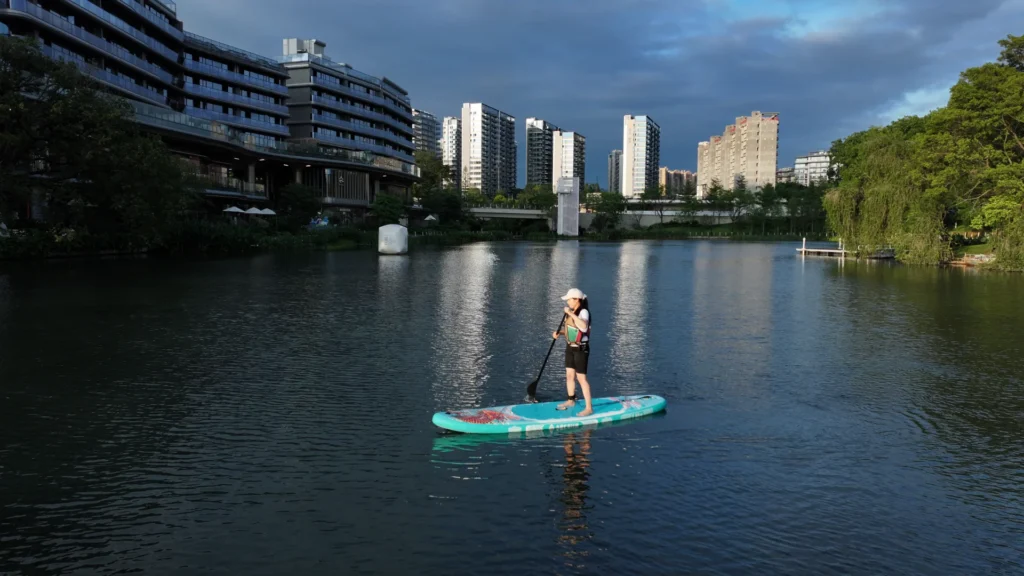
Six inches doesn’t sound like much until those six inches are part of a paddle board. Move from a 10-foot SUP to 10’6″, add another inch of width, and the board can start to feel noticeably different when you carry it, turn it and move around on the deck.
I’m Allen, and I’ve spent nearly a decade focused on inflatable SUP design. For this comparison, I wouldn’t ask which size is simply “better.” A 10′ board puts more emphasis on compact handling and agility, while a 10’6″ board gives us more platform to work with for stability, glide and general-purpose paddling.
Within the current ABYSUP range, that’s a particularly useful comparison: our Lightweight references are 10′ × 31″ × 6″, while our core All-Round reference is 10’6″ × 32″ × 6″. Let’s look at what those numbers actually change.
10′ vs 10’6″ Paddle Board: What’s the Quick Answer?
If you want the short version, I’d use this rule:
Choose 10′ when compact size, easy turning and portability matter most. Choose 10’6″ when you want more stability margin, deck space and versatility from one board.
| Decision Point | 10′ Paddle Board | 10’6″ Paddle Board |
|---|---|---|
| ABYSUP reference size | 10′ × 31″ × 6″ | 10’6″ × 32″ × 6″ |
| Main design priority | Agility and compact handling | Versatility and recreational stability |
| Turning | Quicker to rotate and reposition | Slightly more deliberate |
| Deck platform | More compact | Longer and wider |
| Glide | Suited to shorter, agile sessions | More waterline for recreational cruising |
| Best starting point | Smaller riders, travel, quick turns | Broad recreational use and first-board buyers |
One notation point before we go further: 10’6″ means ten feet six inches. You’ll sometimes see boards casually written as “10.6,” but the useful measurement here is ten feet plus six inches.
If you’re comparing sizes across the full range rather than only these two, start with our Paddle Board Size Guide.
What Does Six Inches of Extra Length Actually Change?
Length affects more than whether the board fits into your garage.
When everything else is reasonably similar, a shorter board has less length to rotate through a turn. That’s one reason a 10-foot platform can feel quick and responsive, particularly for smaller paddlers or anyone who enjoys changing direction frequently.
Add six inches and you start moving the design toward a little more waterline. That generally helps the board carry its forward movement between strokes rather than pivot as readily.
10′: Easier to Move Around
Our current 10′ Lightweight boards use that shorter footprint deliberately. The ABYSUP Lightweight & Agile Series is designed around portability and responsive handling rather than maximum deck area.
That can be useful when you’re:
- paddling tighter waterways;
- making frequent turns;
- carrying the board through narrow storage spaces;
- loading it into a smaller vehicle;
- or simply want less board to manage around you.
10’6″: More Length for Cruising
The extra six inches on our All-Round reference gives us more board to distribute the paddler and equipment across while also extending the waterline.
I wouldn’t claim that six inches suddenly turns a recreational board into a touring SUP. It doesn’t. But over repeated strokes, the 10’6″ format shifts the balance slightly away from quick rotation and toward steady general-purpose cruising.
When I’m comparing two nearby lengths, I think less about which number looks more capable and more about whether the paddler needs the board to turn easily or carry forward efficiently. — Allen Xiao, Senior Industrial Designer at ABYSUP
Why the 31″ vs 32″ Width Difference Matters Too
If we only compared length, we’d miss an important part of this ABYSUP size choice.
Our current 10′ references are also 31 inches wide, while the 10’6″ All-Round reference is 32 inches wide. So when a paddler moves between these two categories, both dimensions are changing at once.
One inch sounds tiny. On a paddle board, though, that inch runs through part of the platform underneath your feet.
31″: A More Compact Platform
A 31-inch board doesn’t automatically mean “unstable.” Stability comes from the complete outline, volume distribution, stiffness, load and paddler position.
But compared with a similar 32-inch recreational platform, there is simply less lateral deck beneath the rider. For someone with suitable balance and body size, that can contribute to the more responsive character we want from a compact board.
32″: A Little More Margin
Moving to 32 inches gives us more lateral platform to work with. That can be valuable for a first-time paddler who is still developing balance, for someone who moves around on the board regularly, or when the board needs to work for several different users.
The important point is that the 10’6″ doesn’t become more versatile because of six extra inches alone. The combination of 10’6″ length and 32″ width is what moves the whole platform toward a broader recreational role.
Is a 10’6″ Paddle Board More Stable Than a 10′ Board?
For these two ABYSUP reference formats, I’d generally expect the 10’6″ × 32″ All-Round to give more recreational stability margin than the 10′ × 31″ Lightweight platform.
But I want to be precise about why.
It’s not because 10’6″ is a magical beginner length. The All-Round simply gives the paddler a larger overall platform: six more inches of length and another inch of width.
That can make a difference when you:
- are standing for the first time;
- shift your feet frequently;
- kneel and stand repeatedly;
- carry some casual gear;
- share the board between riders of different sizes;
- or prioritize confidence over a lively board feel.
At the same time, bigger isn’t automatically better.
A smaller paddler may find a 10′ × 31″ board easier to control precisely because there is less board around them. A wider, longer board that feels reassuring to a larger beginner can feel unnecessarily bulky to someone much smaller.
This is why I prefer matching board size to rider + use case rather than declaring one dimension the universal beginner standard.
Which Size Gives You Better Glide and Tracking?
If the two boards were identical apart from length, I’d expect the longer board to have the advantage in forward glide. More usable waterline generally helps a SUP maintain forward movement between strokes.
Real boards aren’t identical apart from length, though.
Our 10′ Lightweight and 10’6″ All-Round also differ in width, overall outline and intended use. Rider weight, fin setup, inflation, paddling technique and wind can all change what you actually feel.
So I wouldn’t tell you that a 10’6″ board is a certain percentage faster. We don’t have a controlled ABYSUP test that supports a number like that.
What I would say is:
- 10′ favors quicker response and direction changes.
- 10’6″ moves the balance toward steadier recreational glide.
For a short paddle around a sheltered lake, the difference may not matter much to you. If your sessions gradually become longer and you start paying more attention to how far the board carries between strokes, length becomes more important.
And if distance efficiency becomes the main reason you paddle, 10’6″ isn’t necessarily the end point. Our existing 10’6″ vs 11′ paddle board comparison explains what changes when you move another step toward a longer touring-oriented format.
Who Is a 10′ Paddle Board Best For?
A 10-foot SUP makes the most sense when the smaller platform is solving something real for the paddler.
I would put 10′ high on the shortlist if you:
- are a smaller adult or teen who doesn’t need a large recreational platform;
- prefer a board that responds quickly when you turn;
- regularly carry the board some distance to the water;
- have limited home or vehicle storage;
- mostly paddle solo;
- enjoy shorter recreational or fitness sessions;
- or simply dislike the feeling of standing on more board than you need.
Our two current 10-foot Lightweight references are both 10′ × 31″ × 6″. The Ultra-Light Sport is published at 17.2 lb / 7.8 kg, while the Compact Agility model is published at 17.6 lb / 7.9 kg.
Those weights reinforce the portability side of the category, but I still wouldn’t choose from weight alone. The real appeal of the 10-foot format is that compact dimensions and lower board weight work together.
Who Should Probably Skip 10′?
If you’re a larger rider, want maximum first-session stability, regularly bring extra people or substantial gear, or need one board to suit a very broad range of users, I would look at a larger platform before deciding.
A compact board is useful when compactness serves you. It isn’t a badge of progress.
Who Is a 10’6″ Paddle Board Best For?
10’6″ is popular for a different reason: it gives designers enough board to cover a wide range of recreational situations without moving too far toward a specialist shape.
Our current ABYSUP All-Round reference is 10’6″ × 32″ × 6″. I would lean toward that format if you:
- are buying your first SUP and want a forgiving starting point;
- want one board for varied recreational sessions;
- expect different adults in the family to use it;
- like a little more room to kneel, sit or move around;
- sometimes bring light recreational gear;
- value stability more than very quick turning;
- or want more general-purpose glide than a compact 10-foot board.
The current reference board is listed at 18.7 lb / 8.5 kg, so the difference from our two lightweight 10-foot examples is roughly 1.1–1.5 lb.
That’s still a relatively portable inflatable board. You’re not jumping from “easy to carry” to “heavy.” You’re accepting a modest amount of extra board in exchange for a larger recreational platform.
Who Doesn’t Automatically Need 10’6″?
If you’re a smaller paddler who mostly goes out alone, carry distance is a constant frustration and you value turning response over extra deck room, choosing 10’6″ simply because it’s the common recreational size may leave you with more board than you need.
Does Your Height Decide Whether You Need a 10′ or 10’6″ Paddle Board?
Height helps, but I wouldn’t use height alone.
Two paddlers can be the same height and need different boards because their body weight, balance, experience and intended use are different.
When I’m thinking about fit, I would look at these factors together:
- Rider size: does the platform give you enough usable stability and volume?
- Experience: do you value maximum confidence or a more responsive feel?
- Load: are you paddling solo or adding gear, a child or a dog?
- Session type: quick local paddles or longer recreational cruising?
- Transport: how often do you actually carry and store the board?
- Water conditions: calm protected water or conditions where you want more platform beneath you?
This is also why I don’t want to give you a made-up rule such as “everyone under a certain height needs 10 feet.” Human proportions and paddling habits don’t work that neatly.
Use the ABYSUP size guide to start with your overall rider profile, then use the 10′ vs 10’6″ comparison to fine-tune the decision.
Five Questions That Usually Make the 10′ vs 10’6″ Choice Clear
If you’re still stuck between the two, these are the questions I’d answer before looking at another specification sheet.
| Ask Yourself | Lean Toward 10′ | Lean Toward 10’6″ |
|---|---|---|
| How important is easy carrying? | Very important; I walk or travel with the board often | Useful, but I value more platform more |
| What kind of handling do I prefer? | Quick turns and a compact feel | Calm, predictable recreational handling |
| Who will use the board? | Mostly me | Different friends or family members |
| What matters most on the water? | Responsiveness | Stability and versatility |
| How much deck space do I use? | Mostly normal solo paddling position | I sit, kneel, move around or carry casual gear |
If you consistently land in the left column, take a closer look at the 10′ Lightweight & Agile Series.
If most of your answers land on the right, the 10’6″ All-Round Series is probably the more natural place to start.
If your needs extend beyond either category, our Compare Paddle Boards page puts 10′, 10’6″, 11′ and 12′ formats side by side.
10′ vs 10’6″ Paddle Board FAQs
Is a 10-foot paddle board too small for an adult?
No. A 10-foot SUP can be an excellent adult board when its width, volume and intended load fit the rider. Our current 10′ Lightweight references are designed as adult compact SUPs rather than children’s boards.
What I wouldn’t do is assume every adult belongs on 10 feet. Larger riders or paddlers wanting more stability and deck space may be better served by 10’6″ or another larger format.
Is a 10’6″ paddle board better for beginners?
For many first-time recreational paddlers, 10’6″ × 32″ is the easier starting point because it provides a larger platform than our 10′ × 31″ Lightweight format.
That doesn’t mean a smaller beginner automatically needs 10’6″. If a 10-foot board fits the rider well, its easier handling can be an advantage rather than a disadvantage.
Is a 10-foot paddle board easier to turn than a 10’6″ board?
Generally, a shorter board is easier to rotate because there is less length moving through the water. That’s one reason we use the 10-foot format in our Lightweight & Agile category.
The exact feel still depends on outline, fins, rider position and technique, so I wouldn’t assign a universal turning-radius advantage to six inches of length.
Is a 10’6″ paddle board faster than a 10-foot board?
The longer board generally has more waterline available for glide, so it tends to favor steadier forward travel compared with a shorter, similarly shaped board.
But speed isn’t determined by length alone. Width, outline, stiffness, fin setup, rider technique and conditions all matter. For these two sizes, I would describe the difference as agility versus recreational glide rather than promise a specific speed increase.
Should I choose 10′, 10’6″ or 11′?
Think of them as three different steps rather than a simple good-better-best ladder. A 10′ board prioritizes compact handling, 10’6″ balances recreational stability and versatility, while an 11′ touring-oriented board can move the design farther toward tracking and longer-distance efficiency.
If you’re already leaning longer than 10’6″, read our 10’6″ vs 11′ Paddle Board guide next.
Choose the Smallest Board That Still Gives You What You Need
I don’t think every paddler should automatically buy the largest board they can carry. Extra board is useful when you’re using the stability, deck space or glide it provides. Otherwise, you’re still carrying and controlling it every session.
If portability, quick handling and a compact solo platform match your paddling, explore the ABYSUP 10′ Lightweight & Agile Series.
If you want a larger recreational platform that can adapt to more riders and more kinds of sessions, start with our 10’6″ All-Round Series.
Still unsure? Use the ABYSUP Paddle Board Size Guide to match length, width and board type to the way you actually paddle.
For dealer and wholesale partners, our team can also provide current model specifications and series information for the ABYSUP range.