The board looks full. Your arms are tired. Then you glance at the pump: 7 PSI. Is that enough to get on the water?
Probably not, if the manual calls for more. Inflatable boards take shape well before they reach riding pressure. That firm-looking deck can fool you. Check the gauge, not just the board.
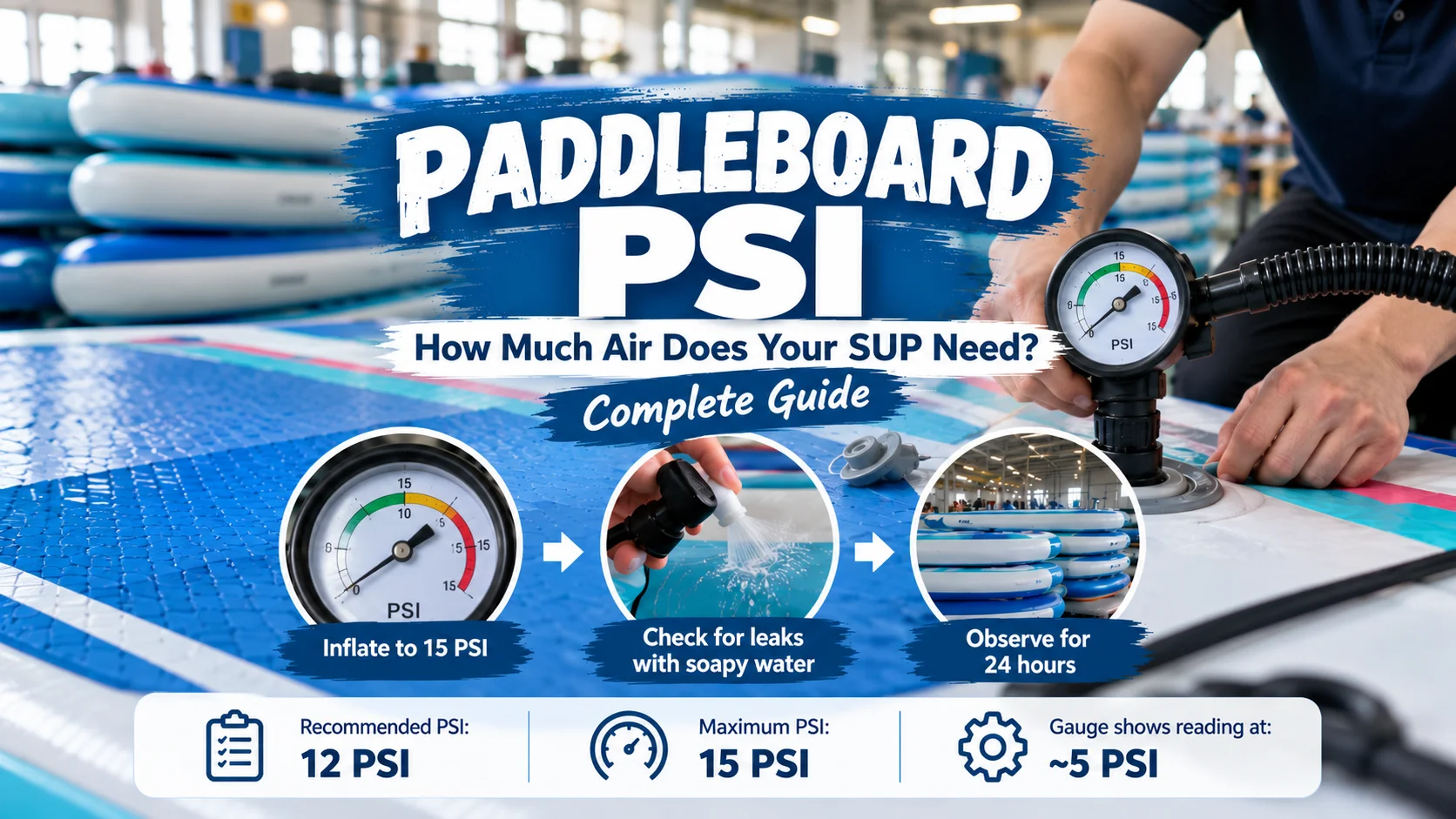
Quick answer: ABYSUP’s internal product reference lists 12 PSI as the recommended inflation pressure and 15 PSI as the maximum for the boards covered by that reference. Check the label and manual for your specific model; pressure ratings vary between boards.
What Does PSI Mean on a Paddle Board?
PSI means pounds per square inch. It measures pressure, not how much weight a paddle board can carry. According to the US National Institute of Standards and Technology (NIST), one PSI equals approximately 6.895 kilopascals (kPa).
Inside an inflatable SUP, thousands of drop-stitch threads connect the top and bottom skins. Pumping air in pulls that structure tight. The result is a board you can stand on, not a floppy air mattress. Still, pressure is only part of the story. Shape, materials and construction matter too.
How Much PSI Should You Put in an Inflatable SUP?
Look for the pressure rating on your board or in its manual. ABYSUP’s internal product guide gives 12 PSI as the riding target and 15 PSI as the upper limit for the products it describes. Your own model may say something different. Follow that model’s label first.
Recommended Pressure vs. Maximum Pressure
Think of 12 PSI as the number you’re aiming for. Fifteen is the ceiling, not a challenge. Don’t keep pumping just because you can.
| Pressure Reading | What It Means | What to Do |
|---|---|---|
| Below 12 PSI | Below the recommended target | Continue carefully toward the recommended pressure. |
| 12 PSI | Recommended pressure | Stop at the target for the applicable model. |
| 15 PSI | Maximum listed pressure | Do not exceed this limit. |
What Changes Between Low PSI and the Recommended Pressure?
Ever stepped onto a board and felt the middle sag under your feet? Low pressure may be the reason. The board can flex more when you shift your weight, especially with a dry bag or another load on deck.
Three Things to Check
• Deck flex: Does the middle of the board bend noticeably under normal loading?
• Tracking: Does the board feel unusually difficult to paddle straight? Pressure is one possible factor, alongside fin setup and technique.
• Load: Are you within the model’s published capacity? Extra air cannot compensate for choosing a board with insufficient load capacity.
Consider board width, length and carrying capacity together with inflation pressure. For recreational and family use, compare the specifications in ABYSUP’s all-round inflatable paddle board collection.
12 PSI vs. 15 PSI: What Do the Numbers Actually Tell You?
The difference is three PSI, or about 20.7 kPa using NIST’s conversion factor. Relative to 12 PSI, 15 PSI is 25% higher on the gauge. That is a pressure comparison—not evidence of a 25% increase in stiffness, speed or durability.
The simple chart below shows pressure readings only. It is not a performance test.
12 PSI — Recommended
15 PSI — Maximum
Scale: 0–15 PSI. Source: ABYSUP internal product reference. This chart compares pressure values, not measured board stiffness.
More air also puts more load on the board’s structure. For a 12 PSI model, stop at 12. A friend’s board rated for more pressure tells you nothing about yours.
Why Is My SUP Pump Gauge Still at Zero?
Here’s a familiar moment: the board is getting bigger, but the needle hasn’t moved. ABYSUP’s internal guide says some supplied pump gauges start showing pressure at around 5 PSI. So a zero reading early on doesn’t always mean something is broken.
But don’t assume every gauge behaves that way. Check that the hose is tight and the valve is set correctly. Listen for hissing. Still no reading? Stop and check the pump rather than guessing how much air you’ve added.
Can Heat or Cold Change Your Paddle Board’s PSI?
Yes. Air pressure depends partly on temperature. NASA’s explanation of the ideal gas law describes the relationship between pressure, temperature, gas quantity and volume. NOAA also explains the behavior of air pressure.
Picture a board left on a sunny beach while you eat lunch. The air inside heats up, and pressure can rise. Put the same board into colder water and the reading may fall. There’s no single “subtract two PSI” rule that works for every board and every day.
• In hot weather: Keep an unused inflated SUP out of prolonged direct sunlight and away from hot vehicles.
• Before paddling: Check the pressure at the launch site and follow the model’s instructions.
• During storage: Follow the manufacturer’s advice for pressure release and temperature exposure.
How Do Manufacturers Check for Air Leaks?
You can see the check in ABYSUP’s factory footage. A worker inflates boards to 15 PSI for inspection, then brushes on soapy water. Escaping air would show up as bubbles. The footage also describes leaving the inflated boards under observation for roughly 24 hours.
That’s a look at the process on camera—not a published test of failure rates. And the 15 PSI inspection shown in the video isn’t a reason to inflate a 12 PSI riding setup to 15 every weekend.
What Does a Leak Check Tell You?
Small bubbles that repeatedly form at one spot can indicate escaping air. A falling pressure reading alone is less conclusive if the temperature has changed. When investigating a possible leak, compare readings under similar temperature conditions and follow the repair instructions for the specific valve and board.
A look at ABYSUP’s factory air-pressure and leak inspection process. The 15 PSI shown in this footage is an inspection pressure, not the recommended everyday inflation pressure in our internal product guide.
What Should SUP Retailers Check Before Stocking a Board?
Customers ask about inflation pressure long after a sale. Retailers need specifications they can explain without guessing. When comparing wholesale inflatable paddle boards, ask for model-specific pressure limits, matching pump gauges and clear user instructions.
| Retailer Check | Why It Matters |
|---|---|
| Recommended and maximum PSI | Prevents conflicting advice at the point of sale. |
| Pump and gauge compatibility | Helps customers reach the intended pressure. |
| Pressure inspection procedure | Supports informed quality discussions. |
| Warranty and repair guidance | Makes after-sales support easier to explain. |
If you plan to buy paddle boards in bulk, request the current specification sheet for each model rather than assuming every size or series shares the same pressure rating.
Paddleboard PSI: Frequently Asked Questions
Is 12 PSI Enough for an Inflatable Paddle Board?
It is the recommended pressure in ABYSUP’s internal product reference. Whether it is enough for another board depends on that model’s printed specifications.
Is 15 PSI Too Much?
Not necessarily. In the same internal reference, 15 PSI is the maximum, not the everyday target. Other boards may have different limits.
Can I Judge Pressure by Pressing the Deck?
No. Touch can reveal obvious softness, but it cannot replace a working pressure gauge.
Does a Softer Board Always Mean a Leak?
No. Underinflation, changing temperature and a leak can all affect how a board feels. Recheck pressure before diagnosing the cause.
How Long Does It Take to Reach 12 PSI?
ABYSUP’s internal reference gives approximately 5–7 minutes with a manual pump and about 13 minutes with a vehicle-powered electric pump. These are reference figures, not guaranteed times for every pump or board size.
The Bottom Line
The takeaway is simple: use the pressure printed for your board. In ABYSUP’s internal guide, that’s 12 PSI recommended and 15 PSI maximum for the referenced products. Keep an eye on the gauge, watch the heat and don’t ignore a board that keeps losing air.
For model-specific specifications, retail partnerships or bulk-order questions, contact ABYSUP for product information.